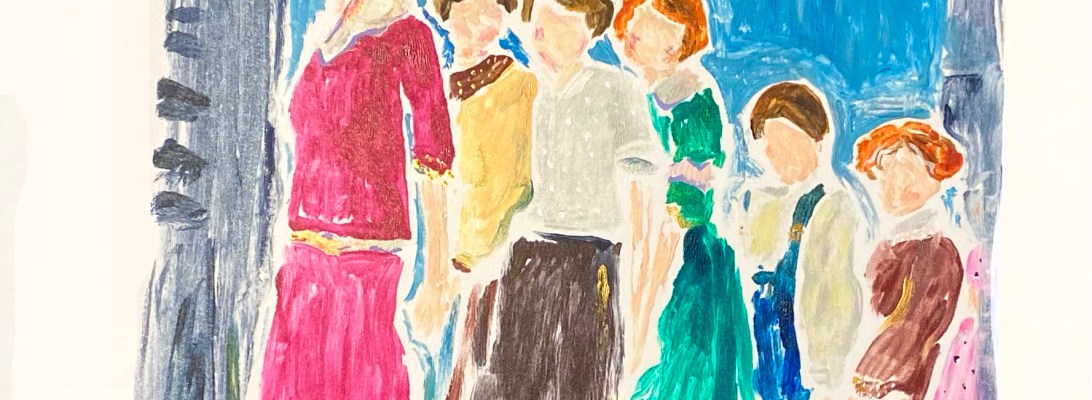
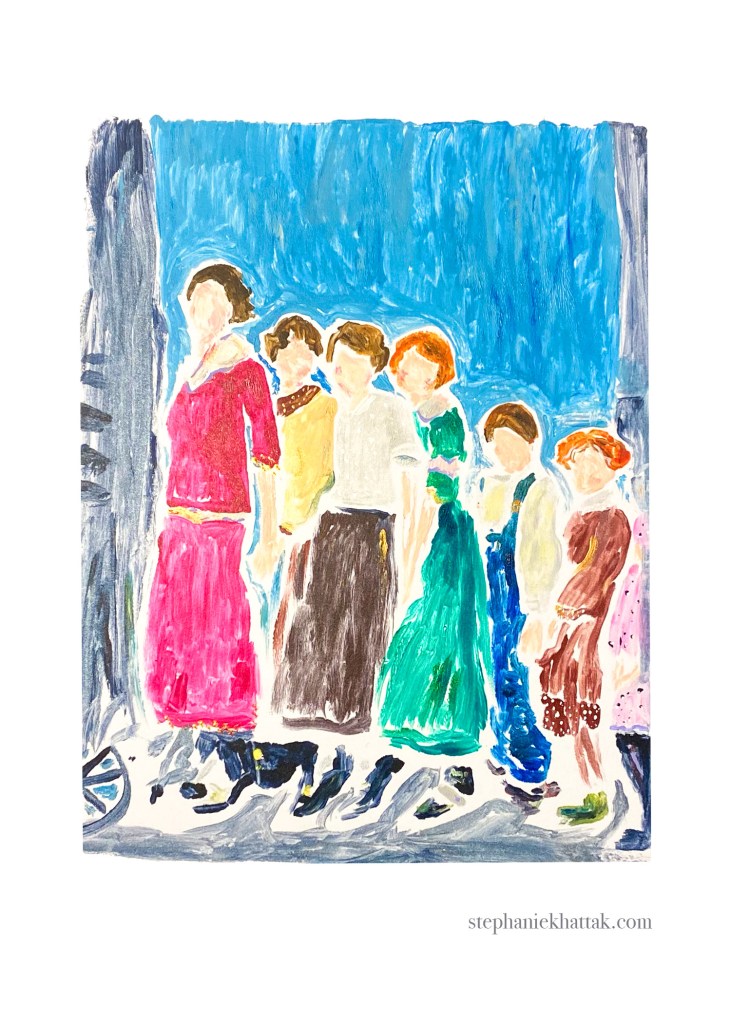
“McBrydes and Porter Kids.” Acrylic monotype by Stephanie Khattak.
This is a family photo of my great-grandmother (in green), her siblings and her cousins. The little boy in the overalls, my great-great uncle Sherman, grew up to be a WW2 soldier killed in action in Sicily. I imagine growing up with so many sisters and girl cousins made him pretty tough and a great mediator.
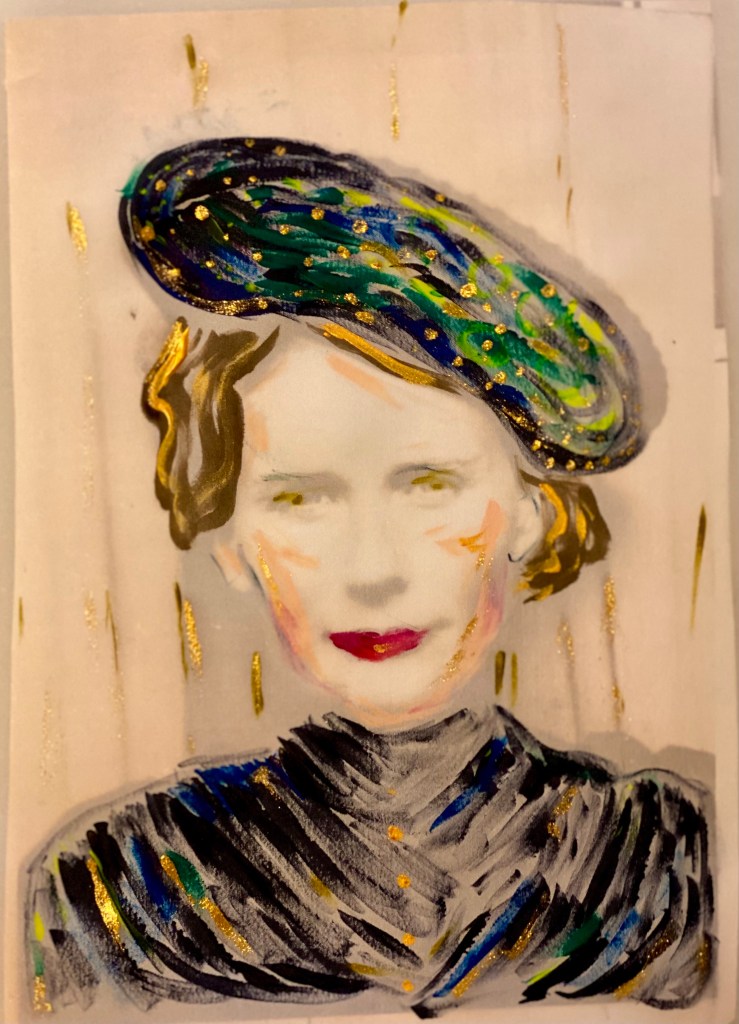
“Beatrice,” acrylic and pigment on silk over vintage photo, by Stephanie Khattak.
This is my great-grandmother on my mom’s paternal side. She passed in February 1978, before I was two years old, so she knew me, but I didn’t really know her. My mom says that they would bring her to my grandparents’ house to spend time with me, and that she really enjoyed that. I like to believe that I enjoyed our short time together, too.
I’m always interested in how creative people structure their time, so I thought I’d share a little bit about how I work. Especially since what so many people see is just the finished product, and that is just the tip of the iceberg!
My artwork takes a long time to do. Not as long as, say, a photorealistic oil portrait, but it is very process heavy and needs a lot of protected time, as it is not work that I can start, stop and come back to. If the acrylic dries on the plate, it is unusable for my process, and if I try to rush through and end up with an off-center or flawed print, it’s back to the proverbial drawing board, or literal printing plate, to start over again.
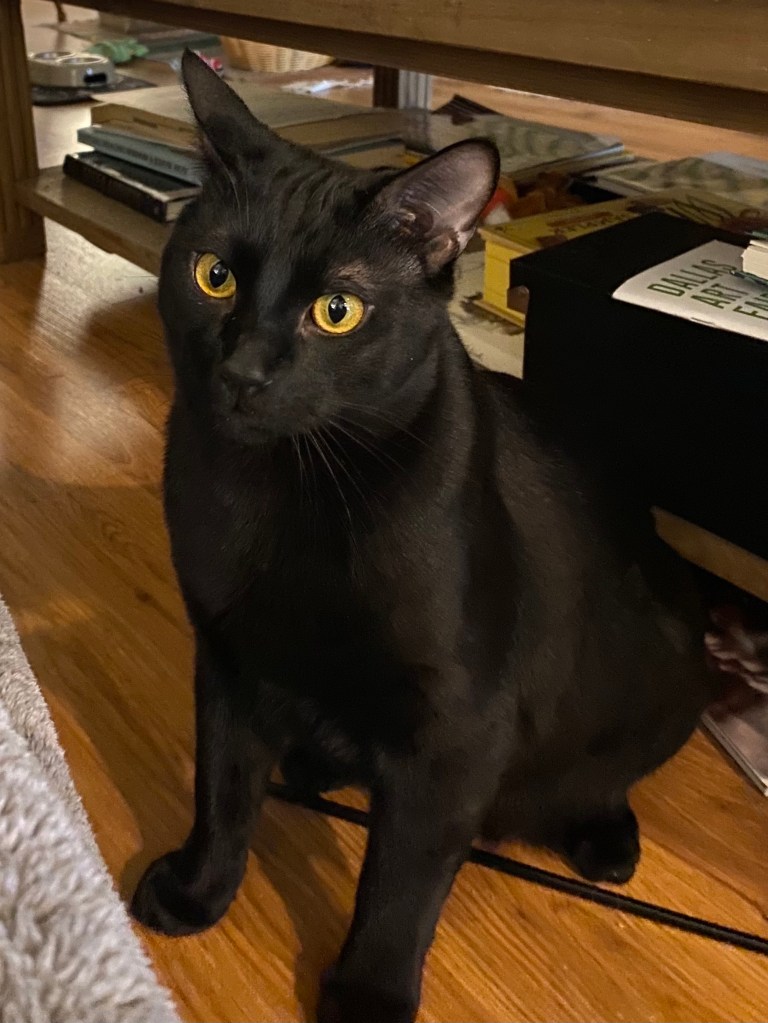
So, printing the art itself is something I usually batch over one or two dedicated days of the week in my studio and in that time I can print roughly four pieces depending on the size and level of detail. (It also helps with cat control, as the kittens still aren’t allowed in there and I don’t like having to shut them out more than necessary. One, it makes me feel bad and two, they bang on the walls and rattle the door. I think the house panther is about three “aha” moments from unlatching the doorknob.)
An intelligent stinker.
When I’m not actively printing or hand-embellishing completed prints – either for my own work or commissions from others, I do a LOT of research. I would say that a typical week is 50 percent creating the art, 40 percent research, and ten percent admin/marketing/operations which includes things like invoicing, cleaning my work space, looking for and responding to promotional opportunities, updating digital platforms and responding to commission requests (not all of these tasks need to be done each week, thankfully.)
My days are structured like any other workday, usually getting started around 9-10 am and finishing around 6 pm for family and TV time with the kittens.
Bonnie loves TV. Here she is learning about culinary travel to Costa Rica.
I sometimes work over the weekends, and I’m always reading on my off-hours, and some of that is research time as well. On weekends I try to recharge and work around the house or go see shows by other artists for inspiration. But during the pandemic I have been mostly at home.
Because my work centers on the Pine Curtain Project, I am always on the hunt for compelling vintage images with compelling stories, ideally that contribute not only to my own family history, stories and memories, but also to the larger cultural history of East Texas. As I wrote in a previous post, I’m focusing on a few main topics this year, which is not to say that other images and themes aren’t included as well. But, I am finding so much information just on these topics, that I am very busy researching, reading, cataloging and analyzing information.
Combining my art so closely with writing and research complicates things in some ways, but in most ways, I feel that it leads to a more rewarding experience for me as the artist, and hopefully for the viewer as well. As a person who likes a little more structure in the day, I feel that this project lends itself well to providing that structure while still leaving plenty of room for the flexibility needed for the creative process to do its thing.
“Logging Team with HorsePower Engines,” by Stephanie Khattak. Acrylic monotype print. 20X26 on paper.
The early prosperity of East Texas started with trees, and the region had (and still has) plenty of those. There’s a reason I named my work “The Pine Curtain Project.” The part of East Texas where I am from is dense with pines – The Piney Woods. It is so much a part of the region’s identity that even today, the local university’s mascot is a Lumberjack, a popular local coffee shop is Java Jack’s, the best-known festival is the Forest Festival and the main drag in Lufkin is Timberland Drive. At the same time, the density of trees can either isolate or protect, depending on how you look at it. Like…a curtain. I imagine this “curtain effect” was even stronger before the timber industry moved in, cleared away and changed the physical, sociological and cultural landscape.
This image makes me think of the beginning of the end of an era, which I feel evolved over generations. It was a double-edged sword, or saw if you want a more thematically accurate metaphor. On one hand, clearing the trees made way for unprecedented economic and civic progress. On the other hand, once the curtain was pulled back, things would never be the same.
As I am more of an artist and less of an academic historian, please explore these links forcitationsand further reading:
Detail shot, work in progress. Southern Pines Lumberman Team, 1930s. Acrylic monoprint, Stephanie Khattak.
Desktop view, work in progress. Southern Pines Lumberman Team, 1930s. Acrylic monoprint, Stephanie Khattak.
This work in progress is of a logging team, part of the Southern Pines Lumber Co. in the 1930s. The image was pulled from the Diboll History Center, Durham family photo collection. My great-great uncle (my father’s great-uncle) worked on this team and is in this photo, something I didn’t learn until I started to research the image.
This was not a branch of the family tree that I was close to, so learning more about them, and their place in history, has been interesting and a nice surprise.
An image this large and detailed required not only my 16X20 plate (aka Big Betsy), but also a bit of my 8X10 plate to extend the edges. This is the largest and most difficult piece I have attempted in terms of balancing aesthetics, details and expediency so that I can pull the print before the paint dries. It is pretty abstract (keeping with my artistic style) but I wanted to make sure that the horses mostly looked like horses and that the large trees came through.
One reason the source image is so striking is the size of the cut trees against the horses and workmen. When I post the final, I will link to it so you can see for yourself. It’s pretty cool, and there are many other photos in the collection that I want to work from.
“Rail Town, Paper Town.” Acrylic Monoprint by Stephanie Khattak. Based on “Railroad Gang,” a 1939 photograph by Russell Lee.
With pine trees come timber, with timber come sawmills. From sawmills come pulpwood and from pulpwood, paper is made, along with plywood, lumber, and other “forest products”. In the case of my part of East Texas, towns are made, too. Businesses, goods, and services that comprise an economy and an identity.
The Deep East Texas timber/sawmill/pulpwood boom started before this image, but nonetheless it captures important ripples of the timber wave. According to the Library of Congress, where I found the source photo, these men were building a railroad to service the Southland Paper Mill, where many years later, my father would work as did his father, his brother-in-law and many if not most other fathers, grandfathers and uncles I knew. The mill changed ownership many times since its construction and finally closed for good in 2007 as Abitibi Bowater. My father and most workers had been laid off a few years before. My father went on to have a happy “semi-retirement” and follow his dream of being a professional singer, achieving some notoriety and many dedicated social media fans. Many others were not so fortunate.
But at the time of this image until roughly the late-90s, timber was a stabilizing and driving force in the community that it had ultimately changed forever. This piece captures a time of hard work and hope for the future.
As I am more of an artist and less of an academic historian, please explore these links forcitationsand further reading:
Image Source: Lee, R., photographer. (1939) Railroad gang, Southern Paper Mill construction crew, Lufkin, Texas. United States Lufkin. Texas Lufkin, 1939. Apr. [Photograph] Retrieved from the Library of Congress.
The source photo for this piece was taken by Russell Lee, a contemporary of Dorothea Lange, hired for the federally sponsored Farm Security Administration (FSA) photographic documentation project of the Franklin D. Roosevelt administration. In 1973 this body of work was described as “the greatest documentary collection which has ever been assembled.” I’m so grateful to have Lee’s iconic images available to build on and inspire me today.
Cass County Annex, Linden, Texas. Acrylic monoprint by Stephanie Khattak.
In November, we took a day trip through East Texas to celebrate my husband’s birthday. We had hoped to go to New York, but life had other plans for us (and everyone else in the world!) I, of course, am very familiar with East Texas, even this northern route that we took, as I was a reporter in Marshall briefly in the early aughts. Caddo Lake, Jefferson and city government were my beats, so I spent a lot of time on these roads. But after I moved back to Dallas, I never went back there, so a lot of it was still new to me. And, of course, much has changed over the past twenty years.
On our trip, we began in Mount Pleasant and ended in Marshall, just as the sun was setting over its beautiful courthouse. In between, at the proverbial “magic hour,” we found ourselves in Linden, Cass County. The great thing about the “magic hour” is that it makes everything look, well, magic. Courthouses are stately and busy downtown squares are vibrant largely on their own. But when a certain kind of evening light shines, it can even make a simple civic building into a thing of beauty.
This year, I did three Christmas prints, two as part of the Pine Curtain Project, and another as part of K.Co Travel Art, a collaborative project that James and I are working on with our creative travel guide business, K.Co Press.
This print is my grandparents, on what is probably their first Christmas together in East Texas. I was told they’re at my grandfather’s parents’ house in Huntington, TX.
“Christmas 1950s.” Acrylic Monotype by Stephanie Khattak.
The next print is my aunt and two cousins. I believe they were at my grandmother’s house in Homer, Texas, all dressed up.
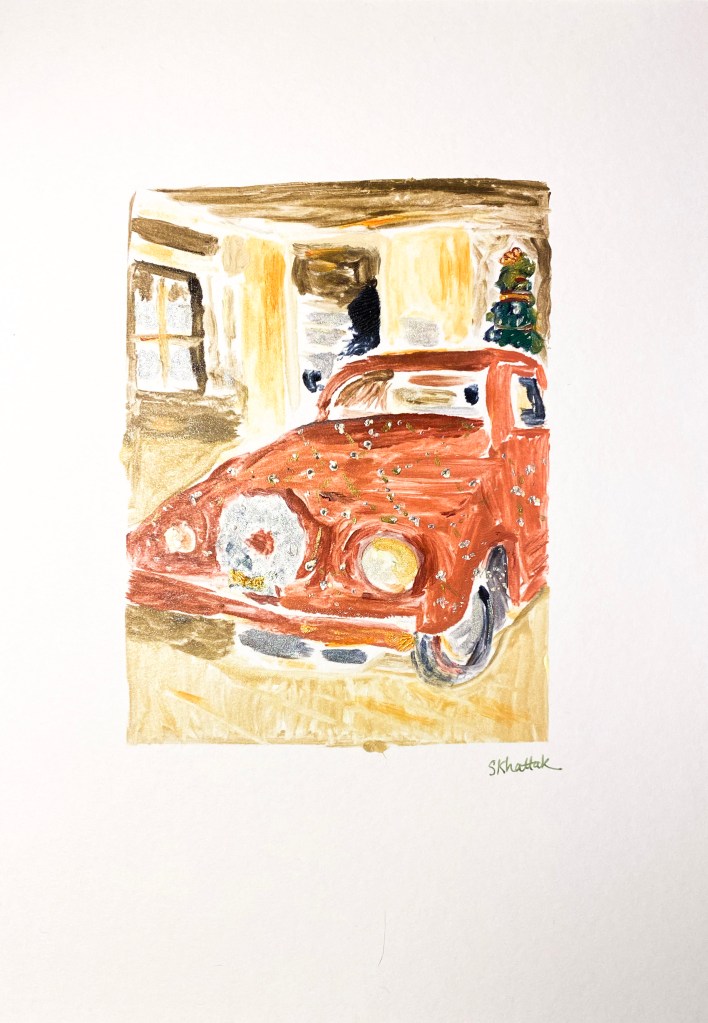
“Christmas 1970s.” Acrylic Monoprint by Stephanie Khattak.“Vintage Truck, Palestine, Texas.” Acrylic Monoprint by Stephanie Khattak.
We saw this festive truck on a day trip from Dallas to Palestine, Texas. We met my parents there for some (extremely socially-distanced, outdoor, etc.) holiday time. We aren’t visiting our families at home this year since home is full of oldsters who we want to keep safe. We found Palestine to be the perfect place for a holiday visit, and this truck was just one fun scene in Old Town Palestine. I’ll write up a blog post for K.Co once James edits the rest of his photos, but I will go ahead and say that if you find yourself in Palestine, don’t sleep on Oxbow Bakery, aka the pie shop. (Literally, don’t sleep! Get there when it opens because many flavors sell out!)
This will be my last post for 2020. What a horrible year! I truly believe that next year will be better, maybe not immediately, but eventually. May your holidays be festive and your new year be hopeful. Thank you for your support, and I’ll see you in 2021!








 stephaniekhattak.com