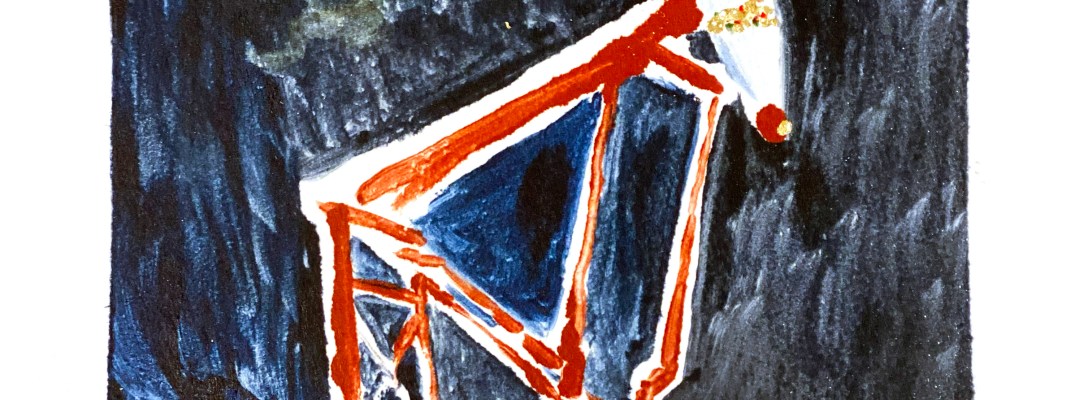
“Lufkin Rudolph” monotype print by Stephanie Khattak.
Each year for as long as I can remember, the holiday season in Lufkin has included “Rudolph the Red-Nosed Pumping Unit,” modified from oil equipment. It has evolved a little over the years and changed locations a few times, but he’s still pumping along!
This year, Rudolph will be lit on Dec. 5, in Downtown Lufkin. Long may he run, even if he doesn’t get very far!
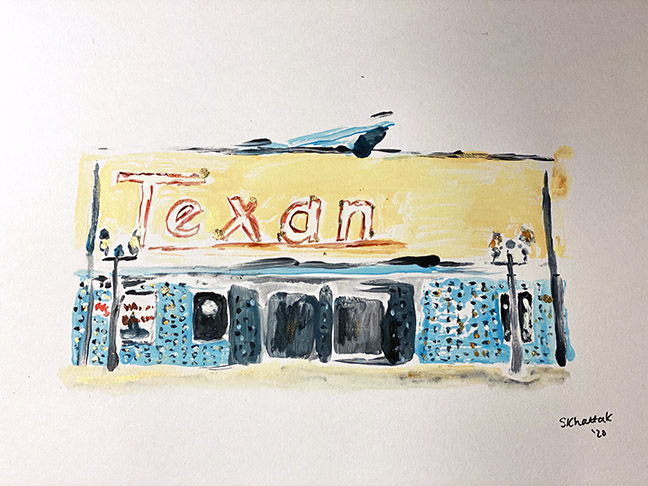
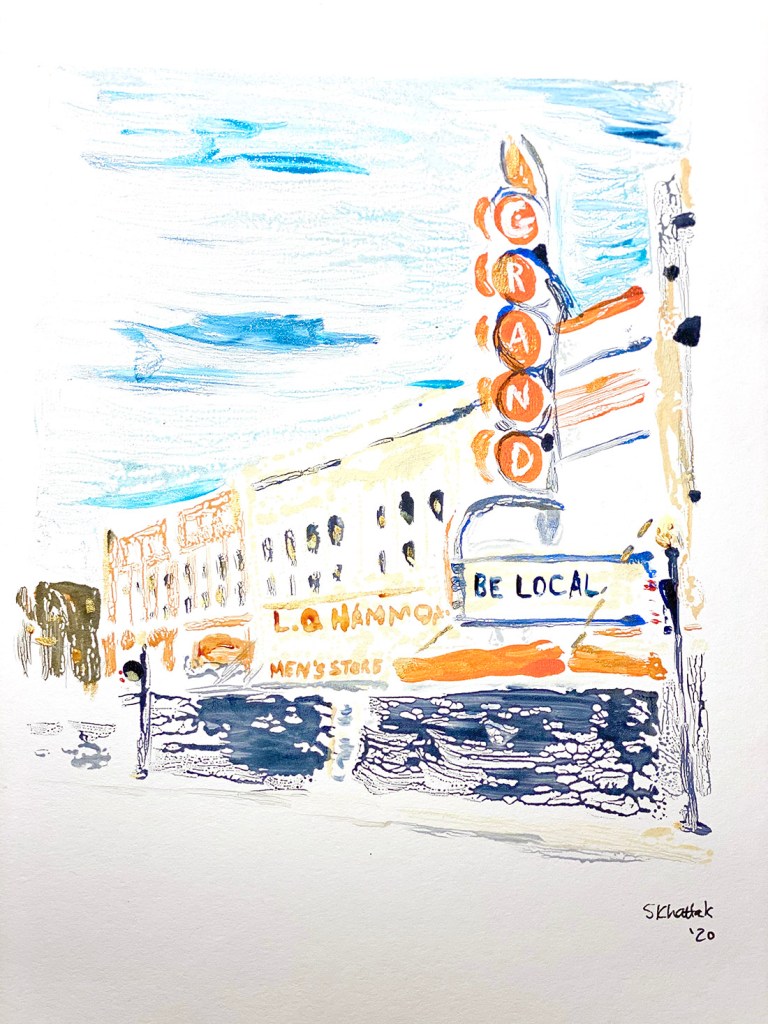
The Texan Theater, Athens Texas. Monotype Print by Stephanie Khattak.Grand Theater, Paris, Texas. Monotype Print by Stephanie Khattak.
I’ve been missing our more ambitious travels, but at the same time, I am enjoying the day trips that my husband and I have taken recently. Because of the pandemic and the fact that we have two rambunctious kittens at home, we are choosing day trips to scratch our traveling art adventure itches.
James enjoys photographing facades, historic downtowns and other iconic scenes of the places we visit. As I looked through the photos and admire the retro details and colors of these buildings, I wondered how they would look translated into a monotype print. I like it!
The Pine Curtain project is still my priority, but it is nice to have creative options, and to extend our travels a little further.
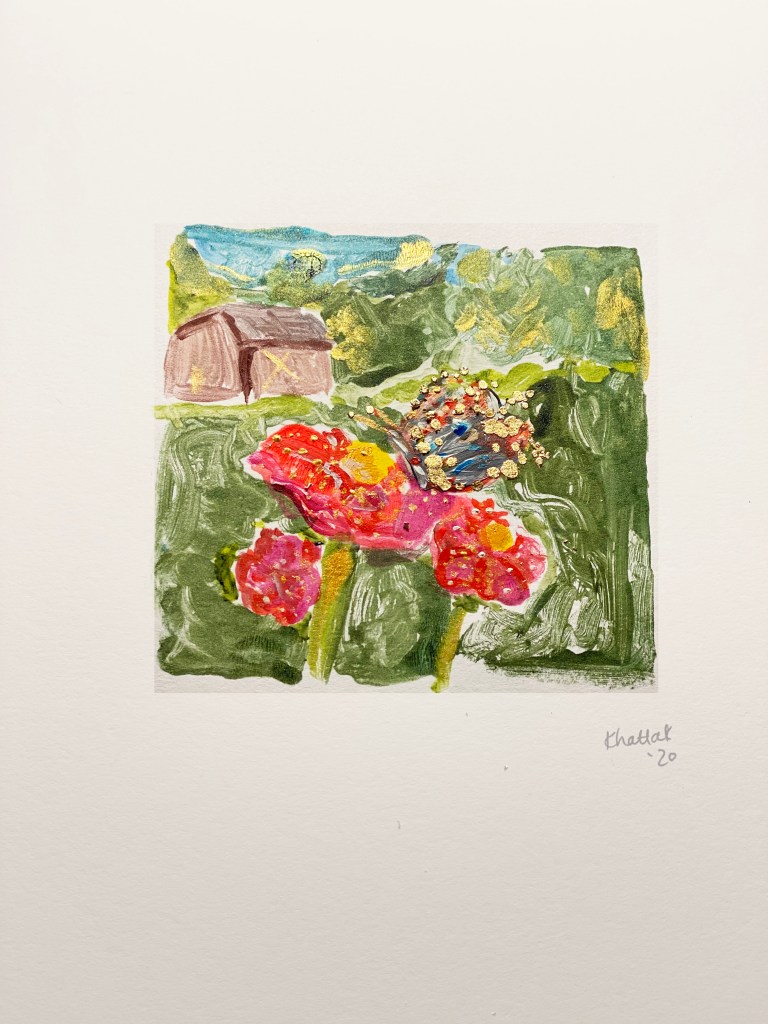
Abstract Floral “Butterfly Farm.” Monotype Print embellished with Acrylic, Gold Leaf. By Stephanie Khattak.
After a long hiatus, I am reopening my art shop on Etsy October 15! I’ll be exclusively selling monotype prints, including the one above, in a variety of sizes. This art store launch will include ten original pieces, and I’ll do a flash/mini update for Small Business Saturday in November, just in time for the holidays. More regular updates to come in 2021!
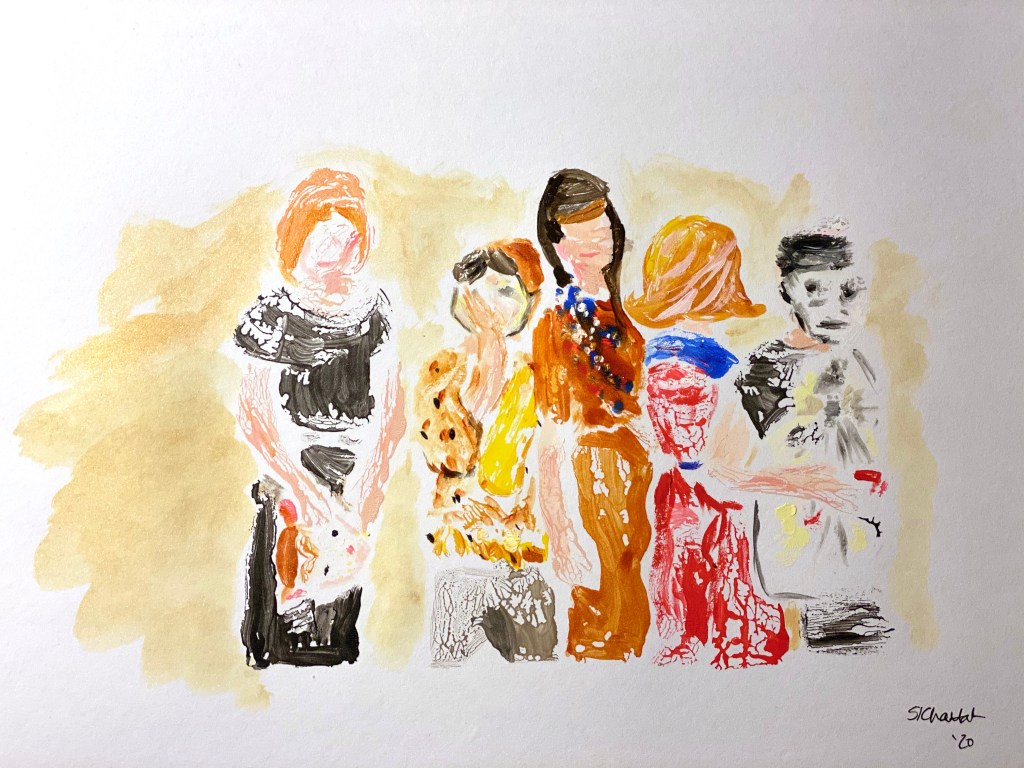
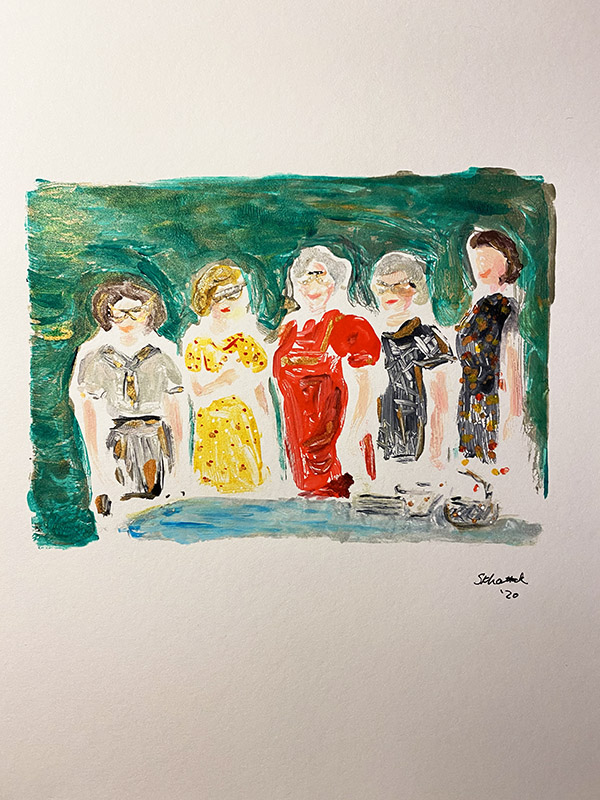
“Multitude of Matriarchs,” Monotype Print: Acrylic and Ink by Stephanie Khattak.
This print was taken from a 1960s baby shower at the Homer United Methodist Church. These were the hostesses, family friends who could always be counted on to spray their hair, polish up their cat-eye glasses and punch bowls, and run the show.
Many, many years after this, I hosted my first shower for my own expectant friend, in the same church fellowship hall where these ladies stand. I remember standing in the church breezeway, cutting gladiola stems, wondering if we had enough tablecloths and feeling a connection to the community of “aunties” who I had seen do the same things over the years. I’m proud to come from a community where it is second nature to show up and celebrate people.
AND, yesterday, I received my copy of “They Left No Monuments,” a volume of East Texas human interest stories by the late historian Bob Bowman.
I’m just scratching the surface of these resources, but I have already learned so much! It’s really exciting to read this information, find archival images, and think about how it might fit into writing, art or both.
I’ve settled into a routine where I work and write in my studio most afternoons, and in the evenings I dig around online and read. Routine and purpose have been things I really miss about pre-COVID times when my business was stronger. If you are struggling, too, I urge you to just pick something fun to do and dive in. If you have a fuzzy assistant or two to keep things lively, even better.
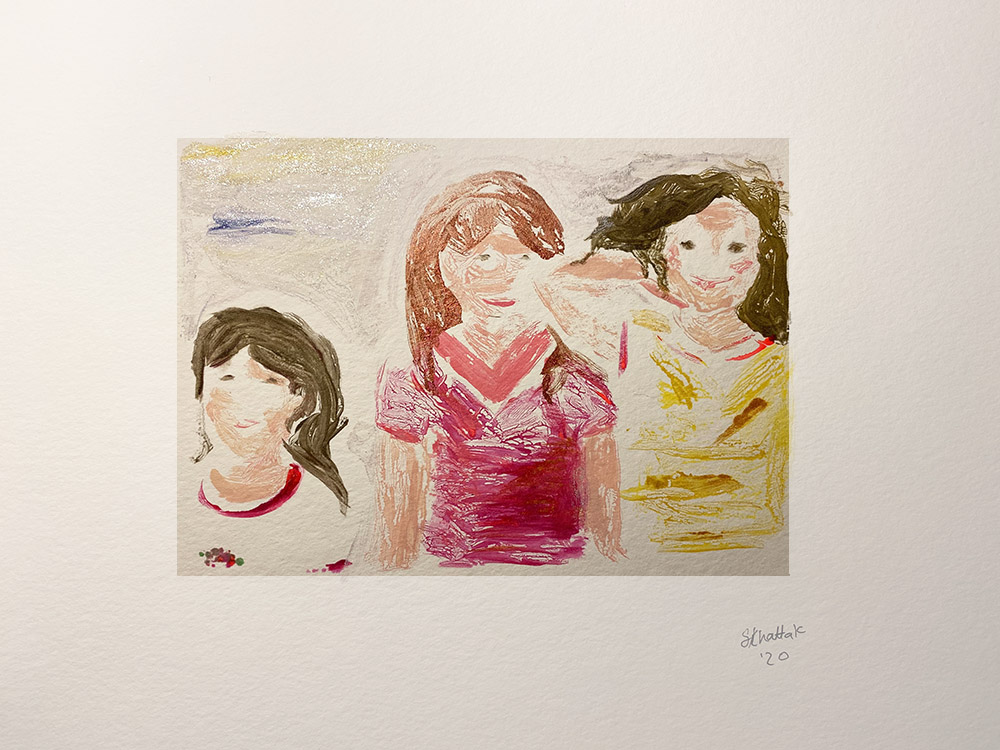
“Besties, 1980” by Stephanie Khattak. Embellished acrylic monotype.
In rural East Texas, your first best friends are your cousins and your neighbors. And often, your cousin IS your neighbor! In my case, my cousin spent lots of time visiting my grandmother, who lived just one stop sign and few houses away. So, almost a neighbor. I’m an only child, and people often ask “Weren’t you lonely growing up?” Because of my cousin and my neighbor, I really can’t relate to that question. How could I be lonely when one bestie lived at the far end of my driveway and the other was conveniently at all family functions? Plus, they’re older than me by a few years, so I don’t know what it’s like not to have friends like them. An upside to being related to and living next door to your best friends is that they’re stuck with you for life. Lucky them! And lucky, lucky me.
Today is the first day of fall, and here in Texas it is finally cooler and a bit rainy. “Hygge Weather,” I call it, and for this year at least, at my house late September to late February is “Hygge Season.” No one knows what Halloween and the holidays will look like, but we can be pretty sure that being cozy at home is still the best way to go, at least for those of us city-dwellers. So, I decided to try and take a bit of control over these things we can’t control, and embrace the positive.
Yesterday, in my Instagram archive, an interesting post popped up from seven years ago. I was in East Texas at The History Center in Diboll, TX, researching for the novel I was working on at the time. (And technically still am, as I put it away with about a third of it left to finish.) My research was centered on the more salacious bits of East Texas history, not something I’d really make into a print. At the same time, that research is still very valid, as I still go back to the materials I copied to check my facts around locations, names and milestones as I create art around and write Pine Curtain Stories. I put my novel away when my professional career started to ramp up, and I didn’t have any time to devote to it. I had often regretted not finishing that story. Now, with the benefit of hindsight, I have many fewer regrets because I see that time wasn’t wasted. The work I put in then is helping me now, and who knows, maybe I’ll eventually drag my book back out and finish it, too. So, if you’re struggling or feel like you’ve wasted creative time on a project that fizzled out, don’t worry so much. Put it aside and revisit it from time to time, and life may surprise you.
As I keep returning to Homer as a creative focus, the concept of Ghost Towns rattles around in my head. Ghosts of the past, ghosts of what might have been. Literal ghosts? Some say yes. And yet, to me, it never really felt sad or like it has dwelled in missed opportunities. Homer’s population is small, for sure. It has hovered between 350 and 500 for most of my life. But it has always been so busy and vibrant. At the same time, it was definitely insular, “the bubble” as I call it, and I did have a hard time acclimating as my life got bigger. So, in a way, those woods and fields are also full of ghosts I loved and then left behind.
So, how does this circle back to art? As I have mentioned before, for me, art helps me make sense of things that are hard to process and harder to articulate. When I am making a print or painting, especially for this project, it opens up new parts of my mind to communicate with, and to communicate without overthinking. At the same time, art begets art, and when I am working on a piece, thinking about the story behind it, my mind is more open to ideas about future pieces, or stories, or research I want to go back to.
Do not now seek the answers, which cannot be given you because you would not be able to live them. And the point is, to live everything. Live the questions now. Perhaps you will then gradually, without noticing it, live along some distant day into the answer.”
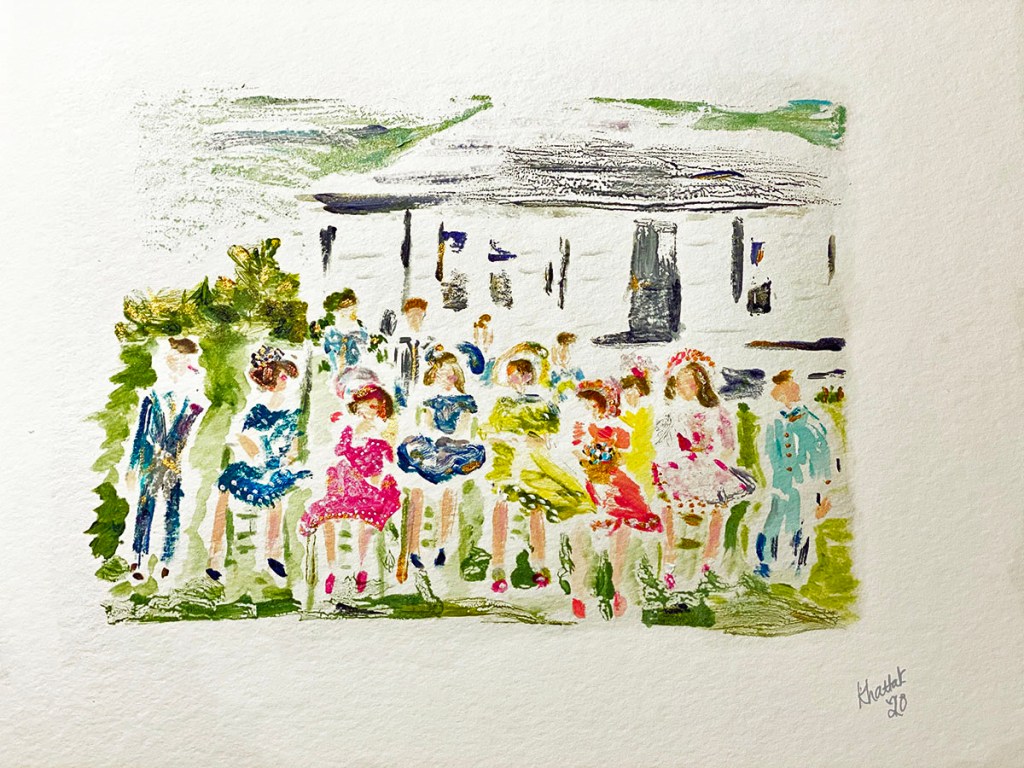
“Homer United Methodist Church, 1961.” Print and Acrylic Paint, Stephanie Khattak.
For generations of my family in East Texas, life centered around Homer United Methodist Church. It functioned (and still does) as part house of worship, part community hub. Sunday services were of equal importance to potluck suppers, holiday events, and youth group get-togethers as well as volleyball games, dances and other non-religious activities. Regardless of how religious you were or weren’t, whether you were a member or a prospective member, or just there to fellowship – ours was a church that just got everyone together for a good time. It was all part of God’s work.
Those good times bound our community through generations. This print is taken from a photo taken outside the first church building in 1961. In the source photo is my mom and a few of her best friends. She still sees many of them every few weeks at least, and not necessarily at church. Many of my friends and I have the same kind of relationships, which were also cultivated through the church but exist outside its walls. We genuinely liked, and still like each other.
The church sits where the Homer “town square” used to be. So, it has a legacy in East Texas history as a place of excitement and energy. The church seen here was replaced with a more modern building in the later 60s, which is still there. My family lived a few doors down from the church, within walking distance. Or, when I was learning to drive, within driving the riding lawnmower distance!




 stephaniekhattak.com