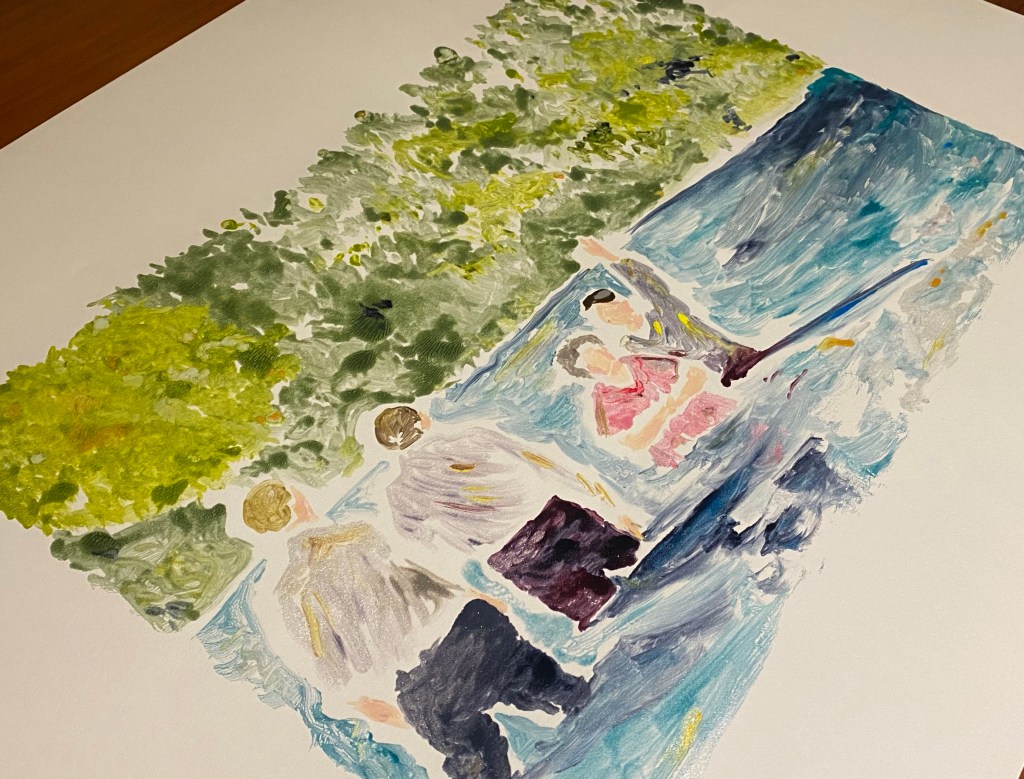
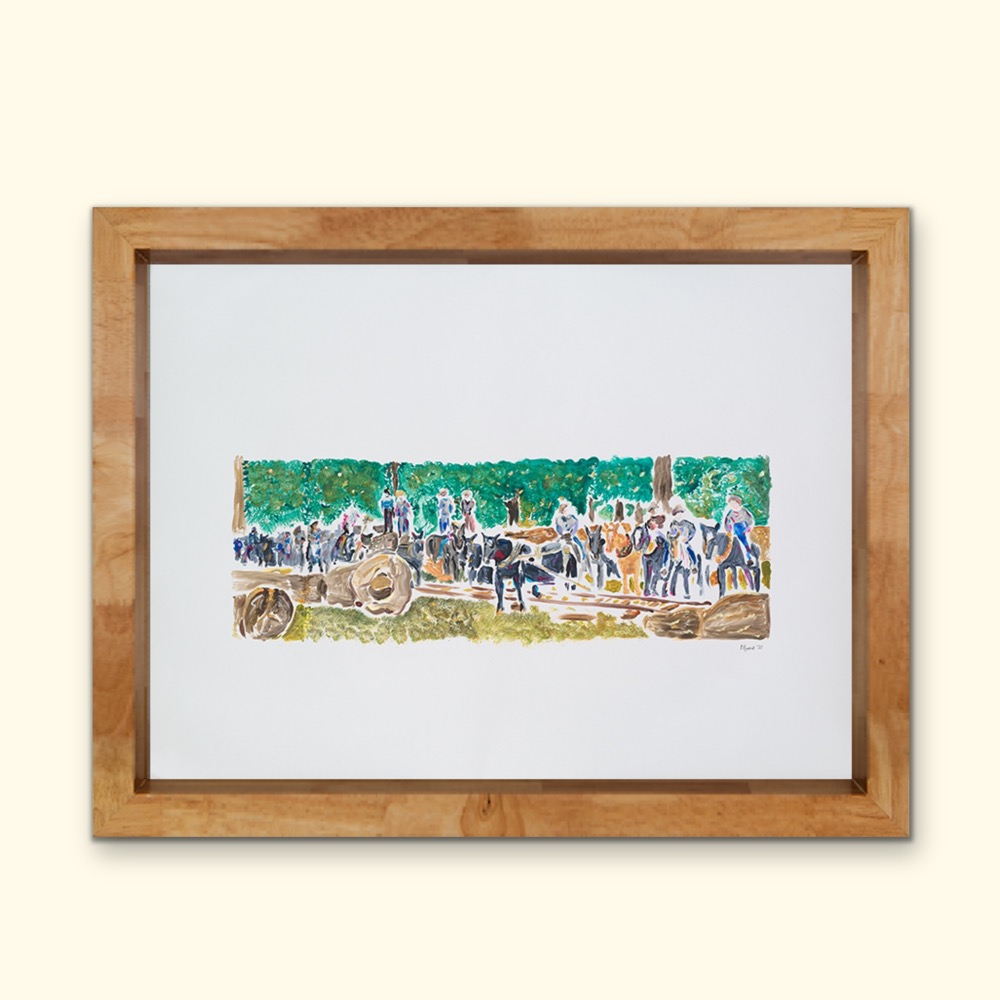
“Down to the River,” 18X24 acrylic monotype on paper by Stephanie Khattak.
I recently joined a Facebook group of family members’ on my dad’s side, which is and was full of preachers and have even had their own church for generations. This is not a side of my family that I know very well, so it is interesting to get to know them and the family history.
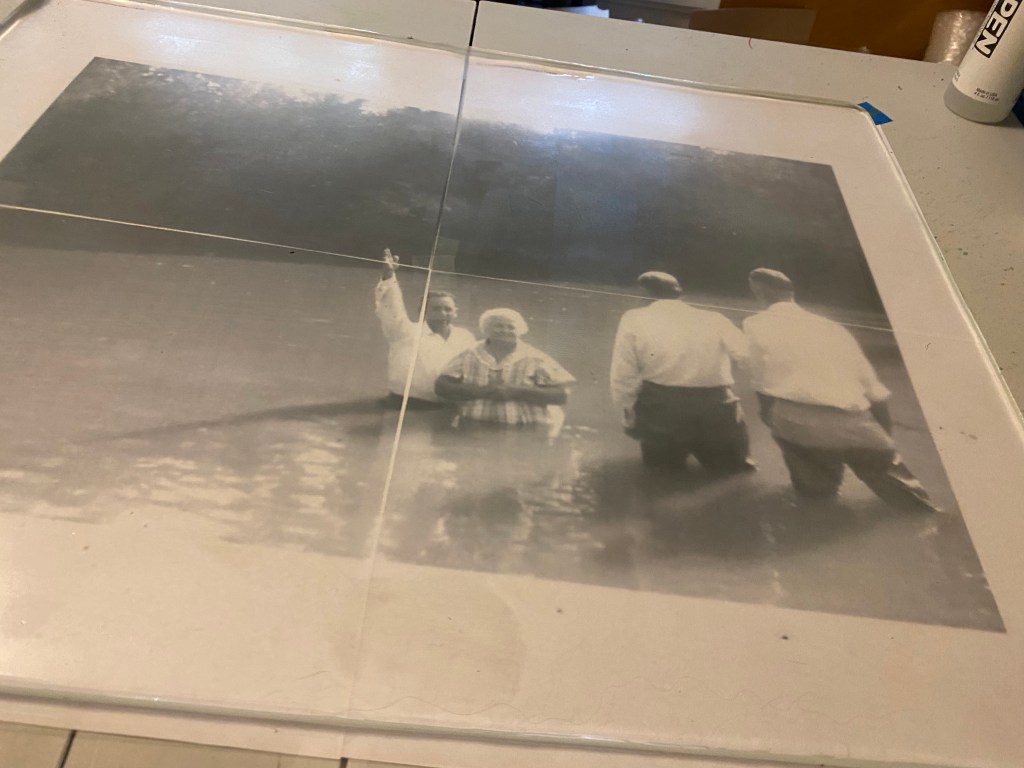
This piece is based on a photograph I found there, showing a river baptism probably around the 1950s or so. The people are not identified, but I would guess that the person doing the baptism is an uncle of mine.
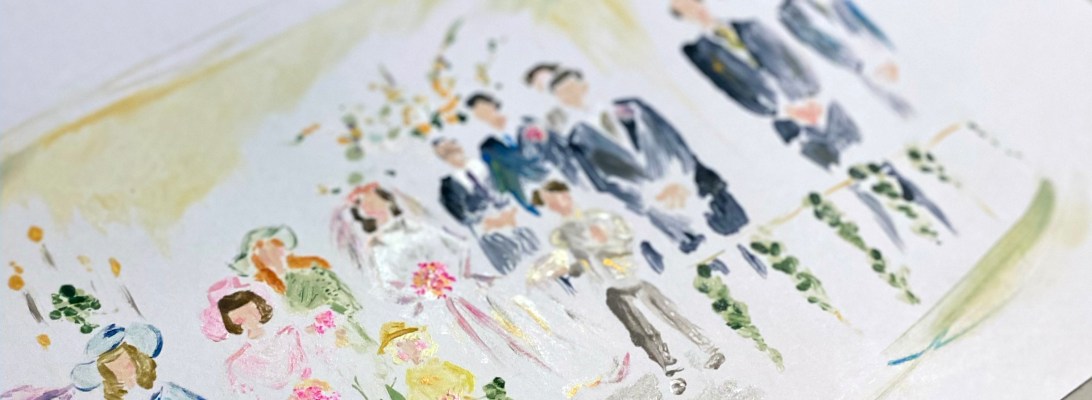
Detail Shot, “The Anniversary” by Stephanie Khattak.
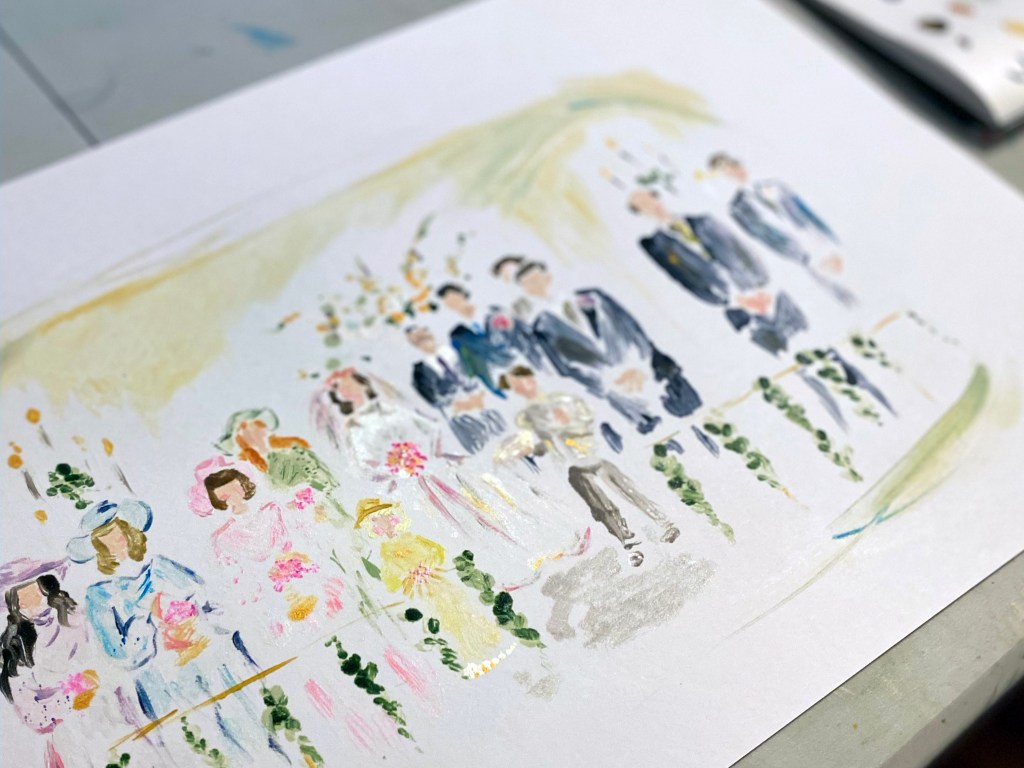
“The Anniversary” by Stephanie Khattak.
My parents had the most seventies wedding ever. White shoes on the men, sherbet-toned bridesmaid dresses for the ladies, complete with floppy hats and flower baskets instead of bouquets. But it worked for this East Texas wedding portrait in 1973 and in some festival/Midsommar aesthetic circles it still works today. They got married roughly a month after my mom graduated high school, which was common for the time. I came along three years later. They’re still together, their health has been good. They lead quiet lives in a nice home with a bunch of cats and a dog so spoiled we’ve taken to calling him Little Lord Poncho. It hasn’t been perfect because what is? But they got their happily ever after.
I’ve started working on larger monotype prints, which is fun. It takes a little bit of problem solving, since I don’t have a large format printer and wouldn’t want to spend money to have something printed professionally that’s just going to be a reference piece. So, in order to get the photo large enough, I open Adobe Acrobat and print as a poster, which enlarges across multiple sheets of paper. I put them together sort of like a puzzle under my large plate (or plates if the finished product will be larger than 16X20.) It is a little extra work, but I love how these look at a larger scale when I can bring out more of the entire scene.
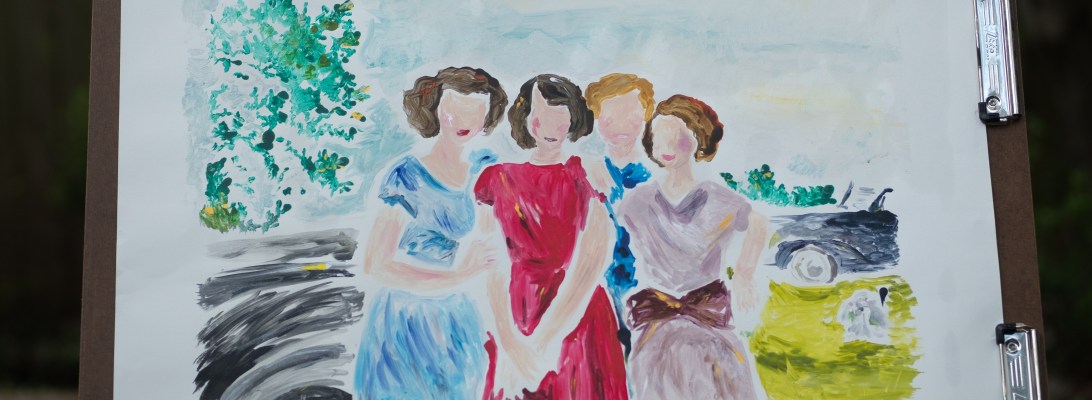
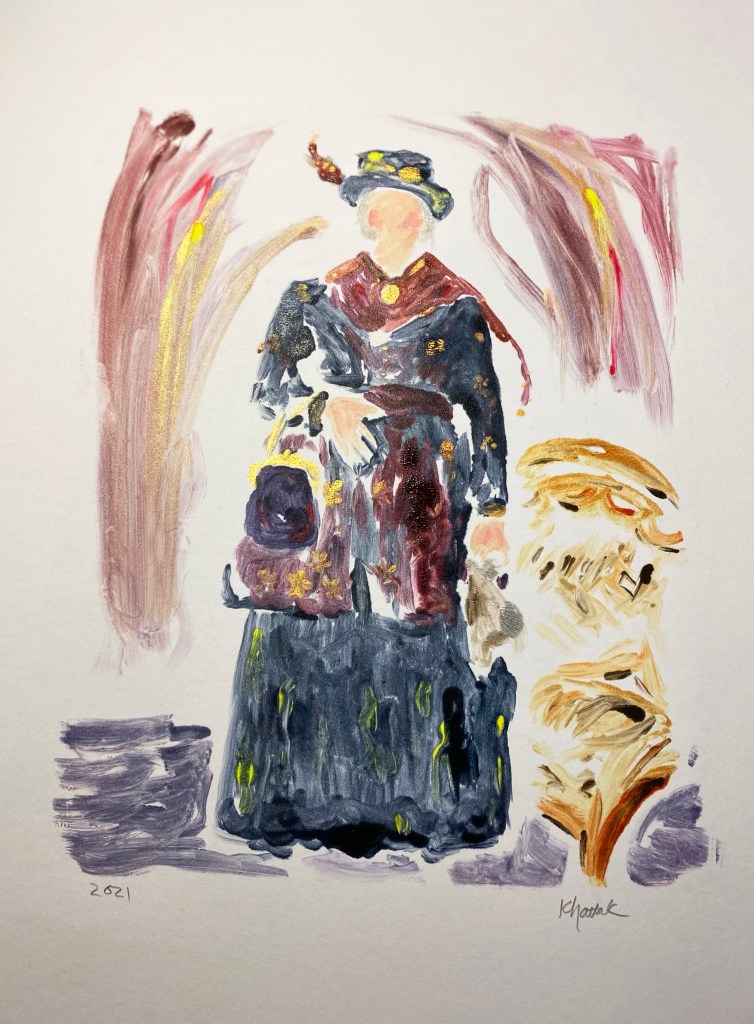
“The Namesake,” Acrylic Monotype by Stephanie Khattak. 12 X 18 on paper.
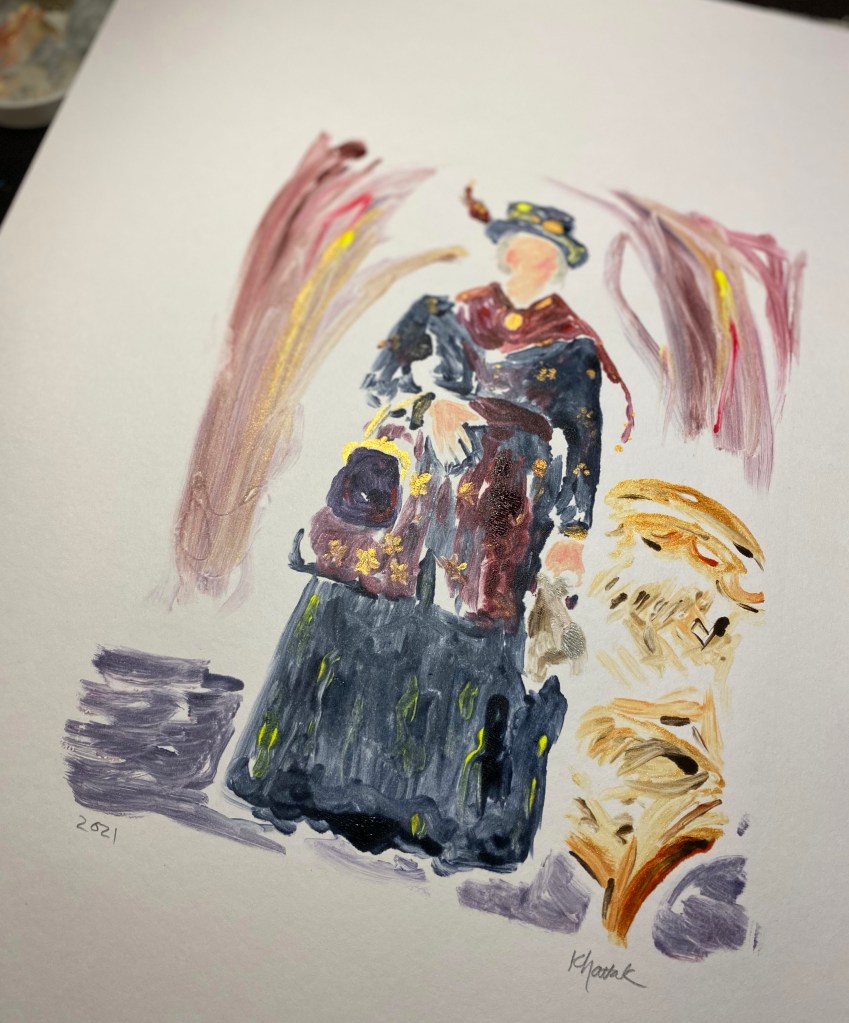
This monotype print is taken from a vintage East Texas photo of my maternal great-grandmother’s grandmother, Ann. There have been Ann’s in the family ever since, including me. My father’s sister is also an Ann, so the name does double-duty for both sides of the family.
Elizabeth “Ann” was born in 1858 and died in 1948, so of course there aren’t many people left in my family who have direct memories of her. But she’s the originator of the “Panther Tales” that have been told to my great-grandmother, grandmother, mother and me, and everyone remembers those. When she was young and living on Renfro Prairie in East Texas, it seemed like there was a panther behind every tree, waiting to slash someone. She’s kept generations scared straight for a hundred years – none of us ever went far into the woods, and as we still occasionally hear panthers scream in the night there, we are right to stay away!
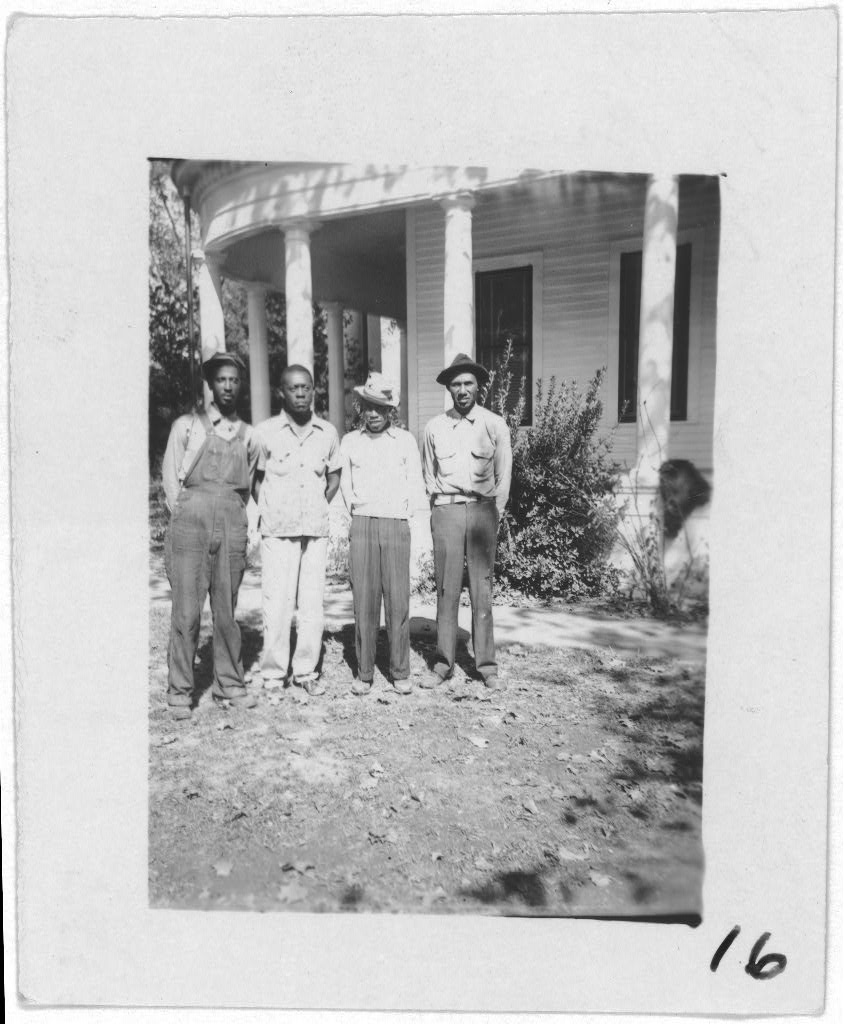
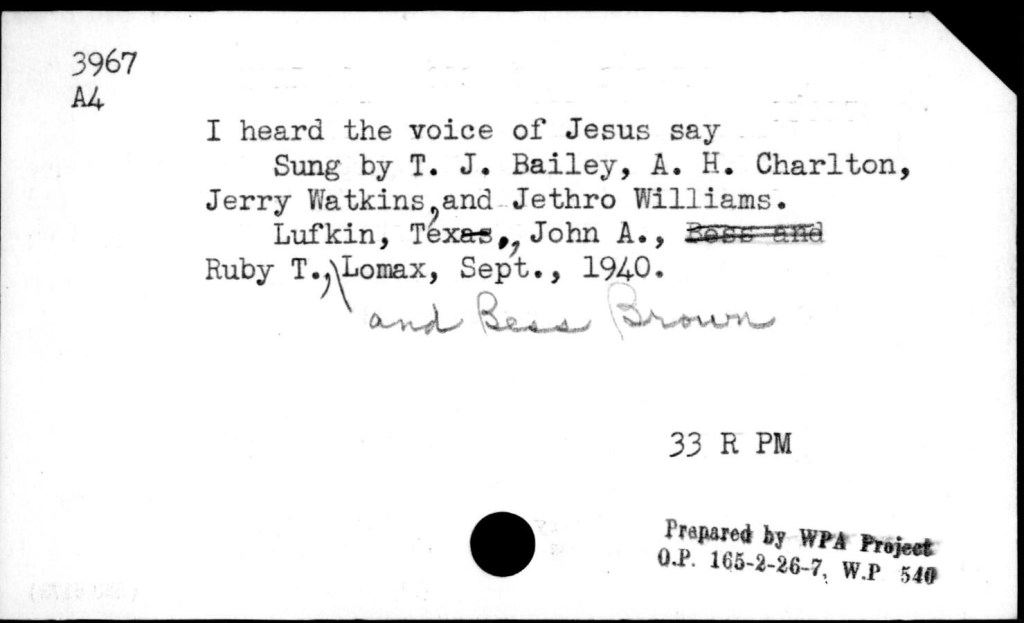
The Angelina Four at Kelty’s Lumber Co., Lufkin, Texas, 1940 Ruby Lomax, Library of Congress. Alphonso “A.H.” Charlton; Tom “T.J.” Bailey; Jerry Watkins, and Jethro “Jabbo” Williams.
I’ve mentioned these guys before when writing about the work of John Avery and Ruby Lomax, but thought that they needed their own spotlight.
The Angelina Four was a quartet of men who were employed by the Angelina County Lumber Company in Keltys, a community outside of Lufkin. The East Texas musicians recorded 15 pieces, a “singing commercial” – Angelina Longleaf Pine, – and 14 songs that included popular, gospel and spiritual music with rich harmonies.
Notes from Lufkin Recordings. American Folklife Center, Library of Congress.
Please explore these links forcitationsand further reading:
Lomax, J. A., Lomax, R. T., Bailey, T. J., Charlton, A. H., Watkins, J. & Williams, J. (1940) Angelina Longleaf Pine. Lufkin, Texas.
*Some of these sources document outdated and now-unacceptable language, policies and ideas around race. Like the authors of these academic works, I do not condone or wish to ignore potential negative impact by reporting or linking to them. In writing about history, I often must weigh the benefit of sharing the “entire picture” against the potential harm in doing so. In this case, I felt that it was important to tell the whole story of the Angelina Four, understanding that the entirety of their lived experiences likely contributed to their creative work and place in history.
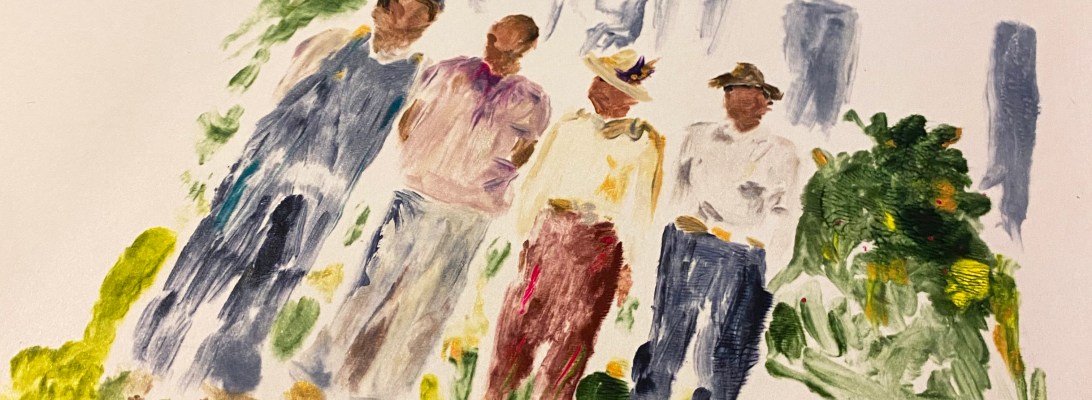
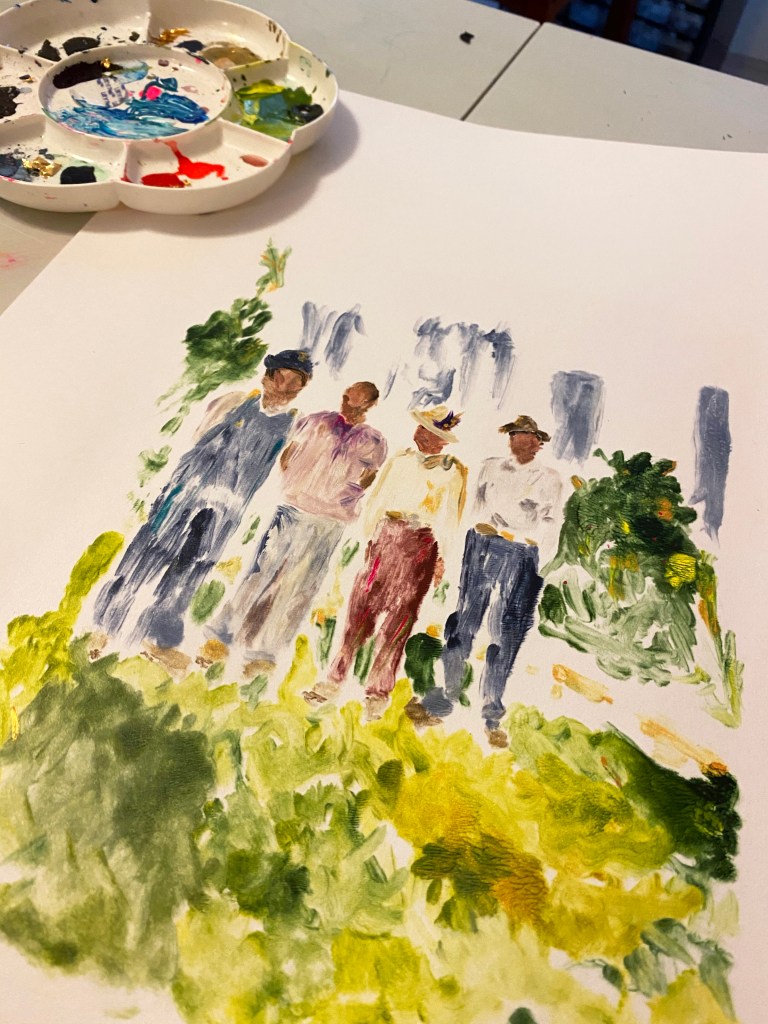
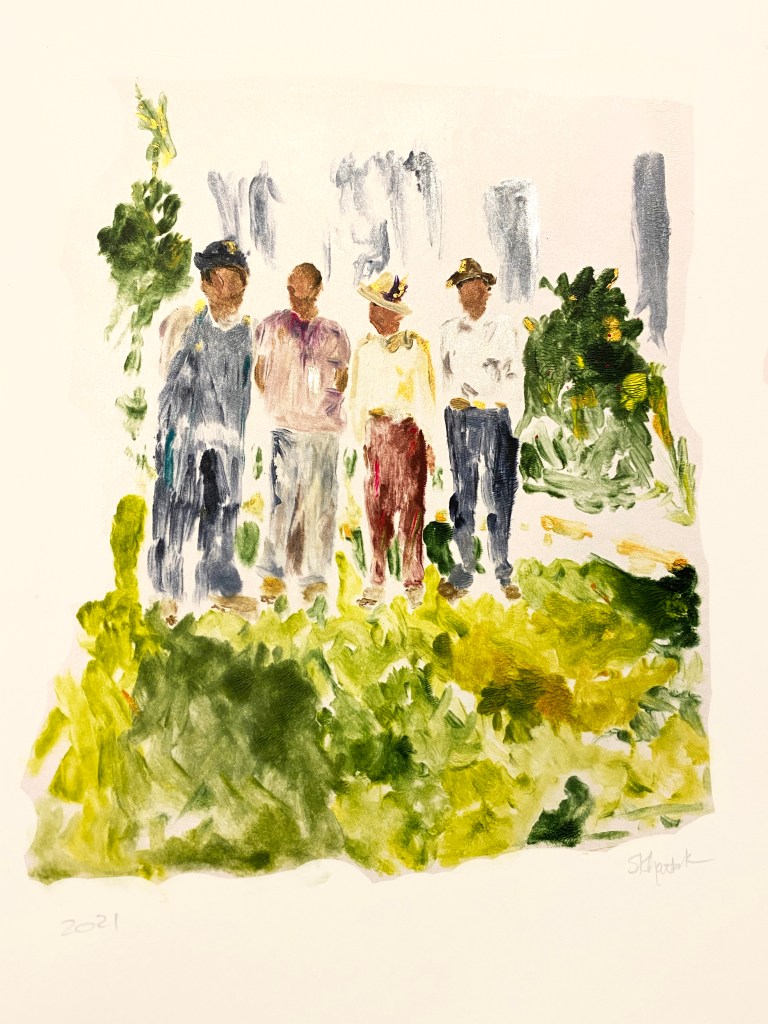
“Logging Crew,” by Stephanie Khattak. Acrylic Monotype, 8X10 on paper.
A few months ago, the Texas Forestry Museum in Lufkin contacted me about providing a limited-edition of hand-embellished reproductions from my “Logging Crew” print for its gift shop! This is really exciting, because not only is the Forestry Museum a really solid East Texas history and cultural center, it’s also in my hometown and I have many happy memories of visiting it over the years.
If you are local in East Texas, I encourage you to go in and visit the museum’s newly updated space! If you’re not local, or not quite up to in-person visits, drop them a line for more information.
This wonderful collaboration kicks off my wholesale art program. If there’s a local museum gift shop, CVB or specialty retailer with a strong local focus where you would love to purchase my work, please tell them about me! I don’t sell reproductions of my work directly, so this program is a really great way for customers to purchase the pieces they like and support independent, local businesses at the same time.
This art is professionally reproduced on BFK Rives fine art quality paper, and each one is hand-embellished, making it a piece of truly unique East Texas art for sale. They’re sold unframed, so that you can display them to perfectly fit your taste and decor.












 stephaniekhattak.com