A reward of my interest in family history and research is learning not only who my family was as individuals, but how they influenced me. Both of my parents are musicians, my dad – a Gen Z wrapped in a Boomer wrapped in a lounge singer – has an impressive online music career with a bigger and more engaged audience than I could ever hope for. My mom sings and plays the piano and organ but mostly at church. They don’t collaborate because they have ….let’s just say creative differences. But music has always been a part of my life and our household.
I learned from my paternal grandmother that she had written and recorded a song back in the 40s in Houston. This tracks, because my cousin on that side is also a really talented musician – singer, songwriter and guitarist.
But what about my mom’s side of the family? She had a lot of formal music classes, but there had to have been something there for those classes to refine.
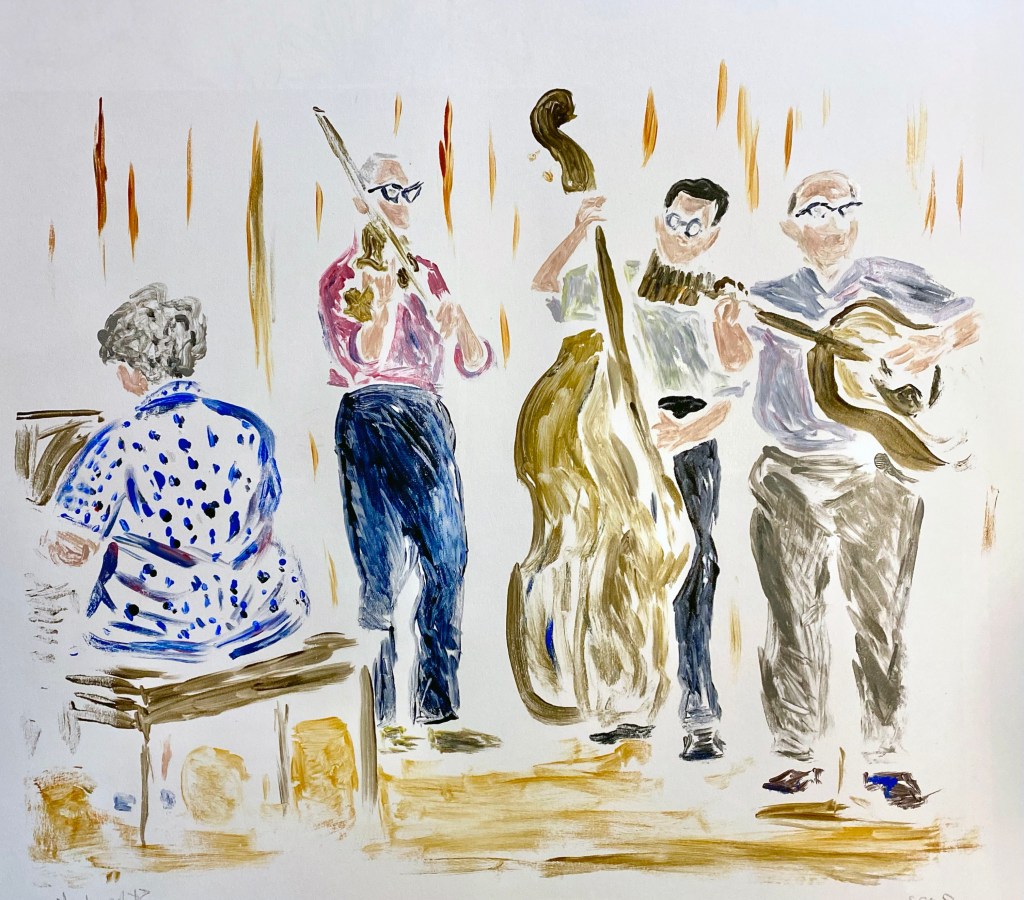
In our church archives, there’s a photo of a band in the early 60s, and the guitarist is my great-grandfather on my mom’s side, Pappy. Aha!
I really like this photo, not only because Pappy is in it, but also because it captures a time in the Homer community when it was really thriving – there were enough people to form a band and enough people to come hear them play. This was the case until I was about 17, and then it started to dwindle down. In junior high, my youth group friends and I stood on that same stage and lip synced into bananas calling ourselves “Banangles.” (Not sure why we didn’t go for the obvious Bananarama, but why be obvious when you can surprise and delight?)
I wonder what Pappy and his friends would have thought about the Banangles. But, I also don’t know what songs they, themselves were playing. Same place, same community, same (or similar) families – whatever they were doing, I bet it was fun.
“Pappy and the Band,” acrylic monotype on paper by Stephanie Khattak, 2022.
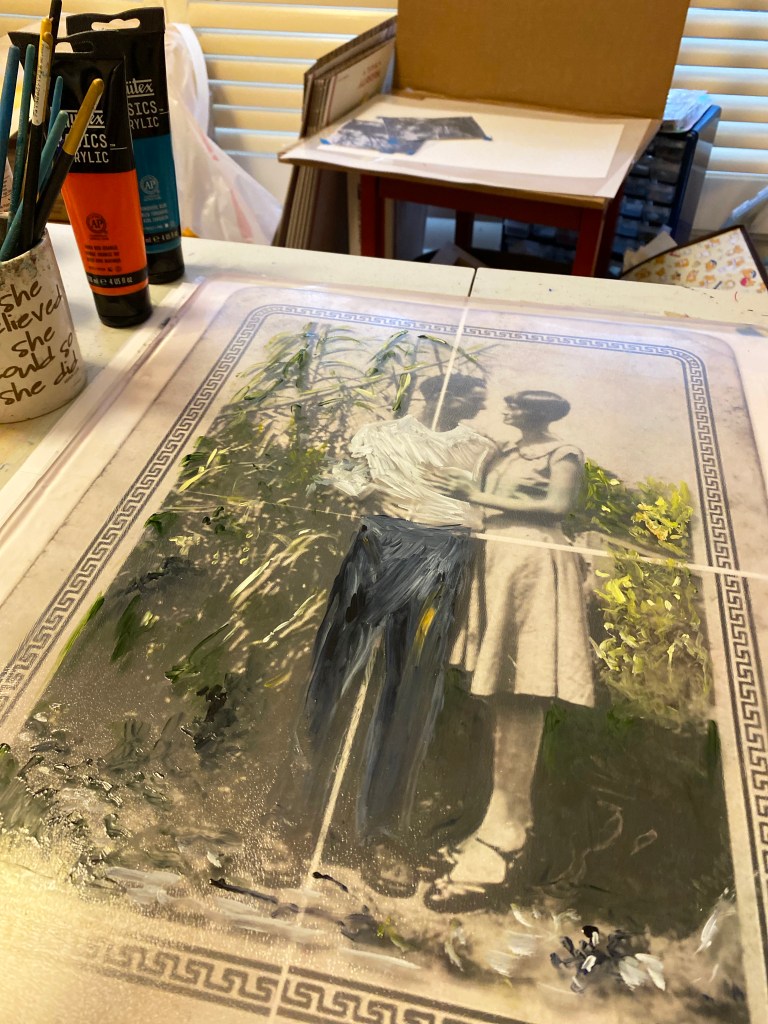
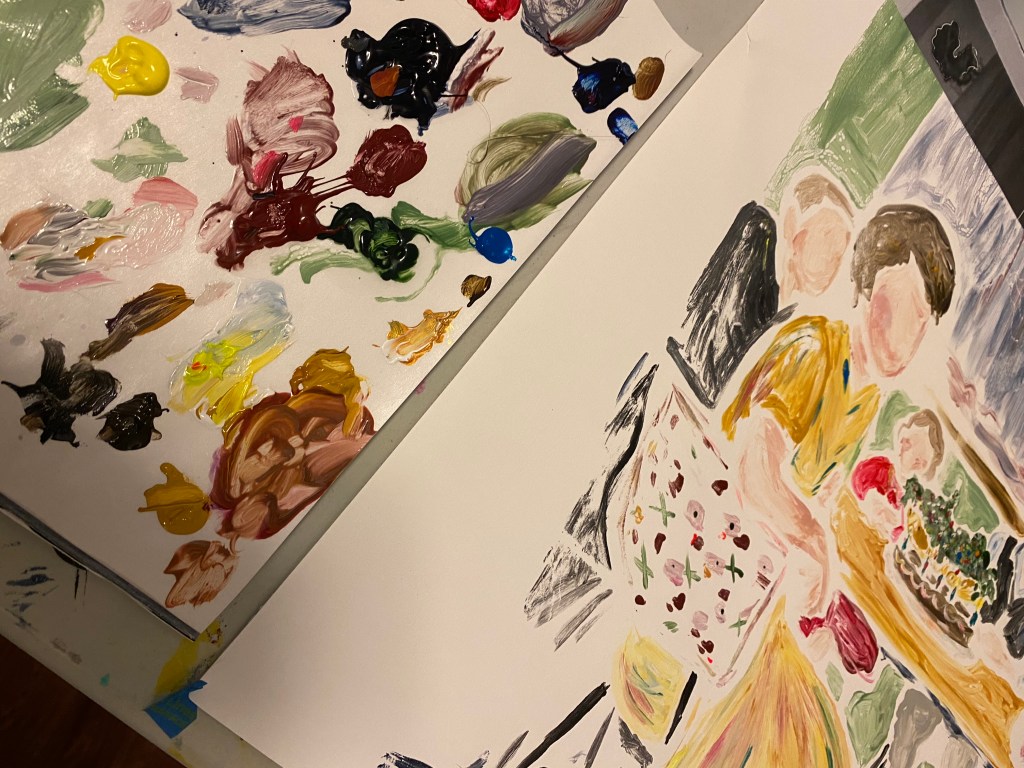
Almost one month into 2022, I am finally able to get back in my studio and make fresh monotype prints. Because this process must be completed in one go, it needs more dedicated time than other types of art. And time is something that has been in short supply!
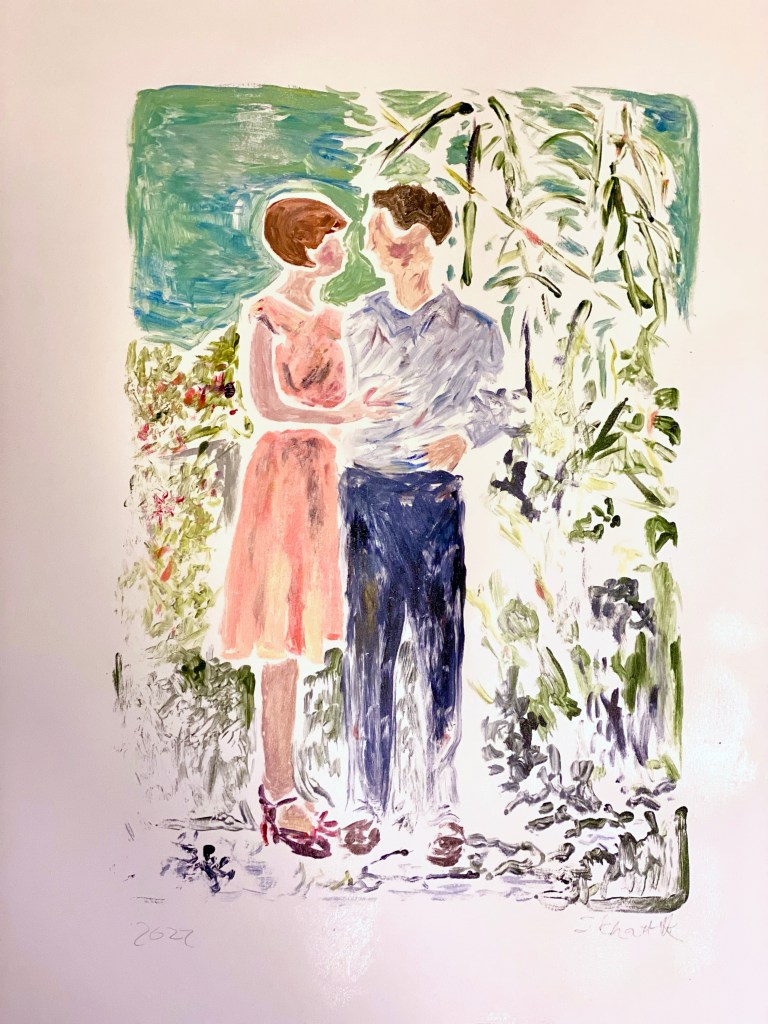
For the my first print of 2022, I chose a vintage photo of my great-grandparents in the 1920s or 30s. Doing the math now, I realize this would make it close to 100 years ago. That seems hard to believe. While Beatrice died at 68 in 1978, Charlie, aka Grandy, lived into his nineties – almost to the year 2000! So, I knew him quite well.
What I like about this photo – other than the people in it – is how stylish she looks. I was too young to have memories of Beatrice before she passed, but I have always been told about her fashion sense and desire to keep current on trends. I see her angular 1920s bob and her shoes and think this was a person who had a sensibility beyond her rural environment.
Not sure if Grandy shared her fashion sense, but I remember that he didn’t like being gifted jogging suits at Christmas. So, maybe.
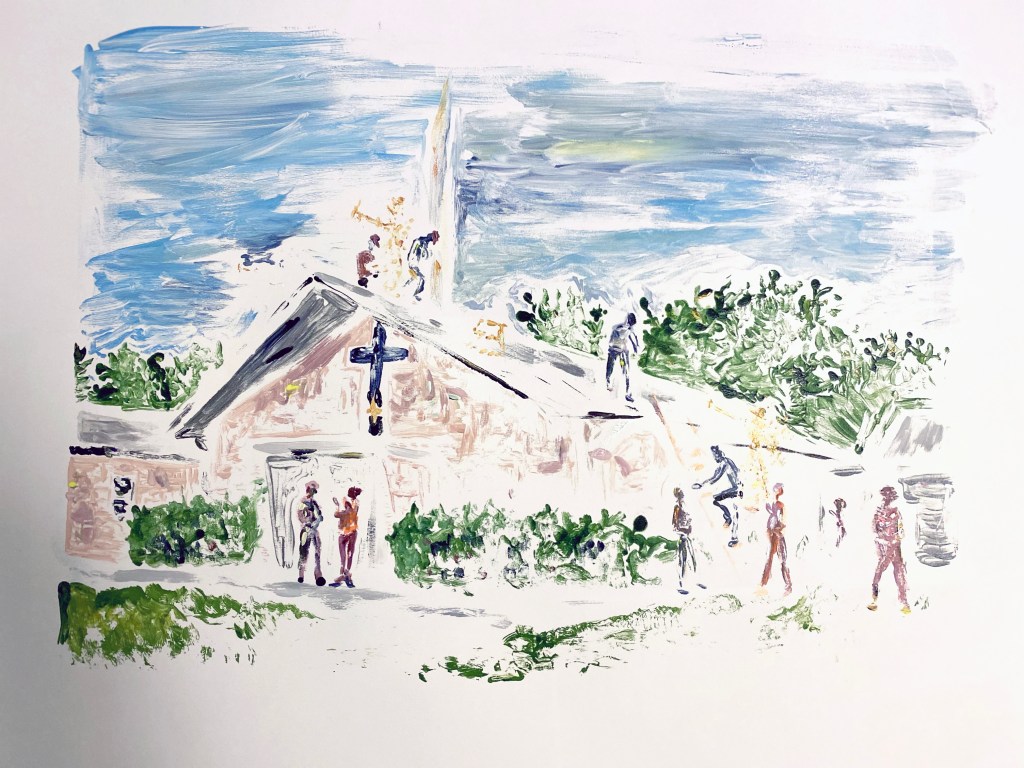
“Homer Church Angels,” acrylic monotype print on paper by Stephanie Khattak.
Each year, my community church puts up a lighted nativity scene, replacing the live nativity scene that it produced in the 1980s, after everyone got older and more tired. After Thanksgiving, busy groups of people work together to test lights, assemble figures and finally, install them on the church grounds and roof. This piece is based on a photo of that process. (I dare not call it vintage since it was within the last 15 years!)
I purposefully left the figures a little abstract. The main reason is because they’re so tiny that trying to personalize them would not render them recognizable anyway. But also because at gatherings like these, it is less about the individual and more about the group. And I would go further and say it is less about this particular group, and more about the spirit of tradition and faith moving through them, as it has before, after and as it will again.
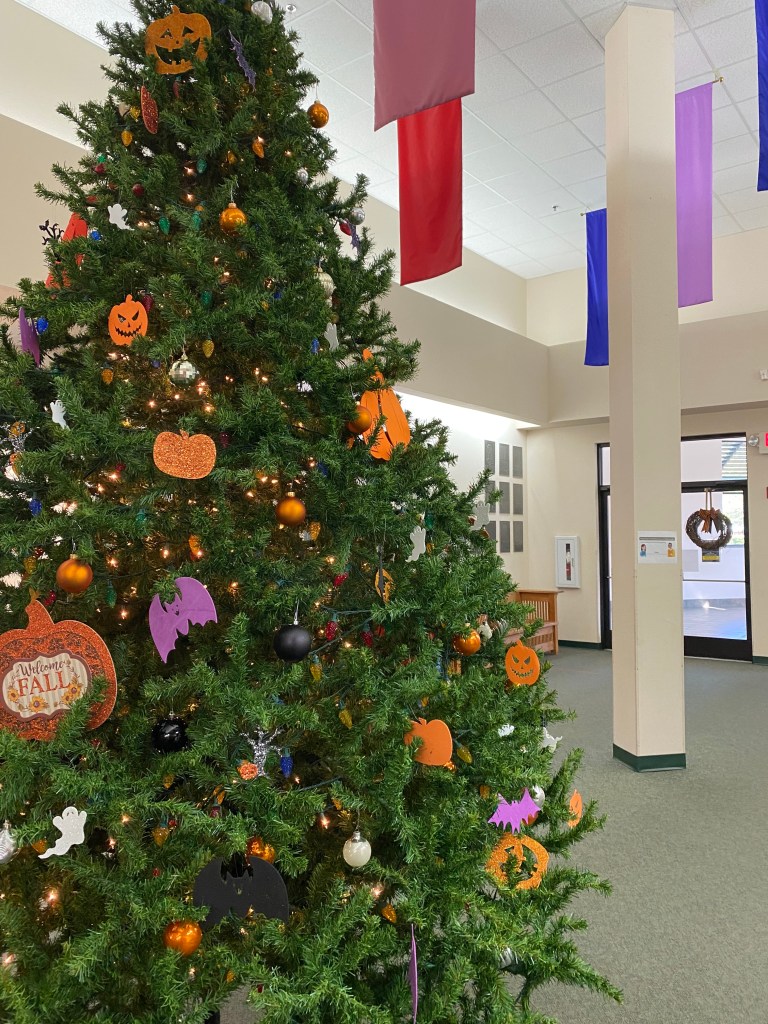
Halloween tree at Kurth Memorial Library, Lufkin, Texas.
I spent the past weekend in and around Lufkin, conducting research and visiting family. I added an extra day to my usual weekend visits to fit everything in, and I still didn’t fit everything in!
Due to the size and complexity of the Pine Curtain Project, I have divided it up into a multi-year roadmap and what I hope are small, manageable chunks. The last time I visited for this work, I focused on some cemetery tours and family oral history. For this trip, I chose two local history centers and narrowed down my research to Old Homer History and the beginnings of a Huntington, Texas history that I am pursuing.
Researching takes a long time, longer than expected and longer than people realize. When I look through archives or do field interviews, I usually have one or two main points I want to explore, but I also have to leave time and “brainspace” for other ideas and topics that I encounter along the way, to either fit them into the narrative or file them away for later. Especially when I am interviewing or consulting someone. This is why you may notice that sometimes my art production goes dark for a few weeks – it is just hard to do everything at once. The past few weeks have been devoted to launching the podcast and preparing for this trip.
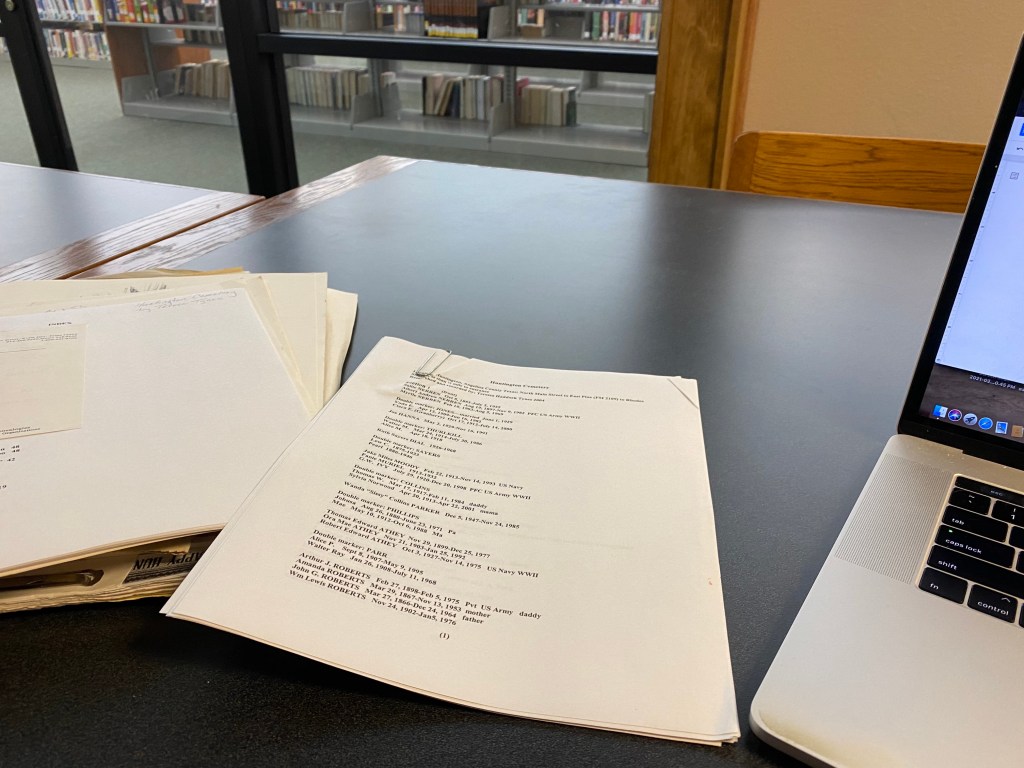
Because the Ora McMullen Genealogy Room hours aren’t compatible with my non-resident schedule, the Kurth Memorial Library team was kind enough to pull stacks of requested materials and set me up in a study room on Friday. I stayed for nearly three hours and only made it halfway through. I spent my time going through three large file folders: One on the historic role of the Masonic Lodge in Homer; one on general Homer history; and one on Huntington, Texas around the 1930s-40s. I have 347 photos from my trip, and most of them are of documents found in these folders, if that tells you anything.
Workspace view and archival documents, Kurth Memorial Library, Lufkin.
Saturday morning, I woke up early and drove out to Huntington, to spend some time talking to Darrell Bryan of the Huntington Genealogical & Historical Society. Darrell is a longtime Homer, Huntington and East Texas historian whose work focuses on armed conflicts, cattle rustling, racism and land disputes. He is also a friend of my father’s, and very nice.
Darrell gave me a tour of the historical society building in Huntington’s Centennial Park, and then spent most of the morning sharing his research finds and opinions; and helping me understand the bigger picture around the incidents I am learning about. I came away with a better idea of the “whys” around the “what happened,” and also new, bigger mysteries to contemplate.
View of Heritage Park from the Huntington Genealogical & Historical Society and Centennial Park, Huntington, TX.
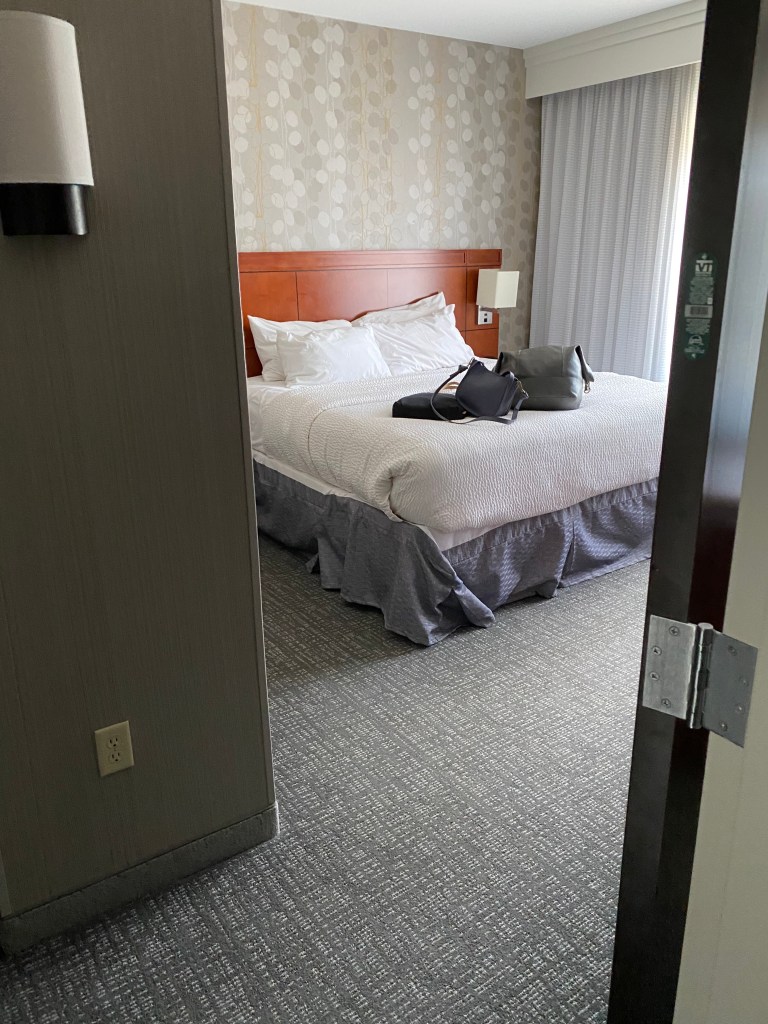
Suite at the Courtyard Marriott in Lufkin.
Since most of my work was in Lufkin proper, I stayed at the Courtyard Marriott. I’m a frequent guest there, and this time they upgraded me to a suite! Score! So, I spent the evenings with lots of space to spread out, organize my notes and snack from the giant bag of gummy candy I bought at Target.
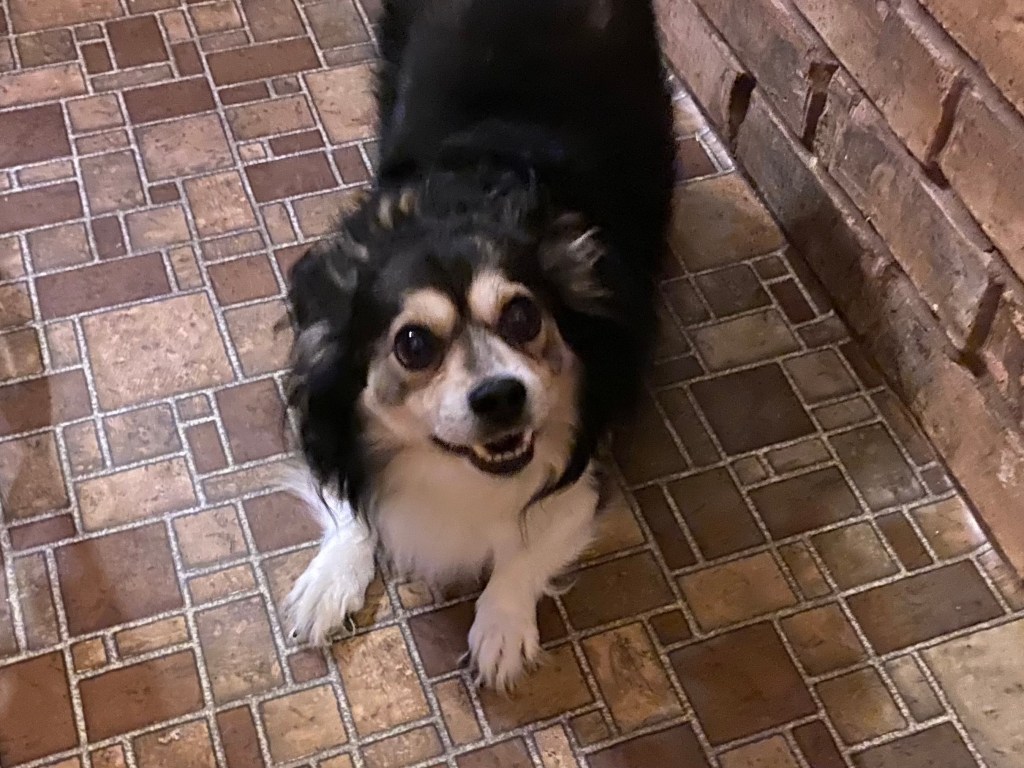
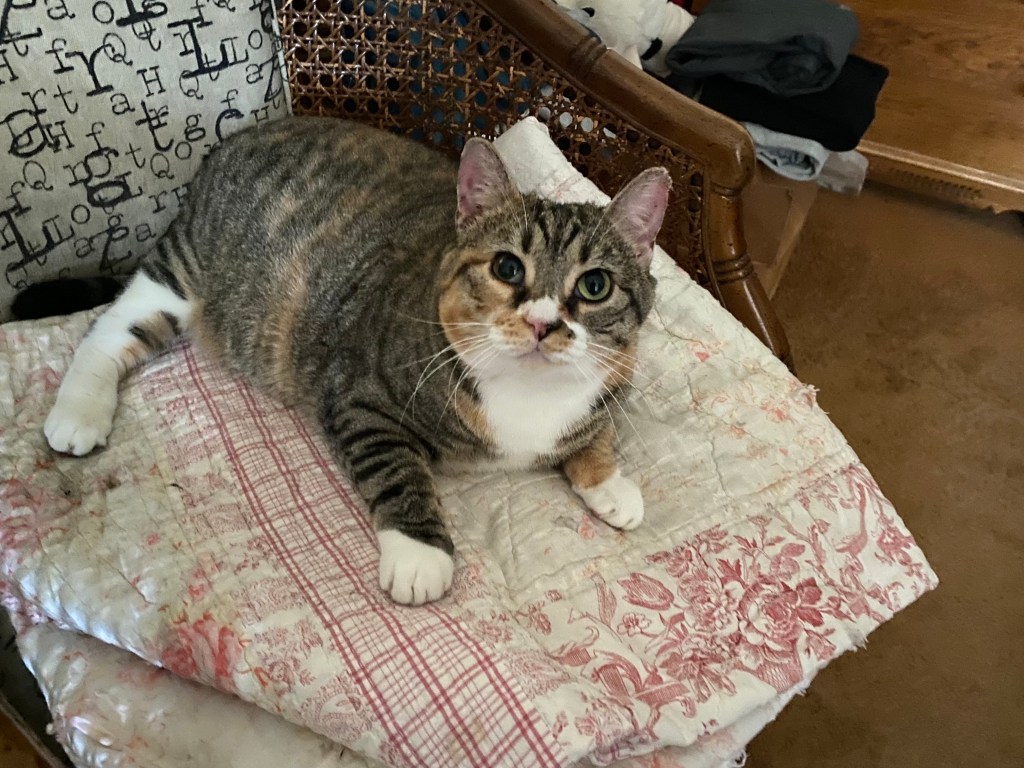
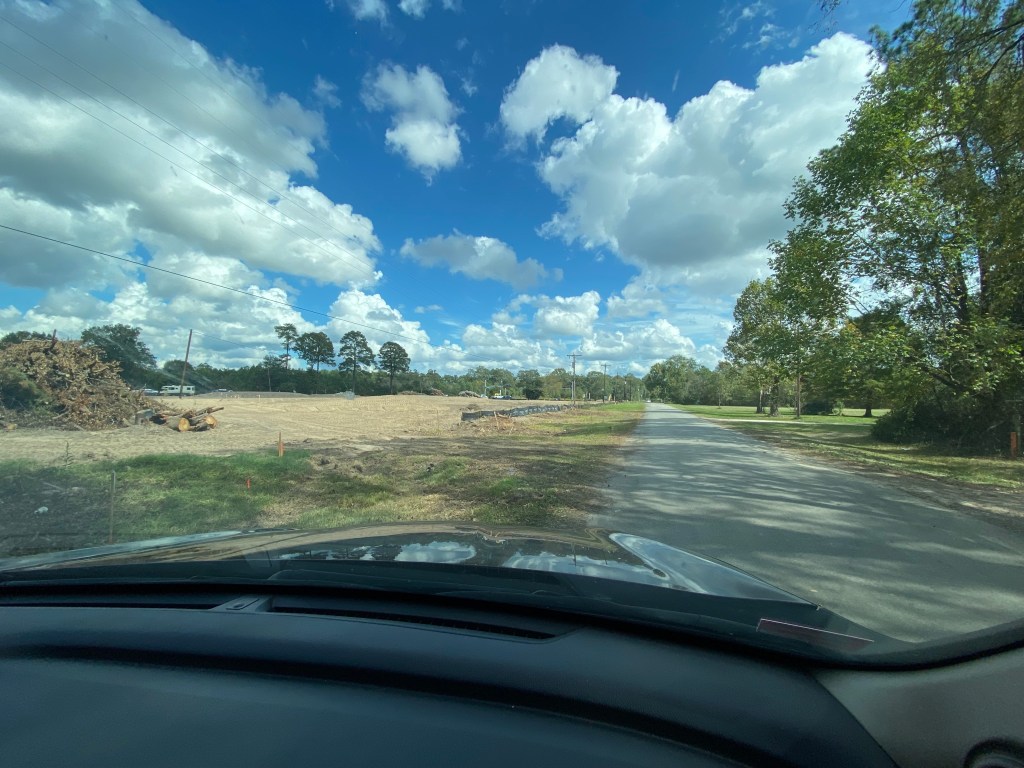
When I wasn’t working or in the hotel, I was at my parents’ house catching up with their animals, and that was pretty cool, too. Less cool is the blighted field across the street from them, that used to have horses, goats, tall grass and trees. Soon, the field will be an all-night gas station and truck stop. An infuriating but important lesson that nothing lasts forever.
Poncho!
Sweet NaNa.
Soon, the construction site here to the left will be an Exxon gas station in Homer. To the right is my grandfather’s front yard. Harder to see – a great big hole at the end of the street to catch groundwater and God knows what else that drains from the site.
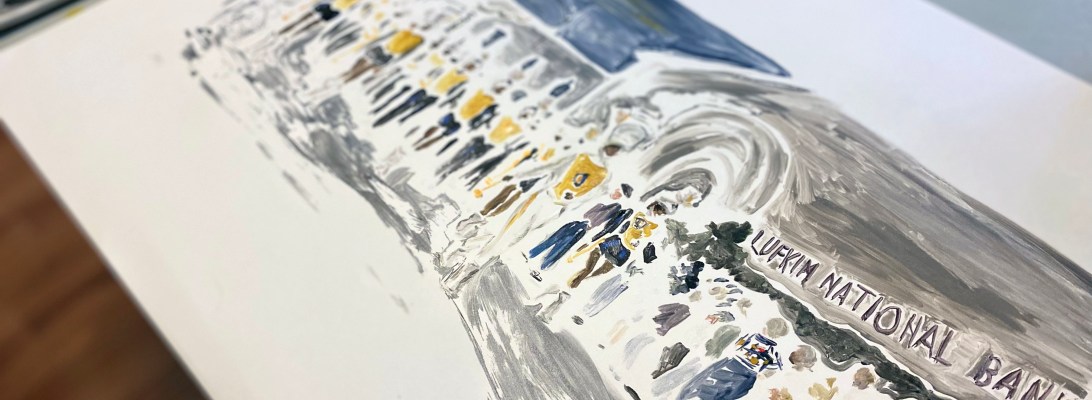
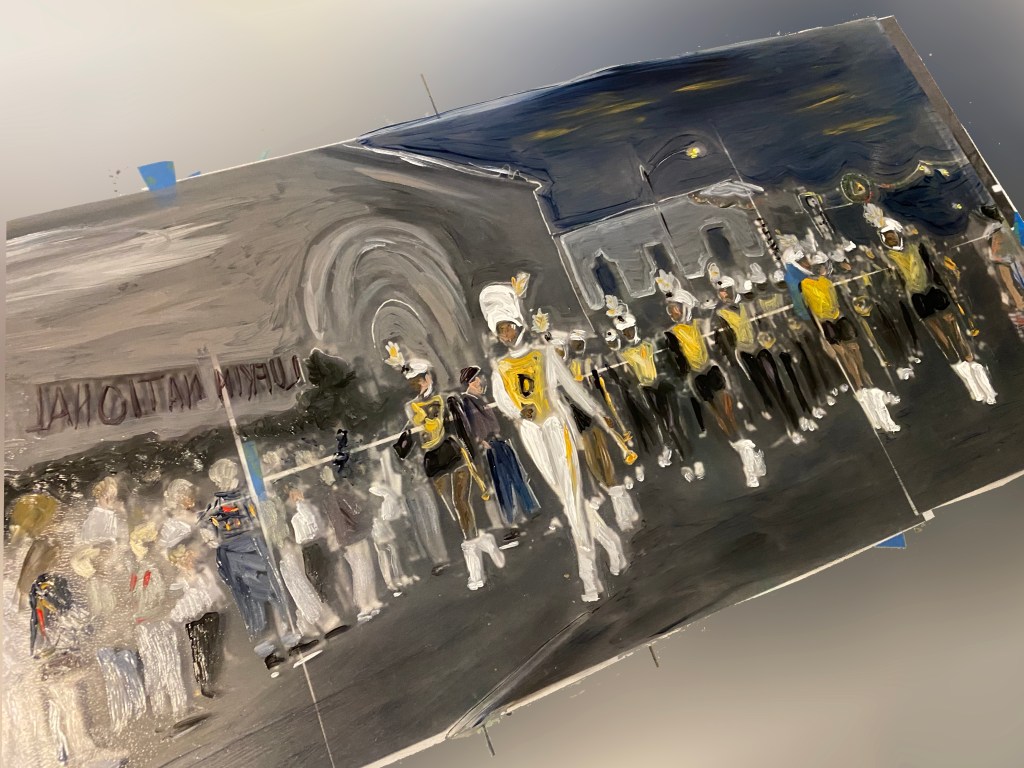
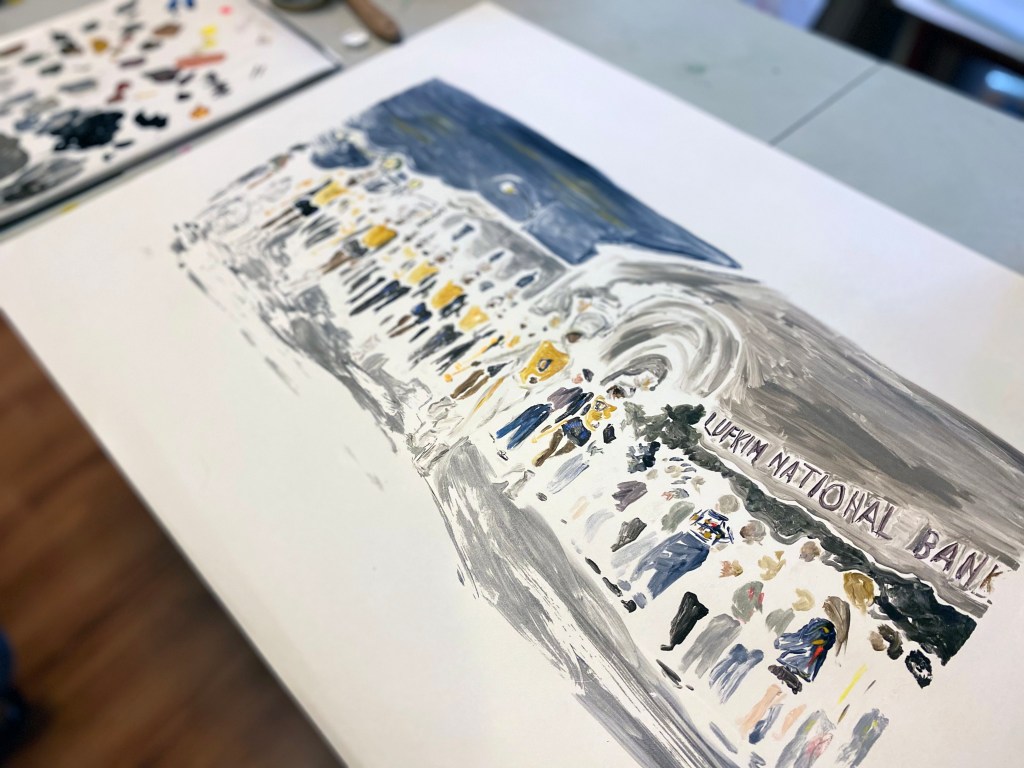
This is another large piece in progress, inspired by a photo from The History Center, of Lufkin Dunbar High School’s marching band performing at a Christmas parade in 1965. So much to like about this photo that I wanted to capture – the uniforms, the mod-looking building behind the crowd. and while it is hard to see here, the Christmas decorations in the background.
This photo was taken in 1965, whenLufkin was still a segregated school district, and Black students attended Lufkin Dunbar High School. The school, named for *poet and writer Paul Laurence Dunbar, was known for excellence in academics, athletics and leadership.
After integration, Dunbar became the district’s middle school, and it now serves as both Dunbar Primary and the Lufkin ISD education center, as well as hosting the Dunbar Hall of Honor.
As with so many other subjects I have researched, this photo was a valuable if much, much belated opportunity to learn more about Dunbar High School and its legacy.
*Note: Paul Laurence Dunbar’s 1899 poem Sympathy inspired the title of Maya Angelou’s bookI Know Why the Caged Bird Sings!
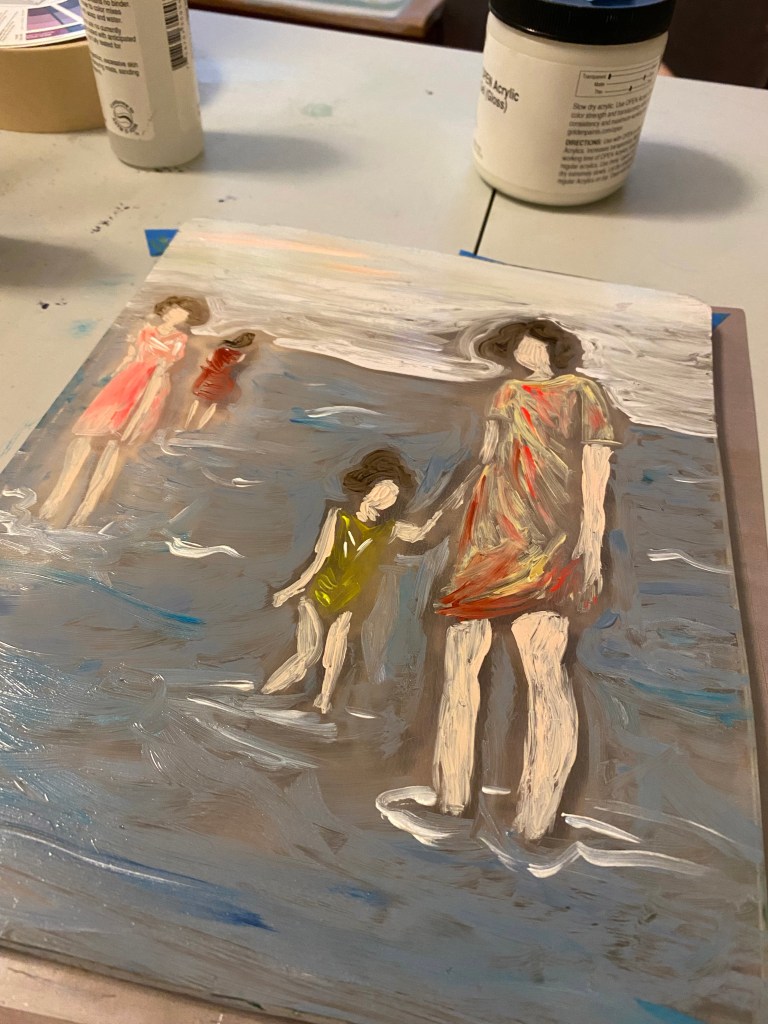
“Waves,” by Stephanie Khattak, Acrylic Monotype on paper, 12X16.
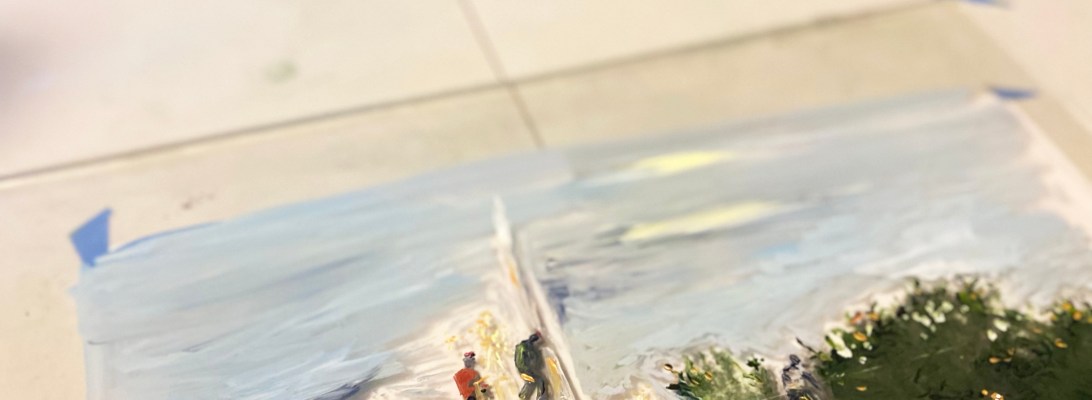
This piece was taken from a vintage photo of my great-aunts and one of their daughters playing at the beach in the early 40s. The young woman to the far left, in the pink dress died of appendicitis in 1944 at age 18, which is probably not too long after the photo was taken. Our family has always been close to our “aunties” and this one has been a bit of a mystery to us. Her sisters had “flower” names, Myrtle, Lila, Viola, Lucille Lilly…her name was Letha, perhaps after the town of Oletha where her father was born. Very few photos of her exist, and this is the only one I have seen, shared with me by my cousin. But this is a great one, capturing what I imagine was a nice day at the beach with her sisters and little niece.
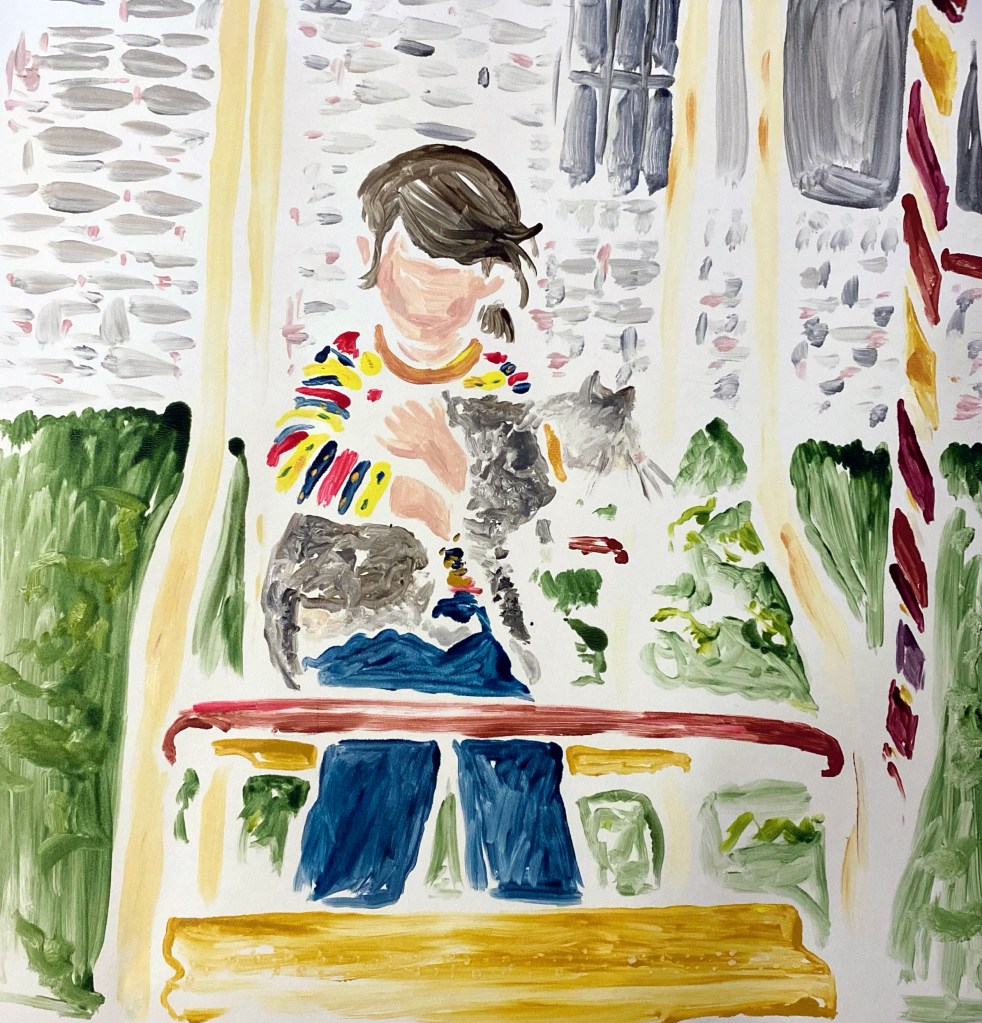
If you have been connected with me for any amount of time, you know I am a cat lady. Here is the kitty that started it all, Baby Kitty in my arms, in this print based off of a 1979 photo. Baby Kitty was a gray striped tabby who lived in the barn between my house and my great-grandmother’s house. I don’t remember her being an inside cat, but she was always around and a really good sport while I learned to love animals. Baby Kitty was a beloved member of our family, to be cherished and pampered as such. As has been the case with every cat, dog (and in my cousins’ cases – horse, snake, parakeet and Galapagos turtle) since then.
My grandmother’s cousin was a career flight attendant. She worked for Braniff International in the swinging sixties, among other notable things, and retired from American Airlines in the mid-nineties after a long and interesting career. Now she lives across town from me with a designer cat and a bunch of friends who are (almost) as fabulous as she is.
Here she is with her mother in their yard. I would estimate the year as somewhere in the late 50s. This was definitely not a Braniff outfit, so I’m guessing it was early in her career. All of her Braniff photos are at her house, and I’m sure she will share them when I pester her about it enough.














 stephaniekhattak.com