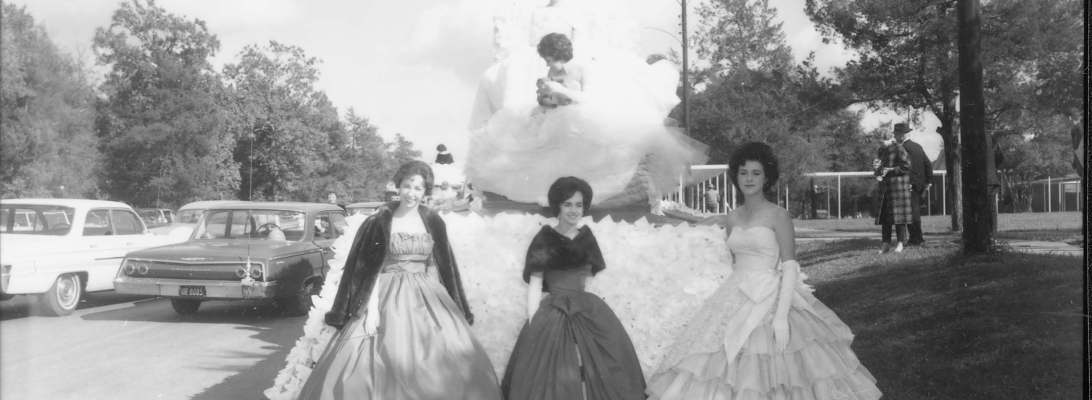
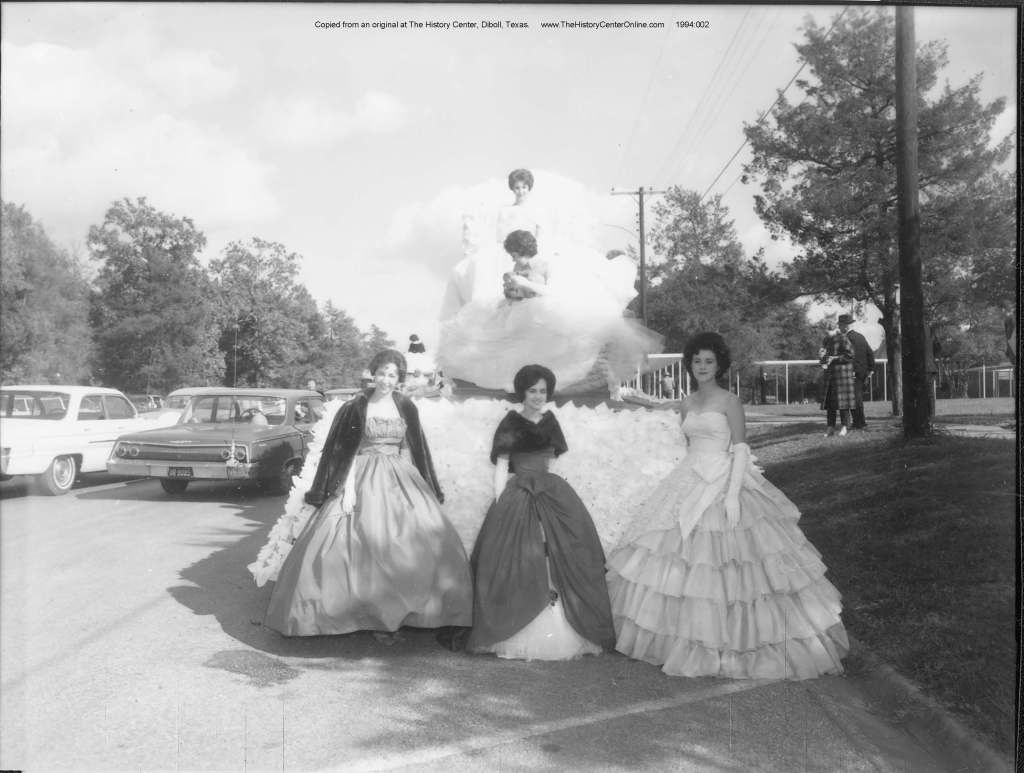
Pineywoods Royalty, 1962

1962 Diboll Day Queen and Court at Forest Festival Parade” via TheHistoryCenterOnline.com

This photo is from the digital archives of The History Center in Diboll. It shows a group of young women in formal dresses, representing their town on Diboll Day at 1962 Texas Forest Festival.

In the Pine Curtain, it makes sense that the annual civic event is a Forest Festival. Since 1938, East Texas forest region communities have gathered for a weekend of special exhibitions and demonstrations, carnival rides, youth team performances, and since 1985, the famous Hushpuppy Olympics Cookoffs!

“The event is no longer the ‘Olympics.’ Lufkin had its hands slapped several years ago when the real Olympics said it owned the trademark to the name. So now it’s the Hushpuppy Cookoffs.”
– Bob Bowman, Texas Escapes

The Texas Forest Festival is such a big deal for East Texas, that at one time, it even had its own commemorative publication! I love the ads in this one from 1948:


(Fun Fact: My mom’s church group won a prize in an early Hushpuppy Cookoff, dressed not in beautiful evening gowns, but homemade costumes as skunks, deer, squirrels and of course, big green net pine trees, complete with real embedded pine cones. They did a little rap and even made the local TV news! I was 12 and as you can imagine, very excited about this. *cue pre-teen eye roll*)


As of now, the 2021 Forest Festival is still scheduled for September! Our East Texas neighbor, Nacogdoches, hosts the also impressive annual Pineywoods Fair, planned for October. So, if you like to celebrate the mighty pine tree, Fall in East Texas is your time to shine.


As I am more of an artist and less of an academic historian, please explore these links for citations and further reading:

Lead Image Citation: The 1962 Diboll Day Queen and Court prepare to ride on a float in that year’s Forest Festival Parade through downtown Lufkin. TheHistoryCenterOnline.com.

Vintage Forest Festival Program collection, Angelina County Chamber of Commerce Publications collection, The History Center.

Bob Bowman, “Hushpuppies,” Texas Escapes.
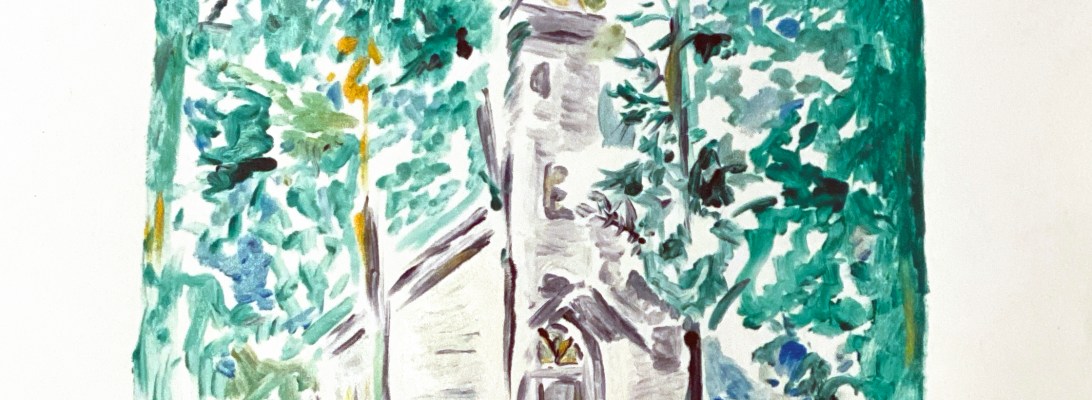
East Texas Historic Church

Image of historic church and old cars in the pine trees of Nacogdoches Texas.
“Church of the Divine Infant, Cotton Ford Road, Nacogdoches, Nacogdoches County, TX”

This image caught my attention as I was surfing around the Library of Congress digital archives this week. I loved the trees and the juxtaposition of the old cars against the even older church. The cars are from the early 1930s, and the church was built in 1847.

When I researched some additional history on the church, I found an interesting story. Built in 1847, the structure predates the Civil War, has been a cornerstone of Catholicism in East Texas, and was relocated several times before becoming part of the Sacred Heart church campus in Nacogdoches.

The book “Historic Nacogdoches,” which can be accessed for free on Project Gutenberg, has this to say about it:

“Mission Nuestra Senora de Guadalupe was founded at the same time on the west side of North street in Nacogdoches, overlooking Banito creek, which was called “the creek of the mission.” This mission was never permanently abandoned until it was replaced by the church which stood on the little plaza in front of the present court house, built in 1802. The third Catholic church was formerly the home of Nathaniel Norris at the northwest corner of Hospital and North streets. The fourth church was the Sacred Heart church on Pecan street, built in 1847 under the influence of Bishop J. N. Odin; which was in turn replaced by the present Sacred Heart church, built in 1937 on a portion of the homestead of Judge Charles S. Taylor on North street, the house of the old Sacred Heart church being rebuilt about eight miles south of Nacogdoches as the Fern Lake church. The sites of the presidio and missions have been appropriately marked by the State of Texas.”

As I am more of an artist and less of an academic historian, please explore these links for citations and further reading:

Spanish Missions in Texas,” Texas Almanac

Nacogdoches, Texas,” Texas State Historical Association

Image Citation: Historic American Buildings Survey, C. (1933) Church of the Divine Infant, Cotton Ford Road, Nacogdoches, Nacogdoches County, TX. Nacogdoches County Texas, 1933. Documentation Compiled After. [Photograph] Retrieved from the Library of Congress.

Baseball Season

“Donna at the Bat, 1960s.” Acrylic Monotype Print by Stephanie Khattak.

Spring means outdoor fun, and in the East Texas country, many of us were lucky enough to have playing field-sized yards or adjacent lots to play in. We could enjoy badminton, t-ball, dodge ball and many other games with whoever was around, using whatever equipment we could scratch up and throw at each other, inevitably making our own rules. This is a photo of my cousin in the 1960s, giving it all she’s got in a baseball game in the pine trees.

This community sportsmanship came to a halt in my generation after a bloody Red Rover, Red Rover battle in the church parking lot. But it was fun while it lasted.

East Texas Mule Skidder

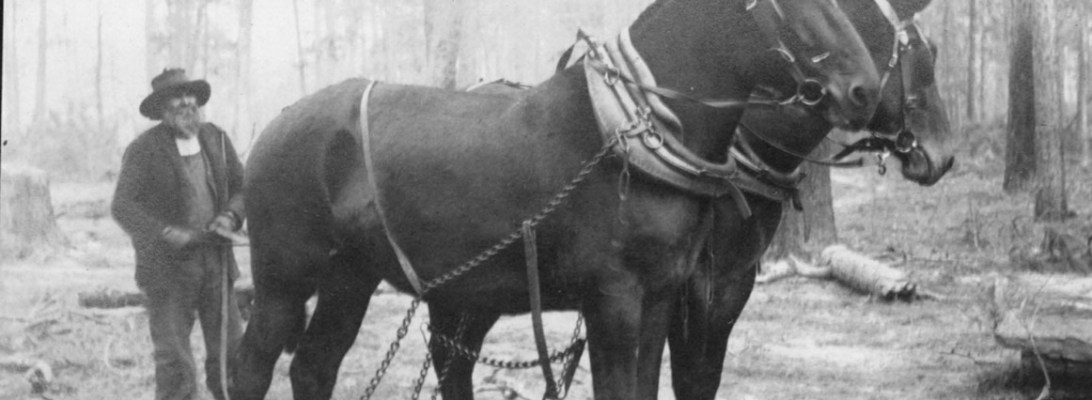
vintage photo of logger with two mule team

This week, I am returning to archive photos from the Diboll History Center. This is just one comprehensive source that I use, and it does a great job organizing its images into historical sets, so it is easy find images from the same era, activity or theme and put them together to document and build larger stories.

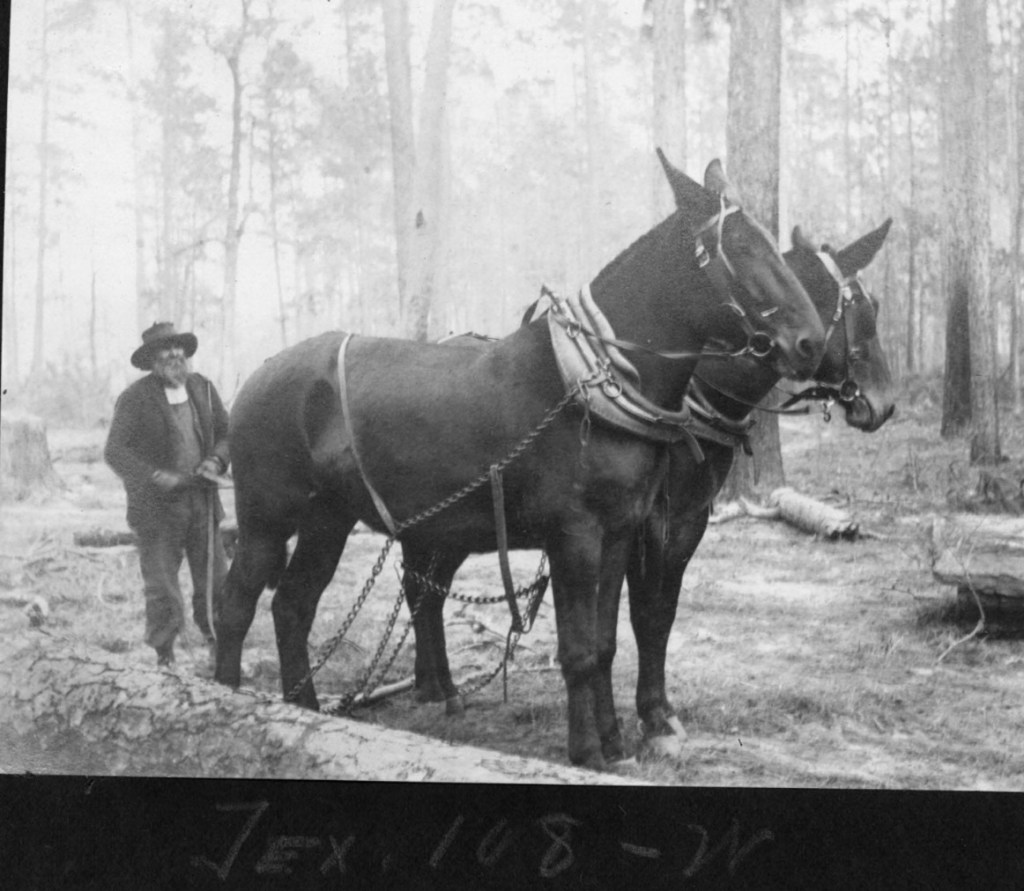
This image is “Two Mule Skidders and a Man,” from the Southern Pine Lumber Company, in 1903. The last time I worked from a vintage photo of East Texas loggers, it was a team from the 1930s, if that tells you how long this area has been working with timber.

These photographs at the History Center were part of a larger project by American Lumberman, a weekly trade journal established in 1899.

“The American Lumberman photographs of the Southern Pine Lumber Company consist of 255 gelatin silver prints made by American Lumberman photographers during visits to Diboll in 1903 and 1907. They document the lumber company’s management, logging operations, Texas South-Eastern Railroad, timber, lumber camps, sawmills, commissary, and social life. The photographs provide insight into the early twentieth-century community life of a Texas sawmill company town and connected logging camps.” – American Lumberman Photographs of Southern Pine Lumber Company in The Portal to Texas History. University of North Texas Libraries.

I didn’t know what a “mule skidder” was until today, and when I Googled it, images came up for heavy machinery, not animals. But back when the animal was the machinery, a driver would position the cart over felled logs, where dangling tongs would then raise the end of the log off the ground. The mule, oxen or horse team pulled the tong forward, allowing the log to “skid” along between the rolling wheels.

The photo caption notes that the actual skidder is not shown here, so it looks like the guys in this photo were suiting up for a hard day’s work. Or maybe resting between tasks. Either way, all three were in the middle of a very important job.

Lucy Ann

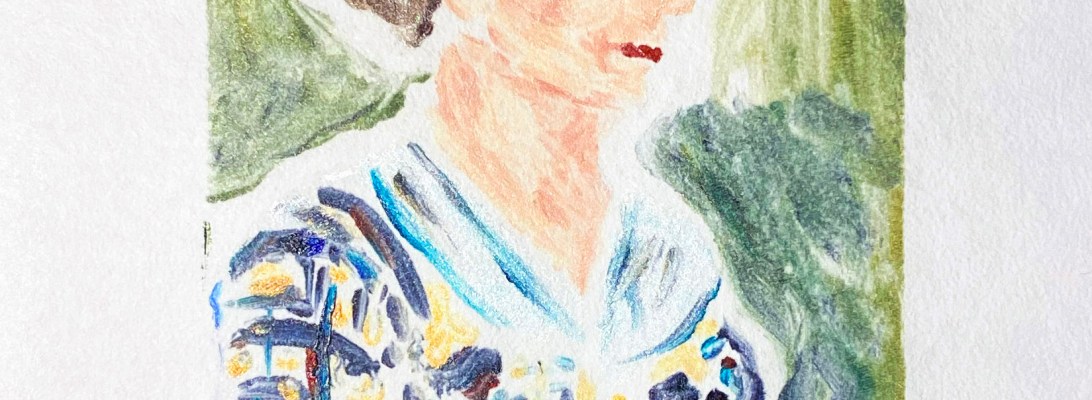
“Lucy Ann,” Acrylic Monotype by Stephanie Khattak.

This portrait is of Lucy Ann, my great-great-great aunt, who lived between 1866 and 1958 in Huntington, Texas.

Portraits are a bit of a challenge for me, because faces are big enough to not look right left “blank,” but the print process makes it tricky to get the details right and still maintain the abstract look that I am going for. I am happy with the way this one turned out.

The Huntington McBryde Kids

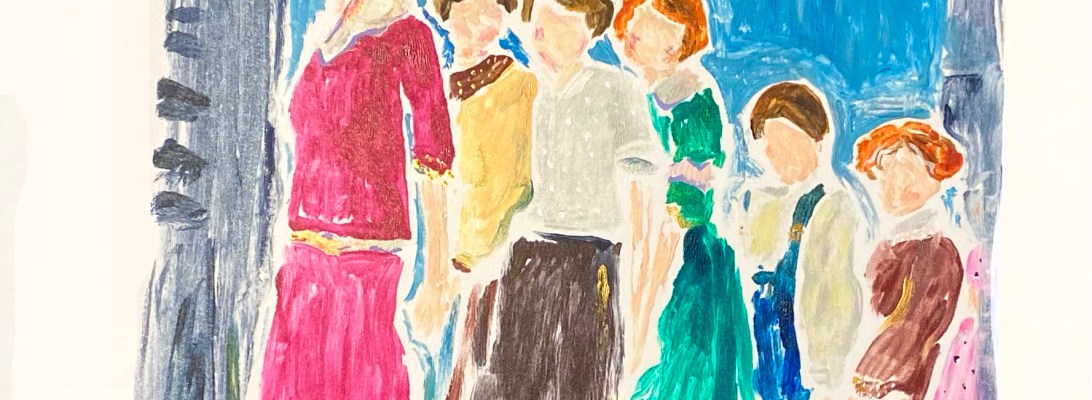
“McBrydes and Porter Kids.” Acrylic monotype by Stephanie Khattak.

This is a family photo of my great-grandmother (in green), her siblings and her cousins. The little boy in the overalls, my great-great uncle Sherman, grew up to be a WW2 soldier killed in action in Sicily. I imagine growing up with so many sisters and girl cousins made him pretty tough and a great mediator.

Portraits on Silk

“Beatrice,” acrylic and pigment on silk over vintage photo, by Stephanie Khattak.

This is my great-grandmother on my mom’s paternal side. She passed in February 1978, before I was two years old, so she knew me, but I didn’t really know her. My mom says that they would bring her to my grandparents’ house to spend time with me, and that she really enjoyed that. I like to believe that I enjoyed our short time together, too.

East Texas Loggers, 1930s

“Logging Team with HorsePower Engines,” by Stephanie Khattak. Acrylic monotype print. 20X26 on paper.

The early prosperity of East Texas started with trees, and the region had (and still has) plenty of those. There’s a reason I named my work “The Pine Curtain Project.” The part of East Texas where I am from is dense with pines – The Piney Woods. It is so much a part of the region’s identity that even today, the local university’s mascot is a Lumberjack, a popular local coffee shop is Java Jack’s, the best-known festival is the Forest Festival and the main drag in Lufkin is Timberland Drive. At the same time, the density of trees can either isolate or protect, depending on how you look at it. Like…a curtain. I imagine this “curtain effect” was even stronger before the timber industry moved in, cleared away and changed the physical, sociological and cultural landscape.

This image makes me think of the beginning of the end of an era, which I feel evolved over generations. It was a double-edged sword, or saw if you want a more thematically accurate metaphor. On one hand, clearing the trees made way for unprecedented economic and civic progress. On the other hand, once the curtain was pulled back, things would never be the same.


As I am more of an artist and less of an academic historian, please explore these links for citations and further reading:

Image Source: “Paul Durham, Sr. Hardwood Logging Crew,” The History Center.

The Texas Forestry Museum

Aldridge Sawmill“, Texas Beyond History.com