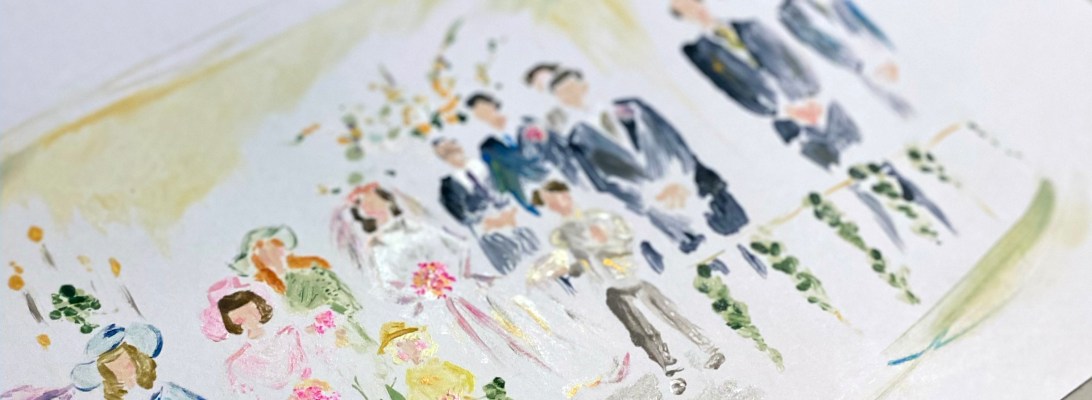
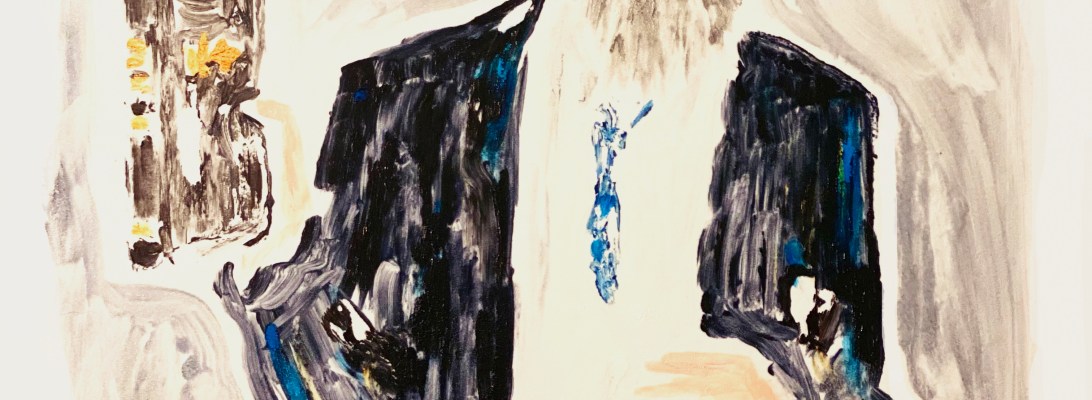
Detail Shot, “The Anniversary” by Stephanie Khattak.
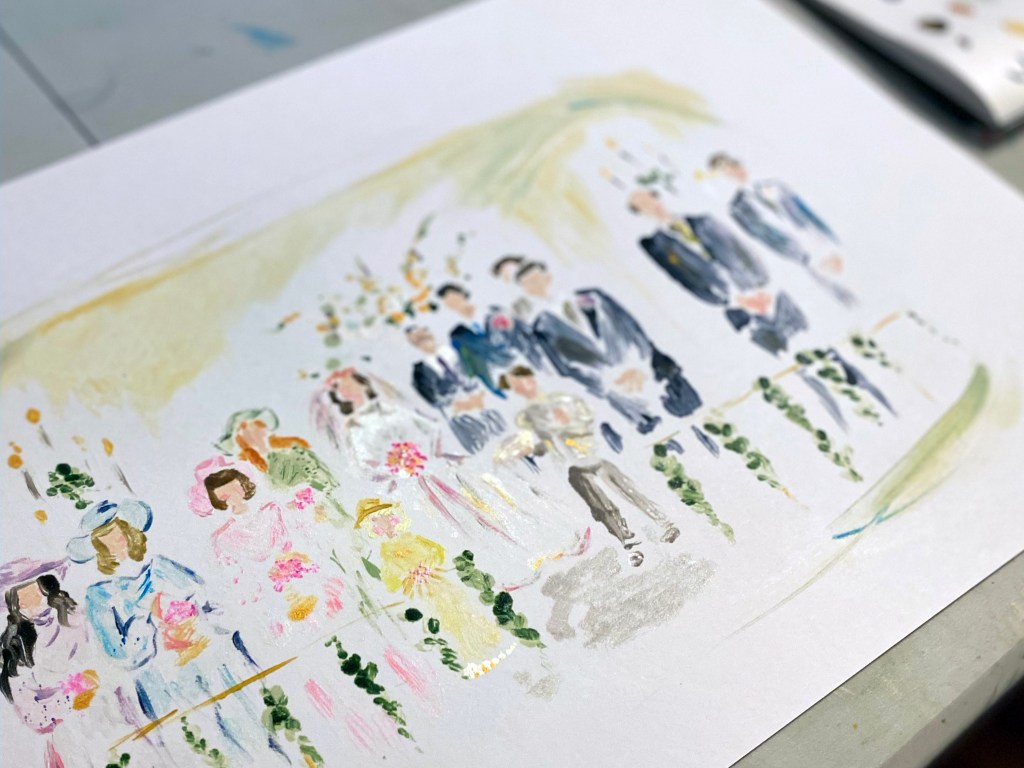
“The Anniversary” by Stephanie Khattak.
My parents had the most seventies wedding ever. White shoes on the men, sherbet-toned bridesmaid dresses for the ladies, complete with floppy hats and flower baskets instead of bouquets. But it worked for this East Texas wedding portrait in 1973 and in some festival/Midsommar aesthetic circles it still works today. They got married roughly a month after my mom graduated high school, which was common for the time. I came along three years later. They’re still together, their health has been good. They lead quiet lives in a nice home with a bunch of cats and a dog so spoiled we’ve taken to calling him Little Lord Poncho. It hasn’t been perfect because what is? But they got their happily ever after.
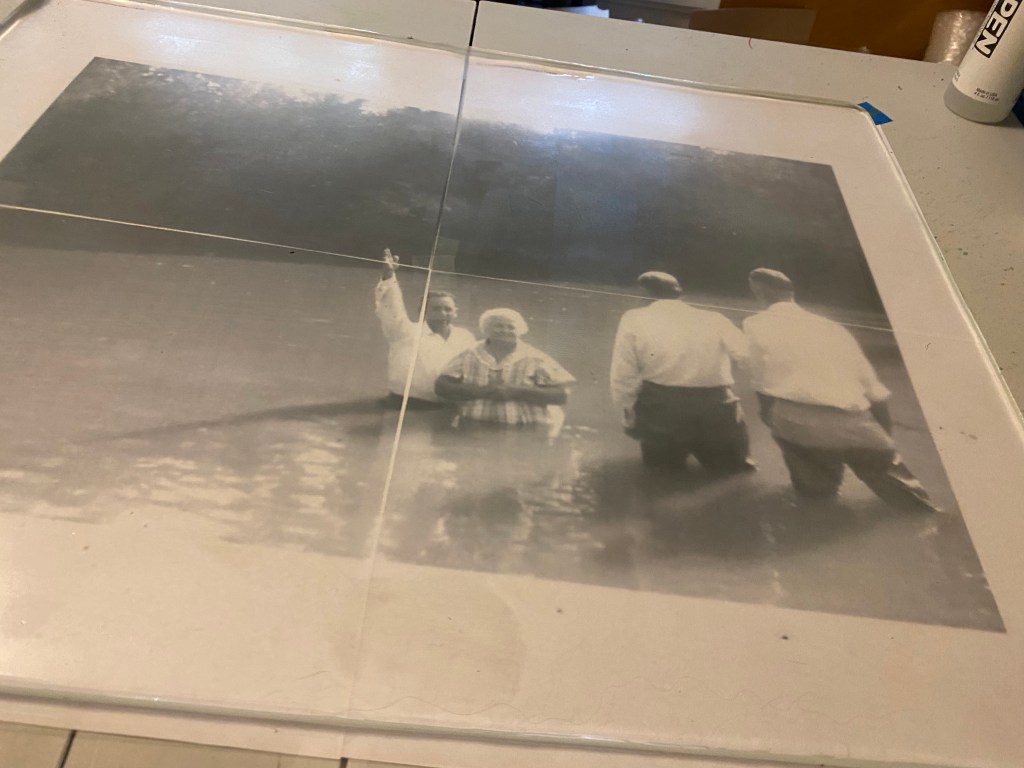
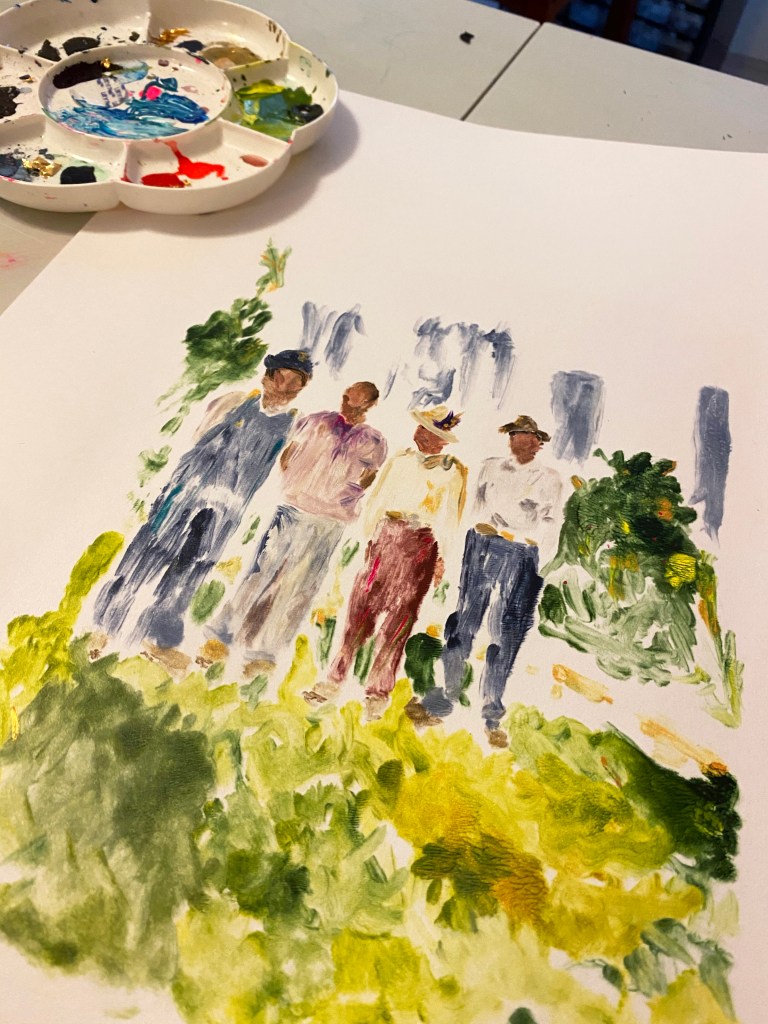
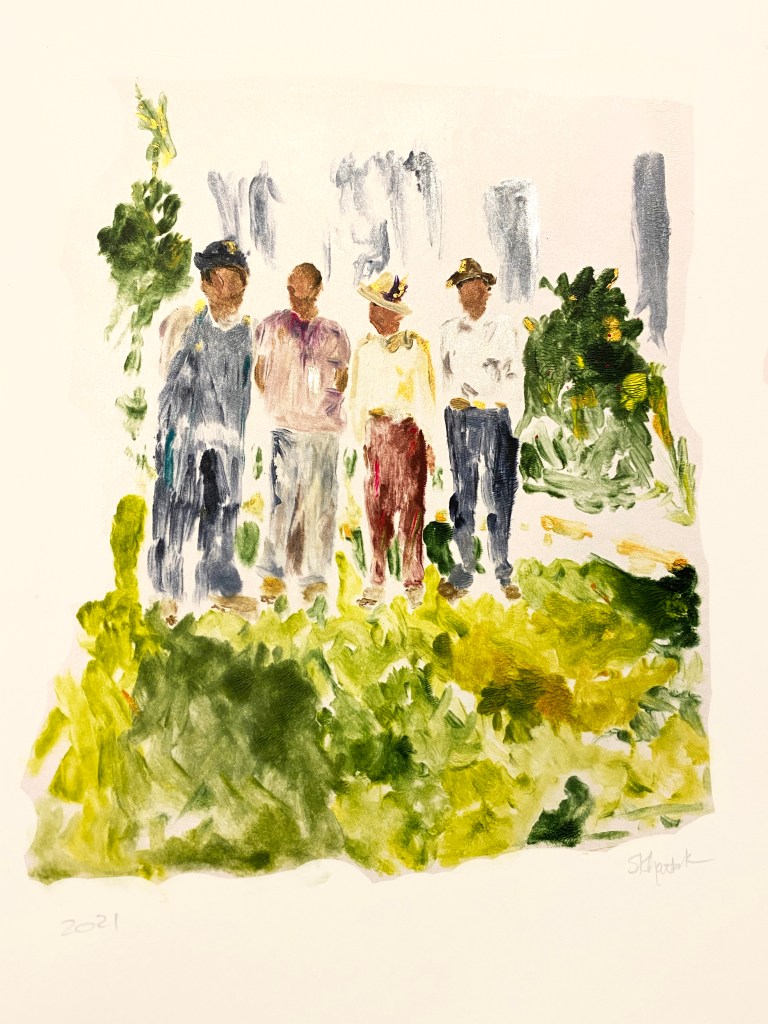
I’ve started working on larger monotype prints, which is fun. It takes a little bit of problem solving, since I don’t have a large format printer and wouldn’t want to spend money to have something printed professionally that’s just going to be a reference piece. So, in order to get the photo large enough, I open Adobe Acrobat and print as a poster, which enlarges across multiple sheets of paper. I put them together sort of like a puzzle under my large plate (or plates if the finished product will be larger than 16X20.) It is a little extra work, but I love how these look at a larger scale when I can bring out more of the entire scene.
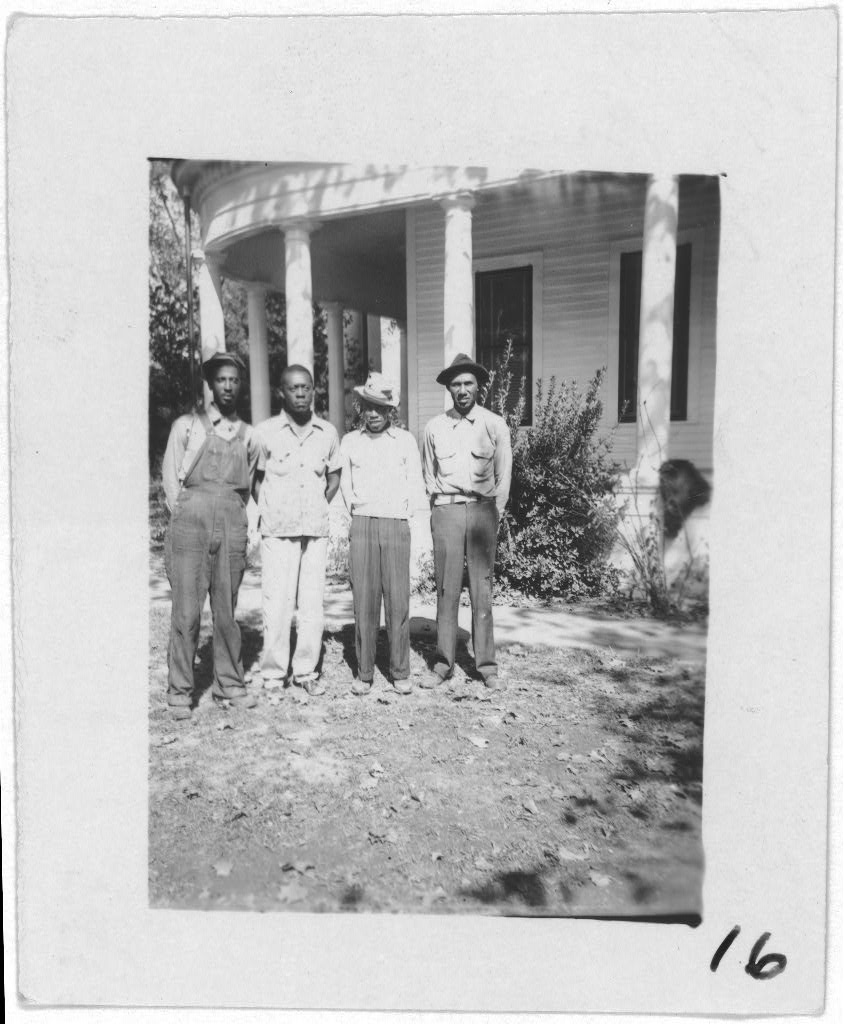
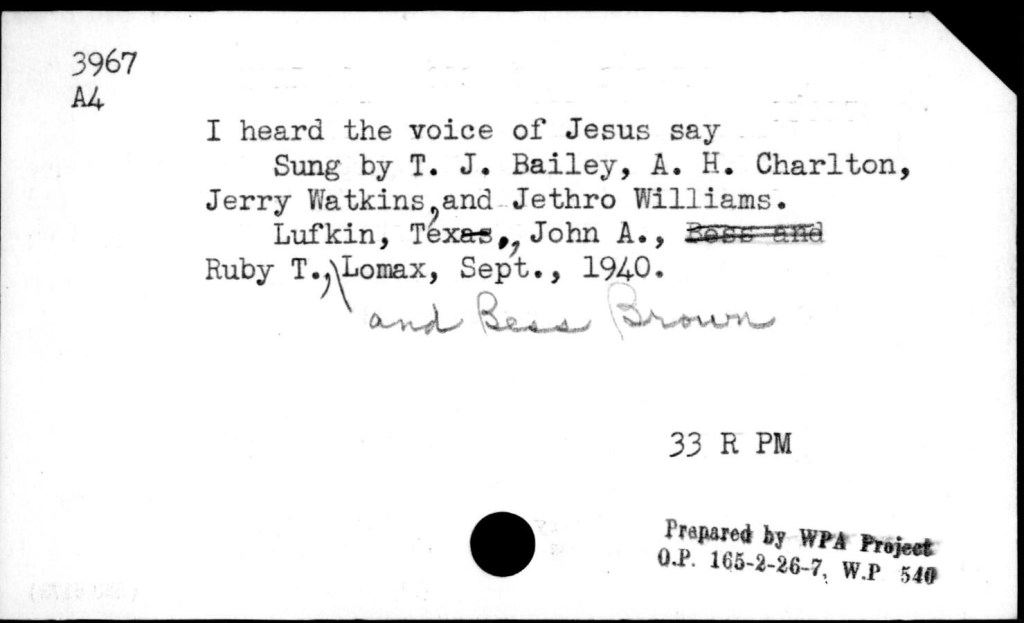
The Angelina Four at Kelty’s Lumber Co., Lufkin, Texas, 1940 Ruby Lomax, Library of Congress. Alphonso “A.H.” Charlton; Tom “T.J.” Bailey; Jerry Watkins, and Jethro “Jabbo” Williams.
I’ve mentioned these guys before when writing about the work of John Avery and Ruby Lomax, but thought that they needed their own spotlight.
The Angelina Four was a quartet of men who were employed by the Angelina County Lumber Company in Keltys, a community outside of Lufkin. The East Texas musicians recorded 15 pieces, a “singing commercial” – Angelina Longleaf Pine, – and 14 songs that included popular, gospel and spiritual music with rich harmonies.
Notes from Lufkin Recordings. American Folklife Center, Library of Congress.
Please explore these links forcitationsand further reading:
Lomax, J. A., Lomax, R. T., Bailey, T. J., Charlton, A. H., Watkins, J. & Williams, J. (1940) Angelina Longleaf Pine. Lufkin, Texas.
*Some of these sources document outdated and now-unacceptable language, policies and ideas around race. Like the authors of these academic works, I do not condone or wish to ignore potential negative impact by reporting or linking to them. In writing about history, I often must weigh the benefit of sharing the “entire picture” against the potential harm in doing so. In this case, I felt that it was important to tell the whole story of the Angelina Four, understanding that the entirety of their lived experiences likely contributed to their creative work and place in history.
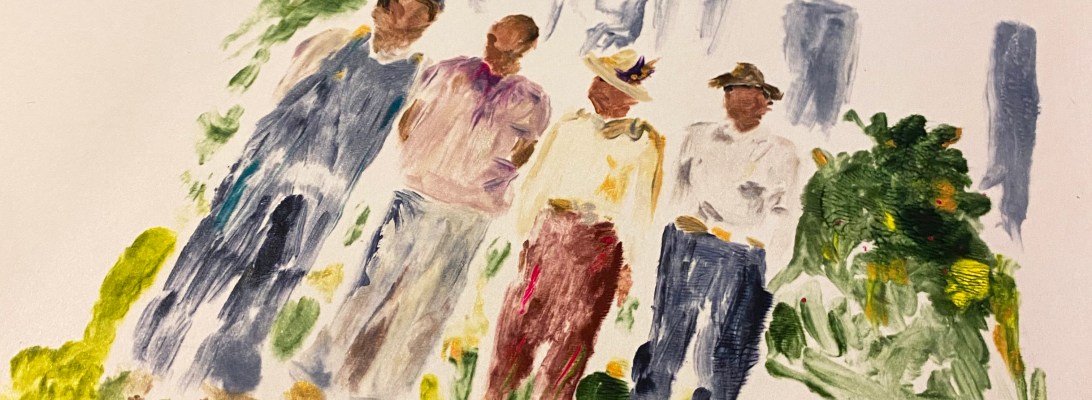
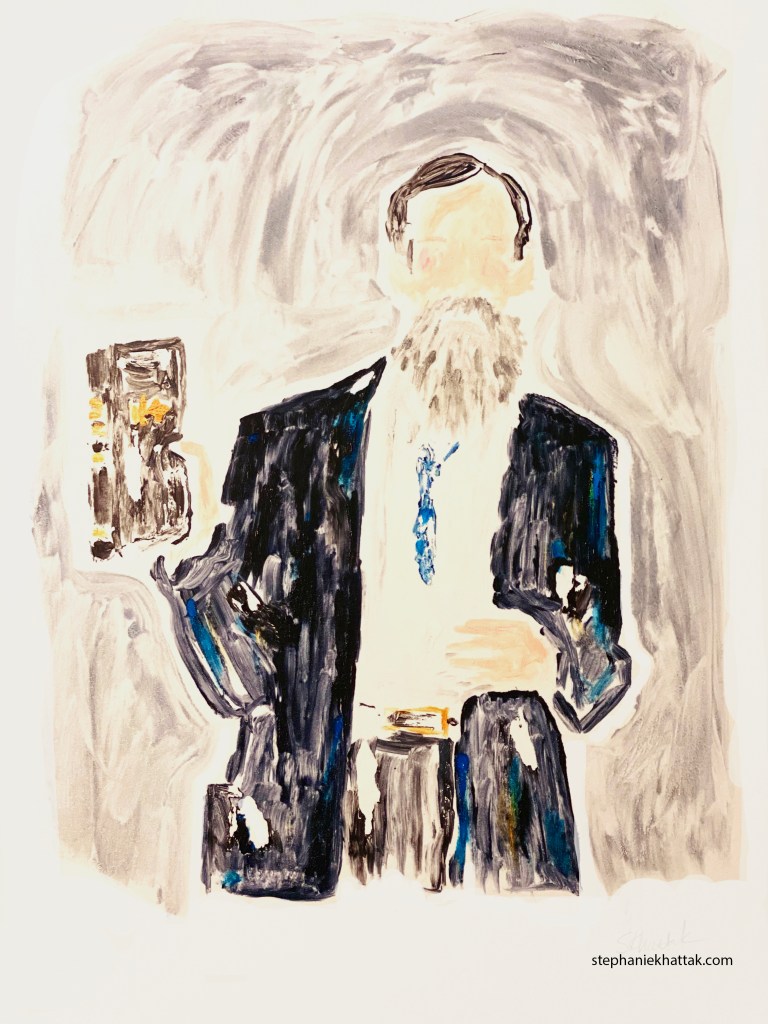
“The Reverend.” 12 X 18 on paper. Acrylic monotype by Stephanie Khattak.
This monotype print is taken from a photo of my grandfather’s grandfather, the patriarch and a preacher in Deep East Texas. He had 24 children with two (consecutive) wives, and when he passed in 1940, he had a three-day funeral. I asked my father about this man’s story, because he was the first that I know of to preach “independently” in my family. I was told that after many years of preaching in one of the main denominations, Rev. Durham became dissatisfied with it. According to my dad, he then “sat under a tree and fasted for three days.” When his fast was complete, he had decided to break from that denomination and form his own East Texas church, which remains today in one of the area’s outlying communities. One-hundred years later, it is still maintained as a church and community center by his descendants, many of whom who are still active in the area as preachers and musicians.
This is the earliest preacher I can identify in this family line, and the religion he preached is hard to categorize. A bit evangelical – one of his sons claimed to walk on water and did, until local pranksters dismantled the underwater ramp he used in his demonstrations. At the same time, this side of the family has a very accepting philosophy of life and a “live and let live” attitude towards others. Music is central to the ministry, and I understand that sermons could go on and on and on…
While he was building his legacy as preacher, his brothers and nephews were busy feuding and fighting all over East Texas. I have found three feuds so far, two of them deadly, and I am sure there are more. I have a lot of thoughts about that, but it’s another post for another day.
Bluebonnet Field in the Huntington Cemetery, Huntington, Texas.
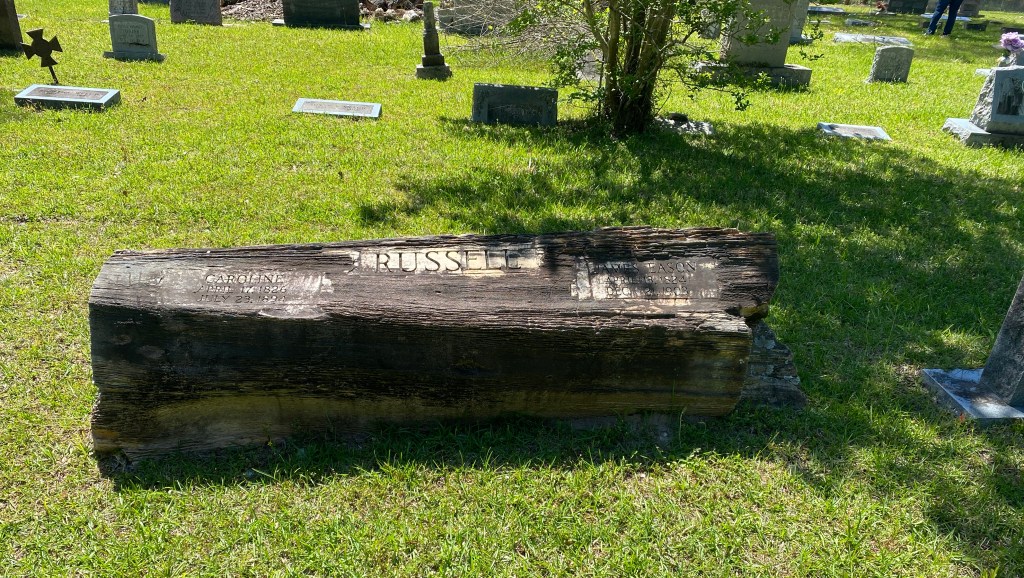
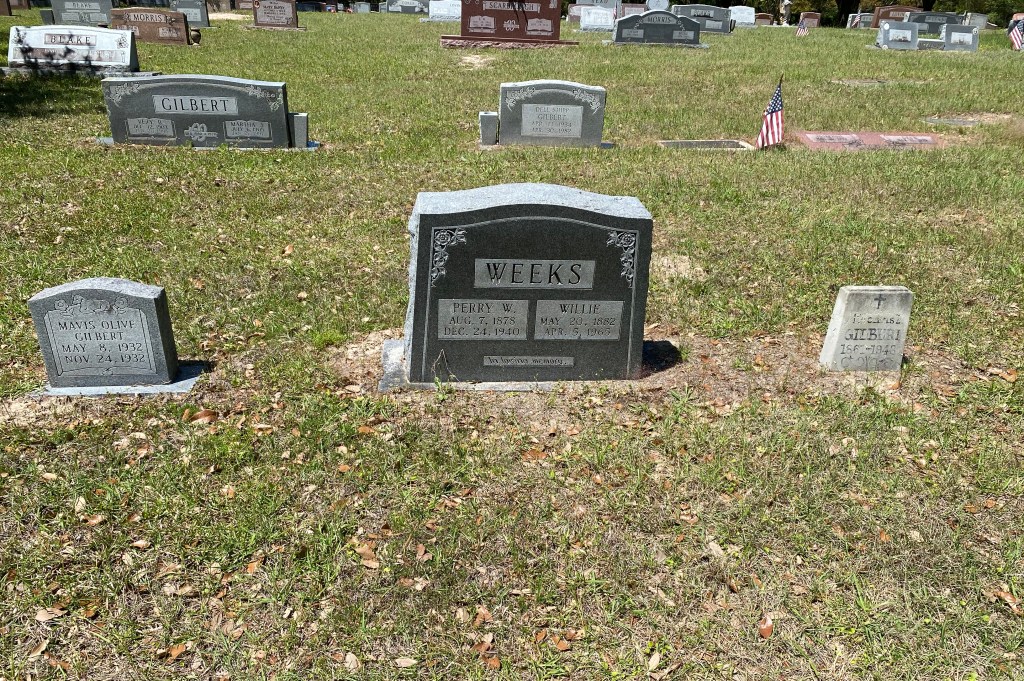
While most of my immediate family have been laid to rest in one cemetery, my home community has many, many others, which hold not only my long-ago ancestors but also those of my friends and neighbors. Growing up, cemeteries were a part of life and close to home. A place to go and feel closer to past loved ones, to tend to their grave sites and spend a peaceful moment. There was nothing scary about cemeteries, and aside from the occasional spook-tacular fall hayride, they weren’t particularly amusing, either. They were just there. They were places of reverence, peace and community touchstones. I’m not even one for zombies or skeleton imagery. Even at Halloween, I prefer to decorate with things like black cats or silly monsters. There are a few reasons for this, but it’s mostly from being a realist. Because no one knows what our souls are capable of, but our bodies are where they are going to be. Once they’re interred, they’ll never sit on a bench, chase a teenager or hug a pumpkin again. (Sad, but true!)
Texas has many historic cemeteries, defined as “any cemetery 50 years or older that landmarks the presence of a family or community.” In my family story, I can think of at least eight, and I am sure there are more. The largest and most modern one is still in use, but we still visit and maintain the ones in the outlying areas, too. In many cases, the cemeteries are all that’s left of those communities. Some are named after the places they commemorate (such as Homer, Huntington, Rocky Hill) and some are named for families (Renfro, Durham.) The Texas Historical Commission is a great resource for learning more about and preserving these places in the state, and Saving Places from the National Trust for Historic Preservation has valuable information, too.
And there’s nothing morbid about researching, studying, or visiting them. These cemeteries and their place in my community have been very helpful in my creative genealogy projects and interest in Texas history.
Before I committed to an ancestry.com membership, I did a lot of research through Find a Grave, an online ancestry records search tool that is free and quite useful for genealogists, historians and family history search. Not only does it deliver results for names and locations of current and historic graves, it also publishes obituaries, along with names that the original record might be linked to. Here’s my grandmother’s record as an example. Lots of info, although she’d be incensed that a photo linked to her good name had an overturned plant in it. Who knows when this photo was taken or who the photographer is, but I feel like I should drive home immediately and check to make sure that plant has been fixed.
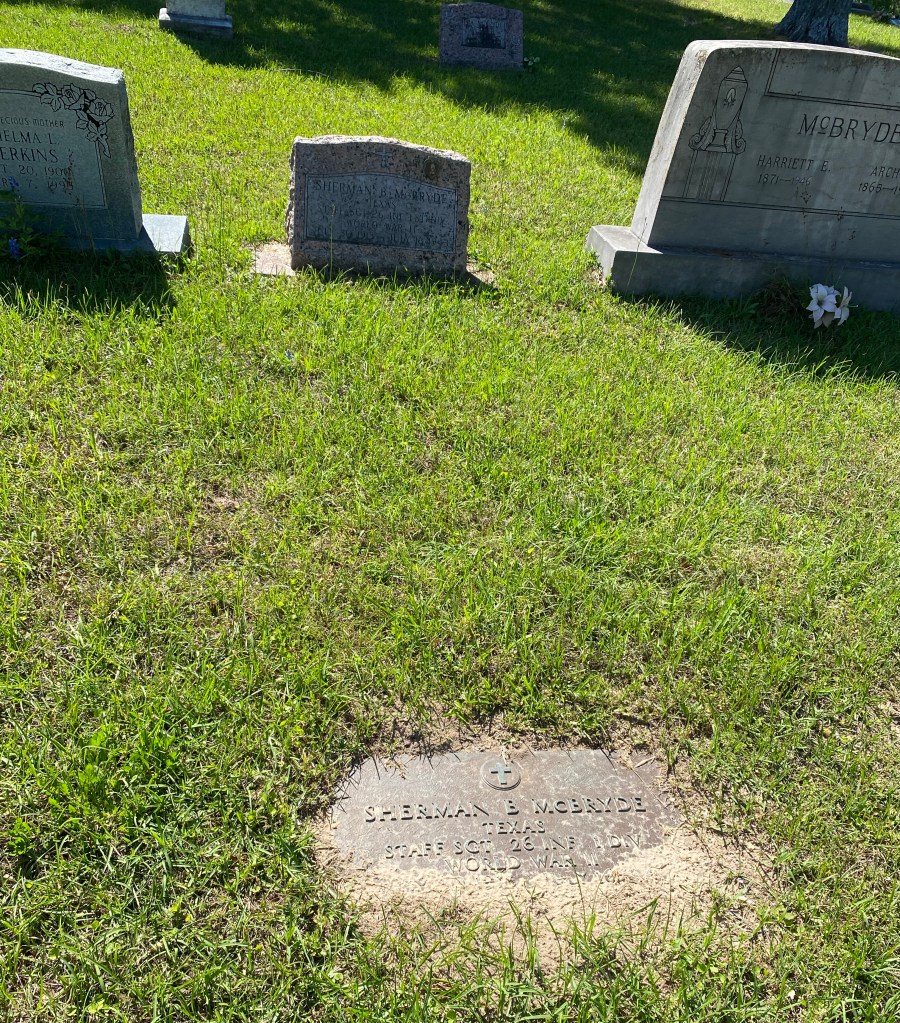
But, as with everything else, the best sources of information have been my family. As I mentioned before, I have been so fortunate to have had long-lived relatives, and few older folks who are living still. On my last trip home, I went to three East Texas cemeteries, two with my grandfather who happily pointed out his (and I suppose, my own) family members: grandparents; great-grandparents, aunts and uncles, and his infant brother who I had not known about before now. I visited the resting place of my great-uncle Sherman McBryde, saw his honor plaque, and learned that while he never married, he did have a sweetheart in Boston. That he was a kind and gentle person who my grandfather really loved. Some of these things I could learn by researching or reading, but for the best parts, as they say, you just have to be there. Or as close to being there as you can when you’re getting know family who lived generations before.
This “cemetery tour” covered my maternal grandfather’s side of the family. My dad has been making phone calls and setting up meetings for me and other family historians, and next time I’ll visit two cemeteries that hold his paternal ancestors. Later in the fall, when it is not boiling hot (just regular Texas hot), I’ll continue on to Renfro Prairie, Rocky Hill, and Mount Hope, if I can find it. Perhaps I’ll be able to circle back to the tiny and old McBryde Cemetery, but that will be more difficult because it’s on private property now.
And there’s another, not insignificant reason for my Texas cemetery tour. As I have spent the better part of last year looking through, learning about, and making art from these people’s lives, photos and personal documents, I realize that I owe them a great debt.
In the literal sense, I owe them my life, because who are we of, if not of our family? All the nice people and mean people, hard-workers and hucksters. The multitudes that they contain. Those who we find commonalities in interests, temperaments and hobbies and those who make us say “I would never!” Ancestors who gave us our pretty eyes or our hard-to-comb hair. Family who only our oldest relatives can remember and even those who are now names in stories, or even a database.
Jonesville Cemetery, Huntington, Texas.
More personally, I owe them thanks for the gifts that the Pine Curtain Project has given to me. Through it, even those who are long gone are still helping their granddaughter, great-granddaughter, great-great-granddaughter, so on and so forth. They still have so much to share. It’s like a complicated group project with some really remote contributors who you can never align time zones with. But it works.
So, when I walk through a historic East Texas cemetery, I say “Thank You” to Beatrice, who loved me before I could really know her. To Charlie aka Grandy who lived long enough for his youngest great-grandaughters to fistfight at his feet and imperil his oxygen tank. To Paul aka Paw who I am more like than I realized in his lifetime. To Pete and Ernestine, for who, though they recently left after long and beloved lives, there are still not enough Thank Yous. I say “they never forgot you” to the infant who lived for a day in 1927; and “Well, you’ve certainly caused a stir” to the alleged backwoods Lothario from the 1800s. “I think I understand” to my great-great-uncle in the late 1930s whose story I am eager to tell when the time is right.
I say “none of you people ever threw anything away, and I have come from your future to vindicate you for that.”
Fielder’s Cemetery, Homer, Texas.
How do you connect with a loved one? Go where they are, wherever they are. Above ground or below it. Maybe their only known place is in your heart. That’s okay, too. But go there and say “Thanks.” Say “I love you.” Say “I’m here.”
As soon as my extended family, husband and I were vaccinated and past the CDC recommended waiting period, we said goodbye to the cats and headed to East Texas for the weekend. The Pine Curtain Project didn’t start in quarantine, but definitely gained speed, depth and focus over the past year when I had more time (for better or worse.) So, it was exciting to finally get to go home, not only to hear stories directly from surviving elders, but also to collect more research items and photographs, and to walk around outside around community landmarks before it gets too hot to do so.
Researching online is great and very productive, but there is so much value in being able to learn things first hand. Our large and busy community has dwindled over the years as older people pass away and ancestral land changes over to new community members or is sold to the new businesses that have been encroaching over the past few years. (A new twist on an age-old song: “They paved the horse pasture, put up a port-o-pot lot.”)
I’m lucky to still have two surviving grandparents: one on each side of my family. My grandfather is 86, and my grandmother is 91. They live within a mile or so of each other and my parents, so a lot of their stories overlap. They’re at various levels of mobility, but they are both very interested in family and community history in their own way. So, I was able to spend an hour or so with my grandmother going over her stash of collected family stories, notes and photos, then an afternoon riding around with my grandfather and walking around family cemeteries.
Both outings filled in some blanks for me, and helped me visualize the places I learn about. In many cases, I was able to add names, context, and detail to the stories I have heard over the years.
Over the weekend, a few people asked why I was interested in this history: why now, and what were my plans for it? Those are valid questions. I have always loved my family and community, but I couldn’t wait to leave it when I was 18, and like most young adults, I didn’t always fully appreciate it. I knew from my fashion magazines that big cities had the good shopping and at the time, Lufkin was no place for someone who desired exotic items like boot cut pants. (I can still hear my confused mother asking, “…like Poppa’s Wranglers?” No mom. Like Poppa’s Wrangler’s but way more expensive. Gah.)
Anyway, like any other place, it contains strengths and challenges, and it took a little while for those to balance out for me. But, better late than never, right? And, a real personal benefit of the project is that it has been a great opportunity to form stronger relationships with my family. We may not agree on everything, but we can all agree that some late-great ancestor sounded “crazier’n an outhouse rat,” haha.
I don’t have kids and at nearly 45, that ship has sailed. I am an only child, as well. In many ways, I see this project as a way for me to not only better understand some of the family, community and cultural dynamics that make me who I am, but also to leave a record so that it doesn’t disappear with me.
As I have mentioned before, the Pine Curtain Project is loosely themed around the idea of Ghost Towns and Ghost Stories: what happens in a place and what remains, and to the degree that anyone can know – why.
I have been gathering information over the past few months, and have made decent progress on documentation around the larger ideas on my roadmap for this year.
Images, names and dates are starting to turn into timelines and rough biographies. Over time, these will evolve into narratives. Maybe the project will remain a series of smaller stories, or merge into one big one; I don’t know the answer to that yet, or what form any of it might take beyond my visual art and this blog.
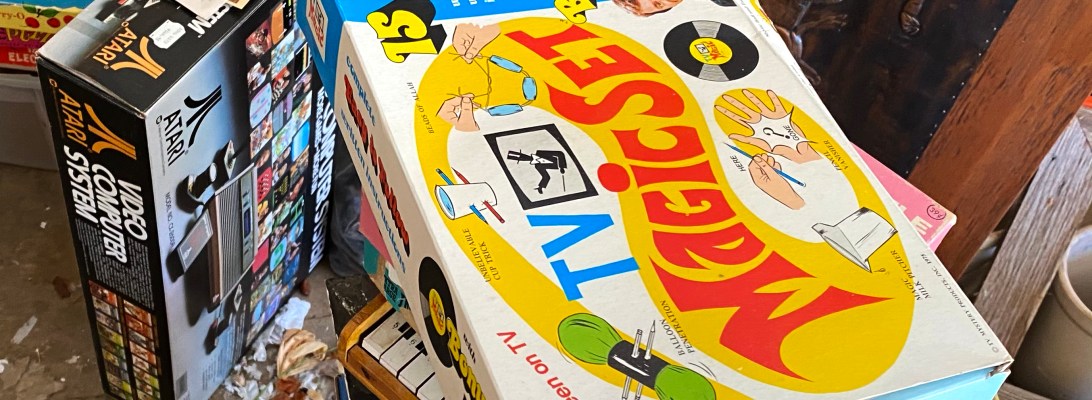
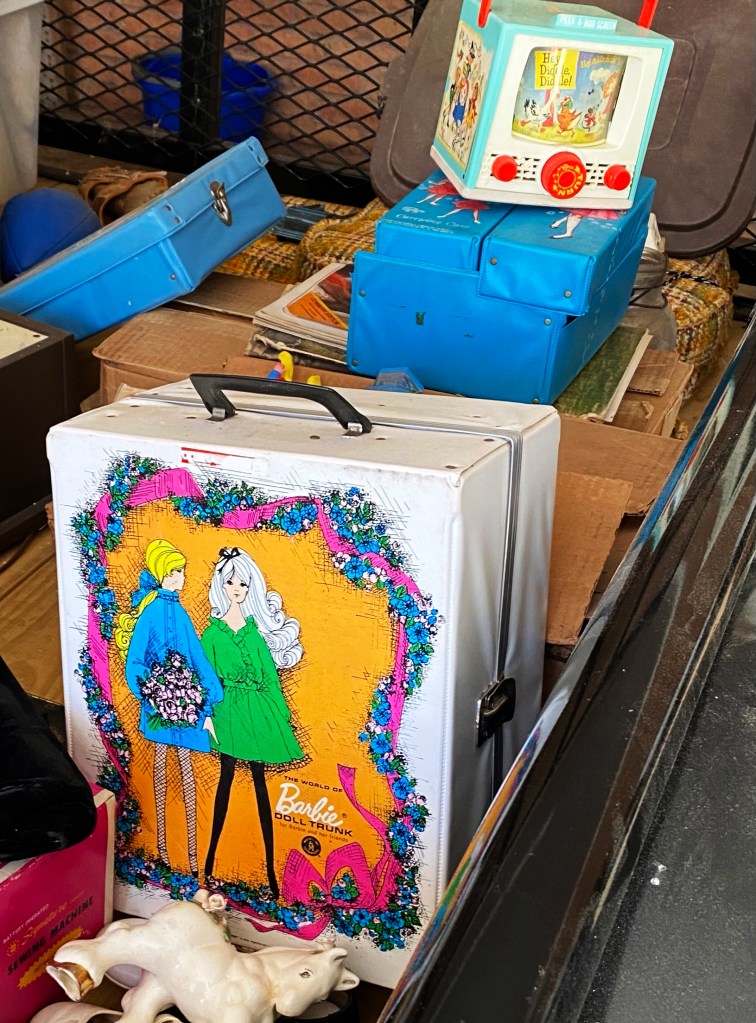
Anyway, I have a new stack of things to parse through this week, and plan to post more art and Curated Histories starting next week. In the meantime, enjoy these images that show just a few of the nearly pristine vintage treasures my cousin found cleaning out her late parents’ house this weekend. I didn’t come home with much of it, but the Barbie trunks are going to hold art supplies now. I REALLY want that Atari but their grandchild gets first refusal. As is appropriate for such a prized heirloom.
The Million & Loving box is an heirloom in itself. Million & Loving was a little neighborhood store, and back in the day had the best candy and served BBQ sandwiches from the back. It went through a few iterations, was sold to a corporation and was just razed to make room for an Exxon/fast food hybrid in Homer, conveniently located at the edge of my grandfather’s front yard.
Ruby Terrill Lomax and John Avery Lomax produced folklife documentary work that comes up a lot when I am researching East Texas History. Along with her husband John Avery Lomax, Texas folklorist Ruby Terrill Lomax traveled the state and other Southern regions for the 1939 Southern States Recording Trip. The Lomax’s multi-genre journey documented Southern folk musicians and their communities through sound recordings, photographs and other ephemera, and spends valuable time in communities of Color and documenting the creative contributions of incarcerated people. The collection’s primary home is in The American Folklife Center, Library of Congress.
Here are a few items of interest from the collection:










 stephaniekhattak.com