I’ve written a lot about the many phases of the gas station saga, the spark and motivation of the Pine Curtain Project and my attempt to document, work though and move forward (and help move my family forward) as things change so much around them. It has been a while since I provided an update — for a long time nothing really happened. And then, kaboom.
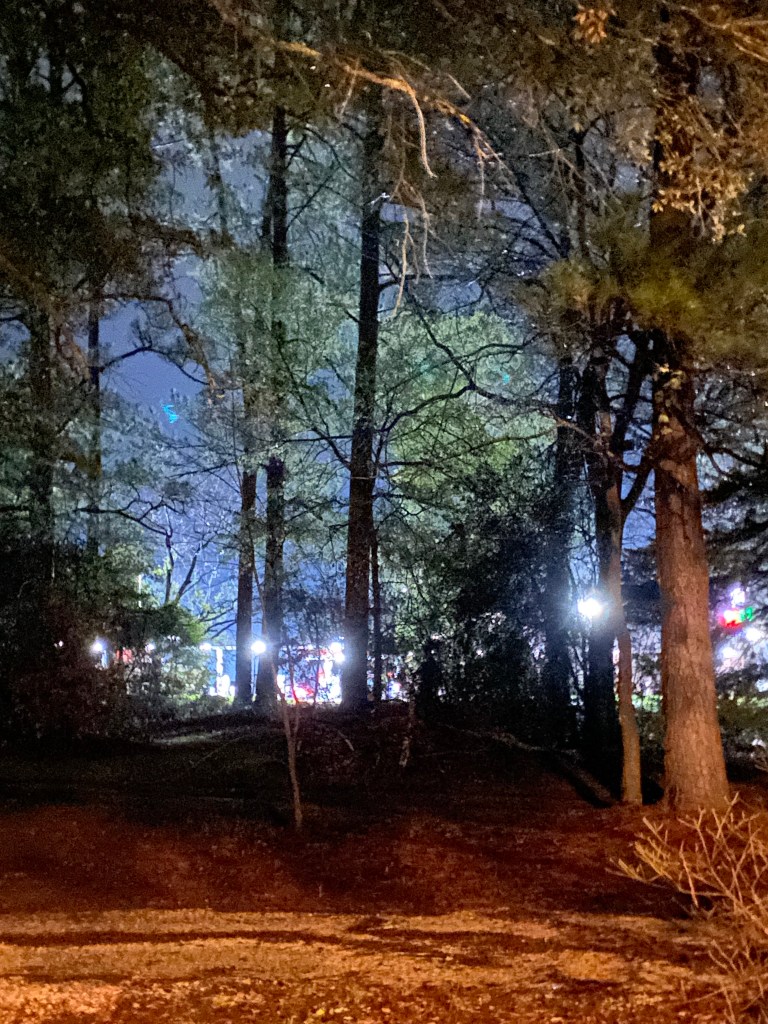
There’s the gas station. When I took this photo, I was standing in my parents’ yard. Not at the edge of it, in their garage. It’s worse in front of my grandfather’s house. Around the time the gas station was finishing construction, other parcels of land began to sell around my families’ homes. It has become a (somewhat expensive and complicated) game of whack-a-mole, with my extended family members and my parents trying to figure out what’s for sale, is it worth buying themselves, is it a good investment, etc. just to maintain some sense of normalcy for a little bit longer. When I was home last, in early May, the area was hard to recognize. Trees have been cleared in all directions, new construction is going up, three or more houses on lots that used to hold space for just one. As these changes have happened, there has been a predictable increase in petty crime like loitering, trespassing and break-ins. And so begins the letting go.
My parents are still coming to terms with what happens next, and because they’re mentally and physically independent, I try to just stay out of the way let them do what they do. And then I look for a bag to breathe into.
They, and my cousin, uncle and grandfather are all handling things in their own way. My grandfather, who lives practically in the gas station parking lot, is getting by with blackout curtains and a good sleep mask. My cousin, the practical one, has bought up some property to delay the inevitable, but has also been making trips to where they all want to resettle to scope it out. My uncle is the only one to actually cross the store’s threshold, because they make a good slushie. My parents are in archaeologist mode.
Every so often, my mom will show up for a visit with a plastic tub of my old stuff. Some of it’s relevant to my research but mostly it’s a hodgepodge. My dad is taking a different approach and finding random old things to refurbish. And I do mean random.
Mom: “Your dad found your bike to fix up for you.”
Me: “What bike?”
Mom: “The little cowboy one. Maroon.”
Me: “The one I had in third grade?”
Mom: “Yes! That one,”
Reader, I am 47. I am almost six feet tall. I don’t have kids and I don’t know any little kids. My cats will never be able to ride that bike.
Mom: “So, do you want it?”
Me: “Umm, why don’t you guys keep it for me a little bit longer.”
A few weeks later.
Mom: “Guess what we found?”
Me: “What?”
Mom: “Your Barbie Dream House!”
Me: “From 1982!?”
Mom: “Yeah, do you want it?”
A few weeks later.
Mom: “I found something you might want in the old barn.”
Me. “??”
Mom: “Your recorder!”
Me: “From elementary school? Like, the ‘Hot Cross Buns’ recorder?”
Mom: “Do you want it or not?”
Other things they’ve “found” and fixed up for me include some kind of ancient weed tiller thing from my late grandfather’s farm, a little deer hide chair from the 1800s, a foot-pedal sewing machine, a 1970’s Ford, a 1960s Mercury Comet and a 1992 Chevy S10. (To be clear, I already have a car!)
I know this is them working through what they need to work through, and who knows, maybe one day I will want to play the recorder again. I think my bestie Missy reclaimed her own Barbie Dream House in a similar scenario, so maybe we can set them up and play, like old times.
The next phase is one that I deeply dread. I have long-promised to help my mom clean out my room, and after years of kicking that can down the road, the day is fast approaching. I do not want to do this. Not only is it going to be an absolute a$$-whip of a project, I know what all is in there.
In the tubs that my mother has brought, the ones she’s piled into my car as its driving away, and the many more that remain, there are stacks of old notes, old writing, old mementos, yearbooks, and photos. Painstakingly folded notes that air one side of long-ago grievances, photos of me looking weird, photos of me trying too hard. Crispy-dried prom corsages. A hand-painted egg from a junior high family science project, still unbroken, resting in its little plastic basket. Diaries that contain God-knows-what about God-knows-who. Tube tops and plastic barrettes and probably all my vinyl pants from the nineties. Notebooks with doodles, directions and things to remember from long-ago trips and my time in New York, when Google didn’t exist and I had to rely on my wits. All of it there, just waiting to bite me.
I know that the cleanest break is to just throw things away. Stop digging, wash my hands, move on. But I can’t. I have to look through these boxes, even the ones that I know will hurt. Because we all know the myth about boxes, and how sometimes, even when pain flies out, there’s still hope left inside. Maybe I’ll find something good.
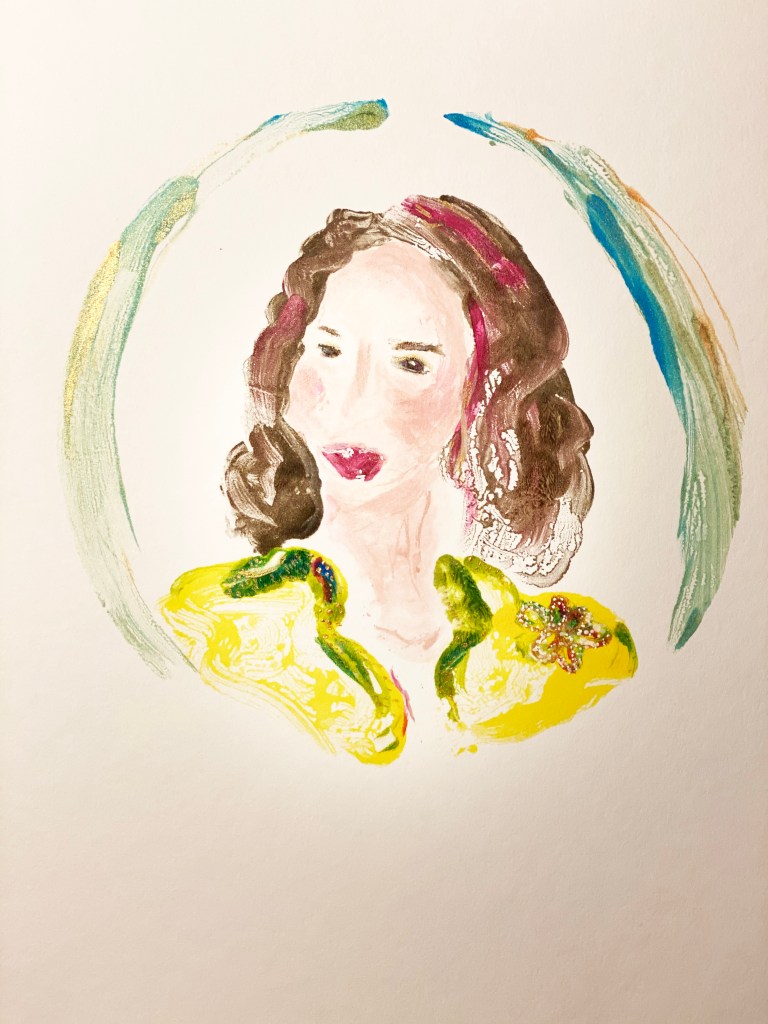
Acrylic monotype on paper, 2020 by Stephanie Khattak.
Lately, I have been thinking of embroidery. And by extension, I have been thinking about my Auntie. She died late April 2020, but not of Covid. A distinction that didn’t matter once she was moved into a skilled nursing center for what we thought would be a few weeks of care and then home, or worst case, private hospice. When she went in, she was well enough to ask for a specific red jacket to be brought to her, already planning her outfit for her release.
For about a month her daughter and my mother, her niece tried their best to communicate through speakerphone, FaceTime, message relays from the nurses (for as long as she could understand them) and finally, the last goodbye. My cousin, my mother and I stood in a nursing home parking lot in Tyler and yelled into a stranger’s iPhone as Auntie slept fitfully, inside and many floors up and maybe heard us but who knows, really.
She was my second casualty of the last two years and the first involving a person. This kicked off a parade of horrors that marched on to include the deaths of her husband “Pete-o”; a cousin younger than me and both of his grandparents – another great-aunt and uncle of mine, and two other cousins – siblings. Within one week, I lost two classmates – one who I had adored since 1981 and another that I had happily tolerated for just as long. A married couple from the family next door warranted a double funeral, closing off yet another chapter of our multi-generational story. My friend from college died that February, and in October my ex was killed in an accident while experiencing a mental health crisis. Loss upon loss.
And of course, the Big Bad gas station looms large across from my parents’ house. The Final Boss that will send my family scrambling back to Hoot Owl Holler where we came from, four generations and nearly 100 years ago.
I know mine is just one story in many similar ones these days. I really don’t know where any of us go from here. For me, and for a lot of people I imagine, there is a strong sense that things will never feel normal again. And how can they, with such loss? And how could we even want them to?
Thinking of Auntie, and thinking of embroidery, I keep coming back to stitches and sewing. Perhaps it is my mind, as it often does, working things out creatively when it is hard to communicate in other ways. Piecing it back together, trying to bring out the beauty.
Auntie was the family seamstress, making most of my clothes for most of my life. All of my prettiest dresses came from her: the red strapless prom dress with a full petticoat skirt and bow on the bodice, so glamorous and timeless that it was altered to fit my very short best friend a year later and looked equally amazing. A black, off-the-shoulder floral Gunne Sax-inspired dress for the 1990 National Future Homemaker’s of America (FHA) convention in Washington DC, complete with hand-placed clear sequins over every pink and red rose petal and green leaf. That trip was my first time on an airplane, so of course I had to have two new wrap skirts made to wear on the flights – a navy one with a bright, whimsical crayon print, one in tropical pastels.
In researching my family history, I learned that Auntie’s auntie was a pattern maker, and her great-grandmother did professional needlework and embroidery for the community in the early 1900s. I didn’t inherit any of that. I did poorly in my Home Economics sewing unit, somehow stitching a needle into the pillow I was making. (My FHA success came through its public speaking components.) Once, I thought I’d sew a sundress for my little cousin and was feeling pretty good until my mother walked by, sighed and rolled her eyes. “Make something she can wear,” she said.
But still, I think about stitches, piecing together, making something plain just plain prettier. As with my prints, never obscuring or transforming, always honoring and enhancing. So, stitch by stitch, something new begins.
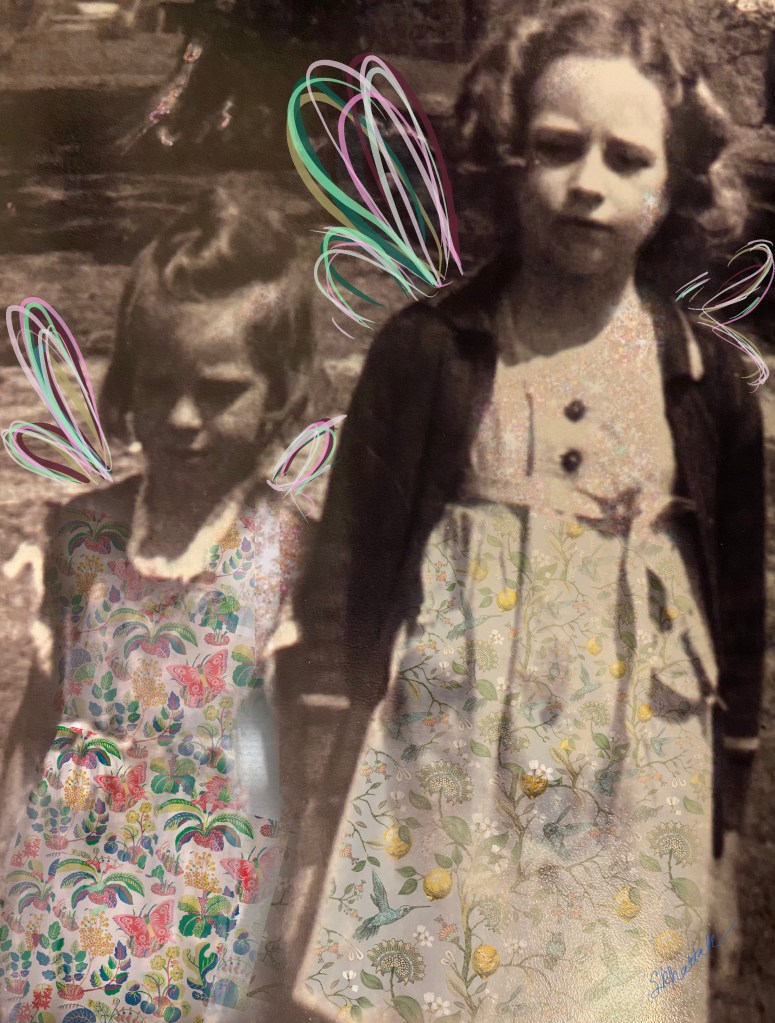
Work in progress, acrylic and embroidery on photo-printed canvas. Stephanie Khattak 2022.
When Auntie and Pete-o died, it fell to my mom and my cousin to clean out their house. There isn’t much in there that I really wanted. An oil portrait of my mother and a matching one of my cousin, if she or her child don’t want it. A framed 1993 Youth Fair needlepoint project depicting the million little things that make up a sewing room: thread, a sewing machine, scissors, spinning wheels…it was so big and complicated that I pulled tearful all-nighters to complete, sometimes working on one corner while my friend Jake worked on the other. It lost to a scene of a teddy bear eating an apple. A teddy bear! But that’s fine because Auntie liked it, and I liked it, and now I want it back.
But, what I really want is her sewing kit, a lidded basket in the shape of a beige house edged in blue and green. It sat by her machine for as long as I can remember, there with everything she’d need for each stitch and sequin, snip, button and flourish. There was never one thing out of place in that house, and yet that sewing kit is nowhere to be found. My other family members aren’t interested in it, and if they were they would just tell me. It’s simply not there.
Maybe it will turn up, but if not, that’s okay. I have a theory, or maybe some magical thinking. Perhaps she came back for it, took it with her to wherever she went. Her greatest joy was in her sewing, the satisfaction that can come from fixing a stitch, making something pretty, making something right.
There is a lot that is wrong right now. Who’s to say that the other side is so cut off from us that they can’t feel it? Maybe they feel helpless, too. So many gone, in such short time. To them they’ve arrived en masse somewhere entirely new with lingering, fuzzy memories of voices through smartphone speakers, unrecognizable shapes in hazmat suits, blinding lights. Who’s to say that they too, wouldn’t like to return to the comforts of old joys, to attempt to set something right, perhaps stitch by stitch. Who’s to say they can’t?
“Mimi and Auntie, 1940s” digital collage 2021. Auntie and her sister, my grandmother. By Stephanie Khattak.
I’m always interested in how creative people structure their time, so I thought I’d share a little bit about how I work. Especially since what so many people see is just the finished product, and that is just the tip of the iceberg!
My artwork takes a long time to do. Not as long as, say, a photorealistic oil portrait, but it is very process heavy and needs a lot of protected time, as it is not work that I can start, stop and come back to. If the acrylic dries on the plate, it is unusable for my process, and if I try to rush through and end up with an off-center or flawed print, it’s back to the proverbial drawing board, or literal printing plate, to start over again.
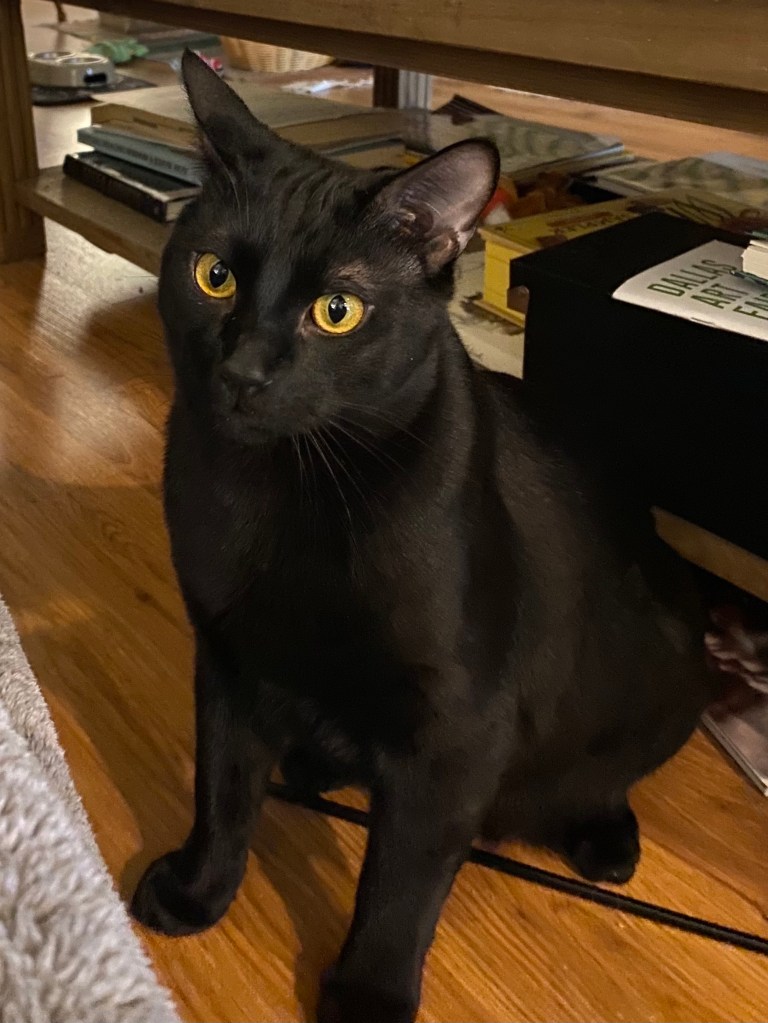
So, printing the art itself is something I usually batch over one or two dedicated days of the week in my studio and in that time I can print roughly four pieces depending on the size and level of detail. (It also helps with cat control, as the kittens still aren’t allowed in there and I don’t like having to shut them out more than necessary. One, it makes me feel bad and two, they bang on the walls and rattle the door. I think the house panther is about three “aha” moments from unlatching the doorknob.)
An intelligent stinker.
When I’m not actively printing or hand-embellishing completed prints – either for my own work or commissions from others, I do a LOT of research. I would say that a typical week is 50 percent creating the art, 40 percent research, and ten percent admin/marketing/operations which includes things like invoicing, cleaning my work space, looking for and responding to promotional opportunities, updating digital platforms and responding to commission requests (not all of these tasks need to be done each week, thankfully.)
My days are structured like any other workday, usually getting started around 9-10 am and finishing around 6 pm for family and TV time with the kittens.
Bonnie loves TV. Here she is learning about culinary travel to Costa Rica.
I sometimes work over the weekends, and I’m always reading on my off-hours, and some of that is research time as well. On weekends I try to recharge and work around the house or go see shows by other artists for inspiration. But during the pandemic I have been mostly at home.
Because my work centers on the Pine Curtain Project, I am always on the hunt for compelling vintage images with compelling stories, ideally that contribute not only to my own family history, stories and memories, but also to the larger cultural history of East Texas. As I wrote in a previous post, I’m focusing on a few main topics this year, which is not to say that other images and themes aren’t included as well. But, I am finding so much information just on these topics, that I am very busy researching, reading, cataloging and analyzing information.
Combining my art so closely with writing and research complicates things in some ways, but in most ways, I feel that it leads to a more rewarding experience for me as the artist, and hopefully for the viewer as well. As a person who likes a little more structure in the day, I feel that this project lends itself well to providing that structure while still leaving plenty of room for the flexibility needed for the creative process to do its thing.
“We don’t make mistakes, just happy little accidents.” ― Bob Ross
There is so much room for JOY in art, something that I too often mentally push to the side, overpowered by the daily details and challenges of being an artist and owning an art-centered business. But, when I step inside my studio, see something amazing at a museum or gallery, or discover a new artist whose work speaks to me, even if I’m low on motivation or inspiration, joy appears.
Recently I discovered a local artist’s blog. They write about their studio time, commissions they are working on, sketchbooks and inspiration. No monetization links or newsletter subscription pop-ups, no “thought leadership…” just a working artist who likes to make art, write about art and share their art. How much more simple could it be? But how compelling it is! As soon as I see that the artist has posted a link to their blog on Twitter, I click to read it. This person is not an art influencer in any sense of the word (and that’s a compliment) but I so love to live vicariously through them. And they have inspired me toward a different perspective.
Writing and art. Thoughts. Ideas. That’s what it is, for me and for you and for everyone who creates online, really. These are your creative treasures, don’t reduce them to “content.” And it’s important to remember that just because you create something doesn’t mean you have to to attach a performance metric to it.
But like many other creatives making their way in this digital world, I find that those are hard habits to break. For me personally, it’s hard to pursue an interest or new project without immediately thinking “can I monetize that?” “Can I build consulting services around it?” Which is great for the business side of my life, but not so much the creative.
At the end of last year, I thought that 2020 would be a “sabbatical year,” and well, you know, LOL to that. I picked a word for the year in March and then just didn’t do anything else. And, it’s fine, mostly. But there are still a few months left in 2020, the world still spins (for now!) and I can still add something positive to my life.
My husband continues to work from home and the kittens still live with us, so I’ve been doing a lot of hopping from room to room with my laptop, phone and reading glasses throughout the workday. One goal I have in the spirit of art bringing joy, is to spend more time in my studio not only as a place to make art, but also just as a place to be; to work and write and enjoy life. It’s small and messy, but it has big windows and a comfy couch, and I should be in here more often, if only because being here makes me happy.
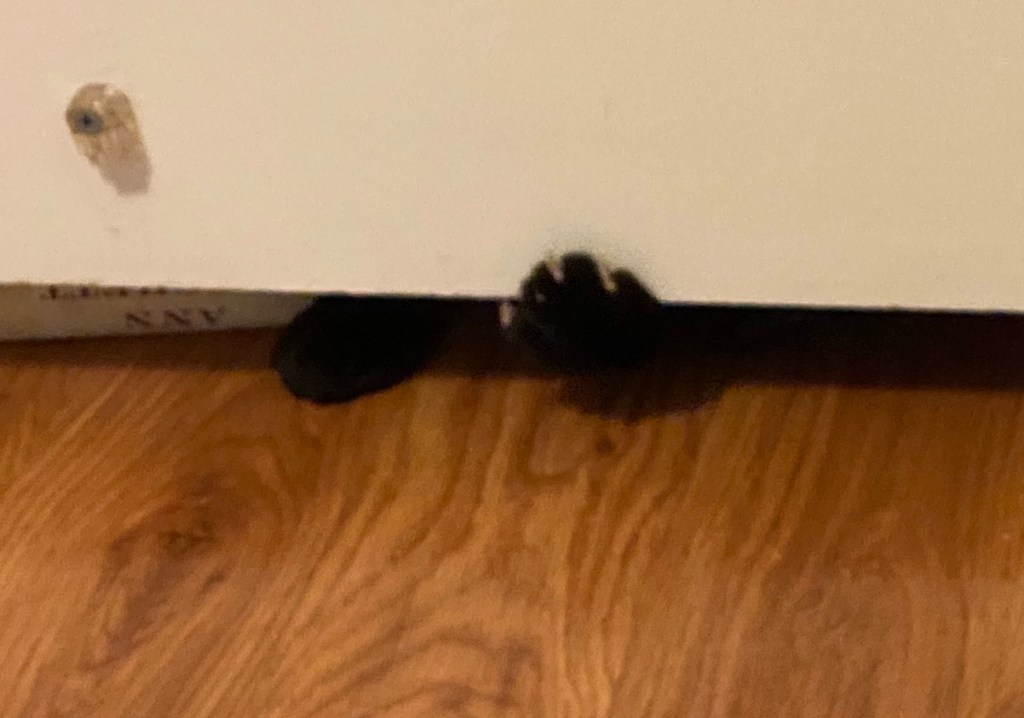
The kittens are too little to be invited in, but my little house panther wants it so badly! He bangs on the door and one by one, pulls down the stack of books I’ve placed in front of it to avoid seeing his paws and face in the crack and feeling guilty. It is like being in the panic room of a horror movie when the goblin is bashing its way in. I do see his paws and I do feel guilty! But too bad, Beans! I’m claiming my space and tuning you out, or putting you in the cat room for a few hours. Your sister, too, because you both cry when we separate you. Sometimes it’s okay to redirect distractions, not to be more productive, but just to be happier.
Panther Paw
I just love art, and it started to feel silly and disconnected for me to approach my personal art, experiences and thoughts as only things to build a business around or market my work through. How about building a joyful, creative life, which is really what we artists and art lovers long to do? Regardless of the subject matter (not all art is joyful, of course) we love our happy little art accidents, the game-changing breakthroughs and successes, the inspirational discoveries we happen upon and the communities that we work in. Why undermine those joys just because we also want to support ourselves?
Going back to my new favorite art blog; the artist recently named their studio, and I’m inspired to do the same. It’s a fun thought exercise, and really helps add to the sense of place. I haven’t decided on a name yet. In my very early days, I was MollyPop Studios(RIP). I’m not sure that fits anymore.
For the next little while, as I create and read and think, I think it will be fun to consider, not necessarily in regards to a business name attached to the art itself, but as the physical place where I work from. A word or phrase that resonates with me as an artist. A place that feels like home.
Good Gravy. Nothing like a little pandemic to make every life choice seem both vitally important and totally inconsequential. I think everyone’s theme word for the year simultaneously shifted to Survive. Rightfully so. It’s hard to focus on “enlightened” needs right now. I mean, when your house is burning, who cares if the bed is made?
None of us are in control right now, if we ever even were.
It’s a lot for me, and for you and for everyone in the whole world.
So what is an everyday person to do? Those of us who don’t work in a vital service industry or on the heroic front lines of health care probably find ourselves at a loss right now. We do the right thing by following public health policies, supporting local businesses, tipping extra…and then what? Speaking for myself, when I get to the part of my brain that controls my “what about me?” response, I don’t have a lot of answers right now.
But “what about me?” is a valid question. We function as a society and work for its good, but we matter as individuals, too. It matters if my business fails or if your company furloughs you. It matters that your kids can’t play with their best friends for who knows how long, or if you don’t get to hug your loved one when they’re ill. It matters! And it’s all happening at once!
The best I can come up with is to share some practical advice from a boss I really liked at a job I really hated.
This workplace was super toxic and extremely full of itself, and every day was an exercise in back room dealings, corporate caste systems and general treachery. It brought out the worst in everyone. But in the middle of all that was my team, which I liked and a boss, who I respected. When I’d go to her office to talk about the latest lie, injustice or general nonsense we had been subjected to and ask how to respond, she’d say “We are going to come to work every day, do our jobs and do our best. We will do exactly what we have been doing.” It was hard to hear sometimes, because it is human to want to react, to fight back or defend ourselves. But since then, I think of that advice when things get so chaotic that my judgement is clouded.
So right now, that’s what I am doing. There is too much to think about, and it is so hard to make decisions when the global landscape changes so quickly, not to mention the simple matter of all the extra steps we have to take to stay healthy and alive.
When things began to shut down, I panicked. My business was just starting to take off, and suddenly, not only could I literally not do it, I also had to try and stay top of mind with my (relatively new) connections without having anything real to offer. No travel meant no meaningful updates for my social channels, etc. I have been a freelance writer for years, but had decided to cut back to grow the business. Scramble time all around. I feel like I’ve pivoted so much I’m back at the beginning! And technically, we (in Texas) are still in month one!
But I am trying to follow the good advice that my former boss shared. Every day, I wake up and I go to work. I stay the course. I am trying new initiatives and projects but nothing drastically different than I was doing six weeks ago, and I’m not knocking myself out to put out new stuff all the time. I’ve temporarily resumed more freelance writing work, because its a known entity, and my other work doesn’t take up 40 hours right now. I’m trying really hard to stay in my lane and succeeding, mostly.
I’m creating art, of course, and writing creatively as well. But right now, those things seem like luxuries. Beneficial and important luxuries, but luxuries all the same. So, I’ll get back to that later, in a different post. I don’t want to be mistaken for being someone who thinks all of this a “blessing,” or a call to “slow down” or to “take time to dance.” If we are dancing, it is because there are hot coals under our feet.
Make room for pleasure, definitely and relax when you can. If you are a spiritual person, lean on your faith. But self care, and even spiritual faith can also look like showing up for your professional, family or personal responsibilities; doing what you need to do, and doing your best.
This is the story of the big life of a little cat.
Molly’s life with me began in July 2002, when I had just moved back from New York City to Austin. I wasn’t happy with the move, and thought I’d get myself a cat as a consolation prize.
But before that, in May, I was in New York, walking with a friend who was visiting for the day from New Haven. “David’s cat had kittens!” she said, referring to her boyfriend at home in Austin, an old friend who had and has been in my life since I was 16.
“Is there an orange one?” I asked.
“Yes!”
“I’d like to see that kitten!” I said, looking around me and thinking that a furry friend would be just the thing to take the sting out of leaving all the exciting things and opportunities that surrounded me in that moment.
A few weeks later, I left New York, with an orange kitten on my mind. I know what you’re thinking, Molly wasn’t orange! No, she wasn’t! Stay with me.
I moved back to Austin, into an empty one-bedroom with an inflatable mattress, a huge indigo plastic iMac and no other furniture. After a few days of pushing the mattress from room to room to “settle in,” I was ready to pay David a visit.
At the time, David was living a few blocks from UT, with at least one roommate and what seemed like 100 cats who seemed to be everywhere all at once. Big kitten energy, is what I’m saying. I stepped around the rolling balls of fur and teeth, and settled on the couch while David made introductions.
“I’m keeping that one.” He pointed at a sweet, silky white boy kitten with big eyes. “This one has been scratching her ear a lot.” He pointed at a beautiful tabby while I priced ear drops in my head. I looked over at the orange one, the prize I had come for, just as David pointed at him. “I think T-Bone has been pooping under the couch.”
“Hm, way to sell those cats, David.” I thought. He ended up keeping all of them except for Molly, so he probably didn’t actually want to sell them at all. But I had a decision to make.
As I was pondering ear drops vs. the stealth pooper, a friendly calico toddled up to me and raised on her back legs, balancing her paws on my jeans. I looked at her, then David. He had nothing to say.
“Maybe this one,” I said, stroking her soft fur. The other cats weren’t very interested in me, but this cat was immediately. “Definitely this one.”
“I thought I’d name her Tank Girl.” David said.
“Hmm,” I looked at the kitten’s face. “Don’t let him name me Tank Girl!” It seemed to say. She had an “M” marking above her right eyebrow. “How about Molly?”
And that was that. She stayed with David for a few more days while I got her litter box, bowl and starter set of cat toys, then we loaded her up in a boxy green plastic carrier and I drove, as slowly and carefully as I could with the precious cargo, down 24th Street and up MoPac, across 183 and onward to my apartment.
I knew my life had changed. When we got home, I remember unlatching the carrier and sitting on the inflatable mattress waiting for her to come out in her own time. After about 15 minutes, she did. We were home.
The joke was on me, because while Molly never pooped under the couch, she peed everywhere. A bladder condition diagnosis and medicine took care of that, but she never stopped preferring a soft carpet, couch or bed comforter to cushion her paws vs. scratchy litter and a drafty box. I think she was 16 before she was an exclusive box-user. She also pushed her way through my newspapers when I was reading them, knocked stuff off the counters and jumped to and from the highest cabinets in my apartment while I begged her to behave. In other words, she was a Grade A Normal Kitten. One night I couldn’t get her to take her bladder pills, which I would wipe in strawberry cream cheese and stick to my finger, hoping she would just open up and let me put it on her tongue. (Why yes, she was my first indoor cat! Why do you ask?) She became agitated and I had to put her in the bathroom and call David to come help medicate his damn cat. He stopped by an hour later, rolled her up in a towel like a burrito and had her pilled in about two minutes. She did everything but say “Aah” and get a lollipop. She was a stinker.
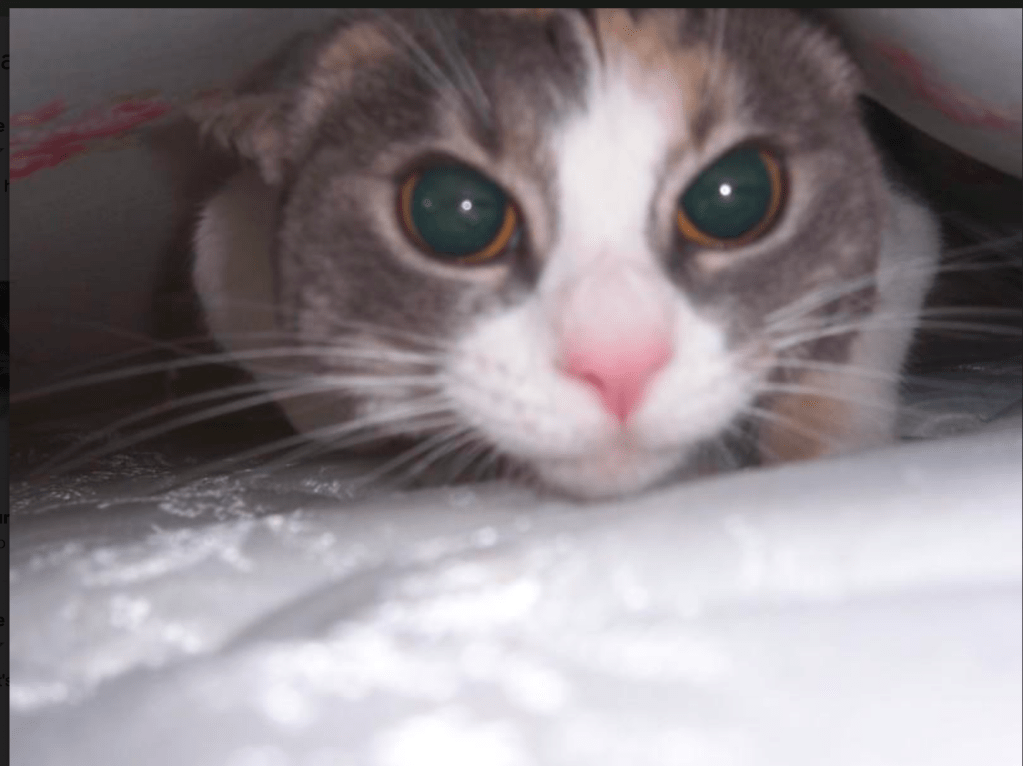
Molly, 2005
And by stinker, I mean, she was the best. She loved Bob Marley and other music with a deep, dance hall beat, and music with reedy voices and instruments, like the Dixie Chicks, sent her into a biting, scratching rage her whole life. She wasn’t a lap cat, but she loved being close to her people and spent most of her final weeks snuggled against me while my husband James and I watched The Crown on TV. Molly loved TV time and strangely enough, had the same preferences that we did.
She enjoyed being where the action was, always part of the conversation circle or checking out houseguests’ suitcases, making sure they were all settled in. Until I met James in 2008, it was just Molly and me and a short parade of not-James’s, some who she liked a lot (the small-town vegan) and others who made her hiss and leap sideways (information withheld because, well, let’s just say Molly often picked up on things that I didn’t.) We spent a lot of time by ourselves. In the early days, I was a newspaper reporter and worked odd hours. Most nights, I’d unwind with her by watching some late-night Cheaters TV and enjoying International Delight coffees. (Remember, I was 26, it was 2002 and “coffee culture” was years away, as were the good cable channels.) Sometimes I’d be home so late, and so tired that I could only hold out the feather stick limply while she jumped at it, desperate for playtime after being home alone all day while I chased down stories about mercury in the local fishing lake and small town petty shit.
I talked to her all the time. I said, “please move,” when she blocked my path to bully me for treats. “Excuse me,” when I brushed past her reaching for the remote. “Thank you, Molly,” when she obeyed a request (there were never really any commands in our dynamic) or gave me kitty kisses. She heard so many stories and so much dirt on so many people. I’d like to think she was as shocked and appalled as I was when people misbehaved or there was drama to share.
Because of this, she was very in tune with people. “She understands tone!” I’d later say to James, who seemed to buy it but I’m not so sure. But she did understand! James likes to remind me that Molly’s brain was the size of a walnut, but it must have been all empathy.
When a friend who had just lost her father was crying at my kitchen table, Molly was there with knee pats and purrs. When I lost a close friend to suicide in 2007, she barely left my side for the months that it took me to get through a day without losing it. When James lost his dad, Molly was right there with us on the couch working through it as a family.
We went on like this for almost 18 years, Molly and me, and beginning in 2010, Molly, James and me. I have so many stories, and to tell them all would be to write a book. She was my best friend. When I looked at her, I knew the world was right. The night before my wedding, I opted out of staying at a hotel so that I could spend the night at home with Molly. One of James’ and my wedding debates was what tier of the cake Molly’s figurine should go on. (I won. She was placed on the top tier with us. I mean, where else would she be?) When we moved in 2018, we had to leave her in the old apartment bathroom all day while the movers did their thing. We freed her around 10:30 that night and drove through Whataburger, the cat carrier on my lap like a puzzle piece. When she first got sick and we knew the end was coming, I’d wake up in the night and see the silhouette of her ears in the dark, right where they were supposed to be. “What happens without this?” I thought.
Molly was, for a long time, the very best thing in my life. Until I met James and had two best things. And she was the most constant thing in what was a very transient and not always great life. Because of my newspaper career, we moved four times in the first three years alone. We did not always have consistency in income or a stable place to plan the future from. Most of my close friends live elsewhere, so Molly was my only steady companion for most of our years together, and you can probably get an idea of my dating life from the “made the cat hop sideways” anecdote above. (But nobody mistreated Molly! Not only would that have been an instant dealbreaker, she was universally beloved even by those who she herself could take or leave.)
Molly, 2003
What was life going to look like without that stabilizing influence, being able to see, interact and care for a companion who had filled that role for 17 years. That is such a long time! Molly’s social media presence predates even MySpace by many years! She was an early Friendster adopter. When she was tiny I put her photo on RateMyKitten but then deleted it when someone said it looked like she was wearing makeup. It weirded me out for some reason. But, Molly was totally Generation Z, a Digital Native by Gen X proxy.
My friends started having babies right after I got Molly. She was the oldest. As the years flew, I couldn’t help but compare their ages, and wonder what human Molly would be doing. The ages came and went where she could drive, start high school, think about college. I don’t have kids, by choice, but it was still an interesting thought exercise.
But a cat is not a person. Adopting a cat, as James liked to remind me, is both a promise made to a kitten and accepting a small tragedy. I knew that it was highly unlikely that Molly would outlive us, and still I hoped. With each birthday, I thought maybe she’d live a long time and be not just old, but really, really old. A Guinness World Record of a cat. But without old cat health problems, because I wanted her to always feel good.
She felt “good” until about three weeks before she died, and I’m grateful for that. There are so many things I’m grateful for. Her facial tumor made her look like she had a jaw full of chewing tobacco, but didn’t hurt her. She was mobile and playing, albeit with some painkiller help, until the morning we said goodbye. The only time she really slowed down was in the final week, between Christmas and New Year, and that just meant that she spent most of her time in one of a warren of Christmas package boxes we had set up in our breakfast nook. We learned to read the boxes. The big one meant she was feeling okay. The medium-sized box on its side meant she wanted to rest but also see the world. The tiny Target box with tissue paper still in it meant “My painkillers are wearing off. Pretend you don’t see me until I can have another one.”
Molly, Dec. 2019
On the last night of her 17 years and nine months, she watched The Crown finale on the couch with us, played with Christmas Tree branches, gave her rolling ball toy a few hearty whacks and went to sleep after a healthy dose of painkillers melted into a Brothful. (Aside – did you know there’s a whole product industry based around soup for cats?!) The next morning, James woke up, gave her heart pills, breakfast, treats and medicated eye wash, then took his shower. Molly made a normal lap through the bedroom where I was, then suddenly broke in to a panicked run all the way to the closet in my art studio and hid in the far corner of the farthest closet. Molly was old, sore and had not run for anything in probably a year. Something obviously awful and bad and non-salvageable had happened.
In the last few weeks of her life, when we chilled on the couch, I’d ask “Molly, is it time?” and give her a good, clear look to see if I could tell. Because, for as long and as much as Molly and I “talked,” she was a cat and could not really talk. I knew she loved her life and wanted to keep it, and I also knew that James and I would have to understand what her limits were so not to prolong the inevitable. Usually, she’d just kind of look at me and go back to TV or bathing herself or whatever it was that she was doing. She was trucking along. Tank Girl until the end.
But that morning, Jan. 2, I didn’t have to ask. At that point, we had to force a radical shift in our perspective from “Molly, our friend and family member” to “Molly, who is a terminally ill animal and just wants to not hurt.” We called our vet, and took her in immediately. After our vet confirmed our suspicions that Molly wouldn’t recover from her cancer-related injury, we, as a team, decided to let her go.
My strongest memory of that day is when the vet brought her back from the staff exam room, a little tranquilized and buzzed but not asleep yet. They had wrapped Molly in a pink blanket like a little baby. Molly was alert, ears up and scanning the room for James and me. When she saw us and was placed on the table, we had a few precious, priceless moments with her to give kisses, head butts and “I love you’s” before she started to slip into sedation for the next step. I honestly don’t remember much after that, only that leaving the vet’s office without her cat carrier, which we donated to the clinic, was the weirdest and one of the hardest things I have ever experienced. It was like leaving your wallet on the bus, if your wallet had your 17-year old cat in it and you’ll never get it back.
This is the story of Molly, but as with all stories, there is more to it.
James and I were visiting David this past weekend. Molly’s mom and siblings (ear drops and the couch pooper, aka Lucy and T-Bone) had passed in spring of 2019 and beautiful Mad Dog had crossed the bridge years earlier. It was the first time in nearly 18 years that I’d see David and not have cats in common to talk about. So, we spent a happy couple of hours talking about the cats we used to have.
“You know the story, right?” He asked. I did, but I wanted to hear it again.
Turns out, I didn’t know the whole story.
Molly’s mom Ella was a stray who David took in. There was a medical delay in getting her fixed, and between the first time she went in and the time he took her back for the surgery, she snuck out a bathroom window and went on a little Rumspringa. When the vet saw her again, she was pregnant with kittens.
Molly’s story, and the story of her siblings runs on such a thin margin that it is nearly cosmic. There are so many scenarios where Molly would not have been with me. I reconnected with David in the late 1990s, through a situation that wasn’t great, but having Molly come from it made the chaos completely worth it. If I hadn’t spent the day in New York with Audrey, who happened to mention David’s cats. If T-Bone hadn’t been in a sneaky pooping phase. If Ella hadn’t escaped, or if she had been fixed at that first appointment. If Molly hadn’t so obviously made herself known at the kitten-choosing night.
I would have missed so much and never even known it. I know I would have probably found another cat, and a different joy, but it would not have been this joy. I love my life with Molly, all the ups and downs, both of our bad behavior, the expense and responsibility that comes with pet ownership, everything. Even the end of it that was so scary and consuming with the medicine and her encroaching, very obvious tumor and eye issues that I assured her just made her look more interesting.
At the beginning of this story, I said that I thought a kitten would be a consolation prize, a second place compromise between a life in New York that I so badly wanted and the life I was expected to lead. It shames me to write that now. How wrong I was. Consolation prize? She was the blue ribbon of my whole entire life. Aside from my marriage, which didn’t happen until 2012, she was the first and only thing that was ever truly mine, the first unconditional love I ever experienced in either direction. We figured the whole pet ownership thing out together and I didn’t always get it right, but I know she loved me in whatever ways a cat can love and she inspired me to do my best for her. A night or two before she died, we were relaxing on the couch and I scratched her head. She looked at me as a geriatric cat with a lopsided face and bad eye, but I could clearly see love, or something like it in her face. I felt strongly then, that even if she wasn’t ready to go at that time, that when she did go, that our lives together really had been everything to each other, and to James, that they were supposed to be. That it was okay for this chapter of our story together to end.
Molly, 2015
In my last post, I wrote about being on a Rickie Lee Jones kick. This coincided with Molly’s final weeks around the end of the year, so Molly got to enjoy it, too. When I hear “The Horses” now, I think of Molly and for now it makes me sad, although I know it won’t always.
I am pretty positive “The Horses” wasn’t written for a dying cat, but that’s how I see it. I think of the Pegasus and Equuleus constellations and how Molly is in the stars now, riding the horses in the sky. In my mind, I see her leaping from star to star, playing as free and easy as she did in the early days when she leapt from my countertop to the top kitchen cabinet and back down to the side table. Maybe we all come from the stars and go back to them. It’s not for me to know. I do know that the beauty and promise of wherever Molly is, is that she’ll never fall again. But I hope she still knows in her heart, or whatever source of light that is left and is still her, that I”ll be here to pick her up until it is my turn to meet her there.
**Disclaimer: With time doing what time does, direct quotes may be paraphrased, but they and the accompanied scenarios are true to the best of my memory.
While I haven’t written a Pine Curtain Storyin a while, they’re always on my mind, waiting for the right time and way to be told. I know they’ll be back soon. I think about those stories all the time. Not because I’m living in the past or wish to (no thanks!) but because I feel they’re important and timeless; both the smaller focus on my friends and I, and the larger focus on what it meant and still means to have been a teenage girl in a specific time and place.
Like any good daydreamer, I have a list of songs that I would choose for a soundtrack to my future Pine Curtain movie. It evolves, but it’s mostly eighties and early nineties alt-rock. The latest addition is Rickie Lee Jones’ “Satellites,” which to me perfectly describes the relationships in Pine Curtain Stories.
“So you keep talking in many languages/ Telling us the way you feel…”
When we were younger we had so many creative “languages” to communicate in – folded notes, made up stories, prank calls and other outward expressions, even collages and cartoons and of course, the treasured mix tape. If we could think of a way to express an emotion or idea, we did, even if it was weird, risky or poorly-executed.
And that goes away.
Now there are text messages, emails, social media and all of those things are fine, but very clinical and dilute the depth of emotional exchanges, dialogue and ideas for the sender and the receiver.
And yet, we are satellites. Some of us are in touch more than others and we are all busy and scattered, at the same time we are bound by those years we spent together. I can think of something that happened in 1991 and immediately feel exactly how I felt then, and remember who was there and what their voices sounded like and what style of clothing they were wearing. If it was nighttime, I can hear the cicadas or wind blowing through the pine trees. I can remember what was playing on the stereo and the sound of car wheels on gravel when we pulled over to socialize on the nights we cruised endlessly between the local mall on one side of town and the Sonic drive-in on the other side.
Satellites homing in on a shared constant.
I wish there were more songs that brought to mind early friendships. Most of the songs on my “future soundtrack” are pretty angsty or about boys. But as the heroes of these stories, we need an anthem just for us. This is a strong contender.









 stephaniekhattak.com