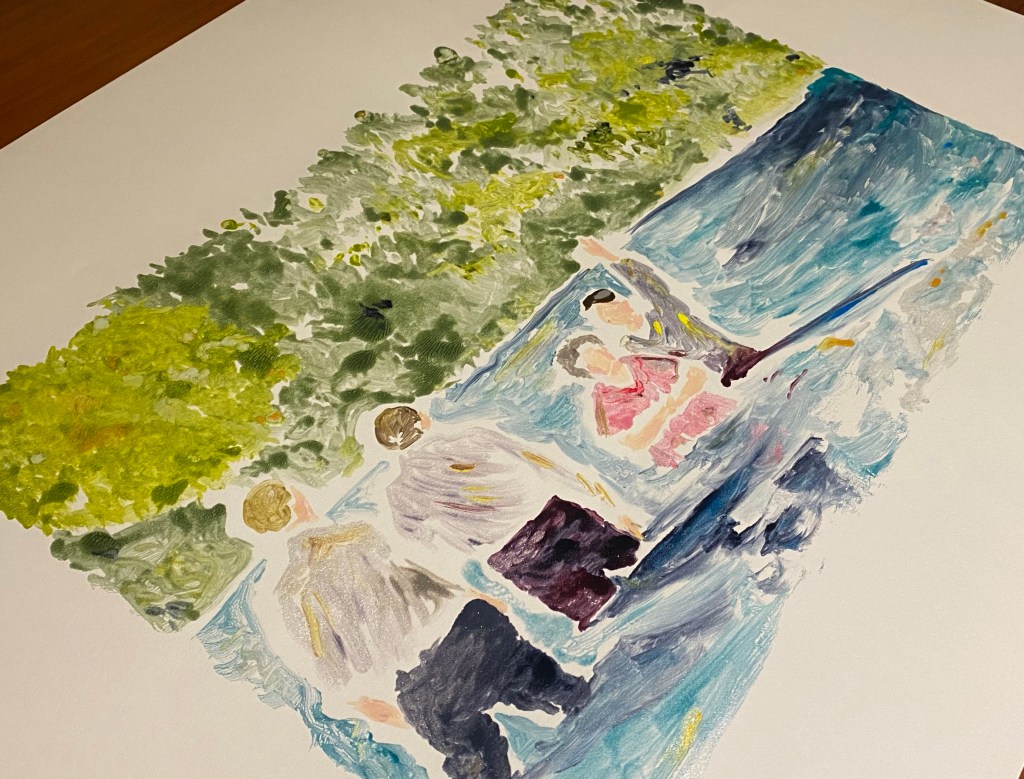
“Down to the River,” 18X24 acrylic monotype on paper by Stephanie Khattak.
I recently joined a Facebook group of family members’ on my dad’s side, which is and was full of preachers and have even had their own church for generations. This is not a side of my family that I know very well, so it is interesting to get to know them and the family history.
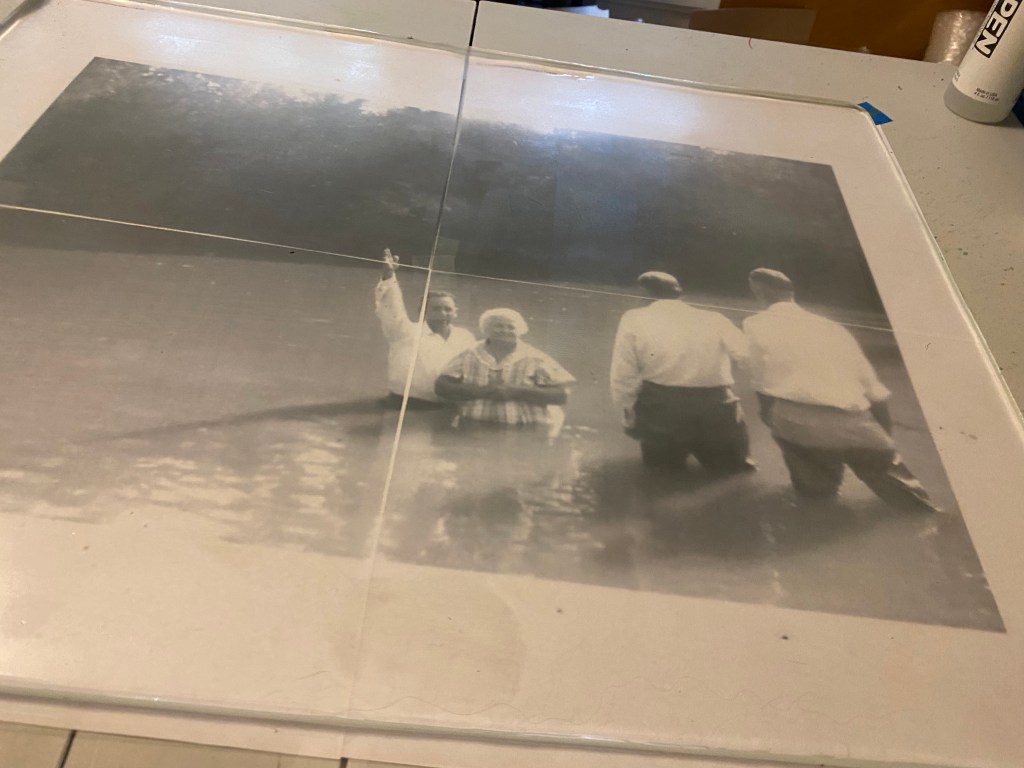
This piece is based on a photograph I found there, showing a river baptism probably around the 1950s or so. The people are not identified, but I would guess that the person doing the baptism is an uncle of mine.
I’ve started working on larger monotype prints, which is fun. It takes a little bit of problem solving, since I don’t have a large format printer and wouldn’t want to spend money to have something printed professionally that’s just going to be a reference piece. So, in order to get the photo large enough, I open Adobe Acrobat and print as a poster, which enlarges across multiple sheets of paper. I put them together sort of like a puzzle under my large plate (or plates if the finished product will be larger than 16X20.) It is a little extra work, but I love how these look at a larger scale when I can bring out more of the entire scene.
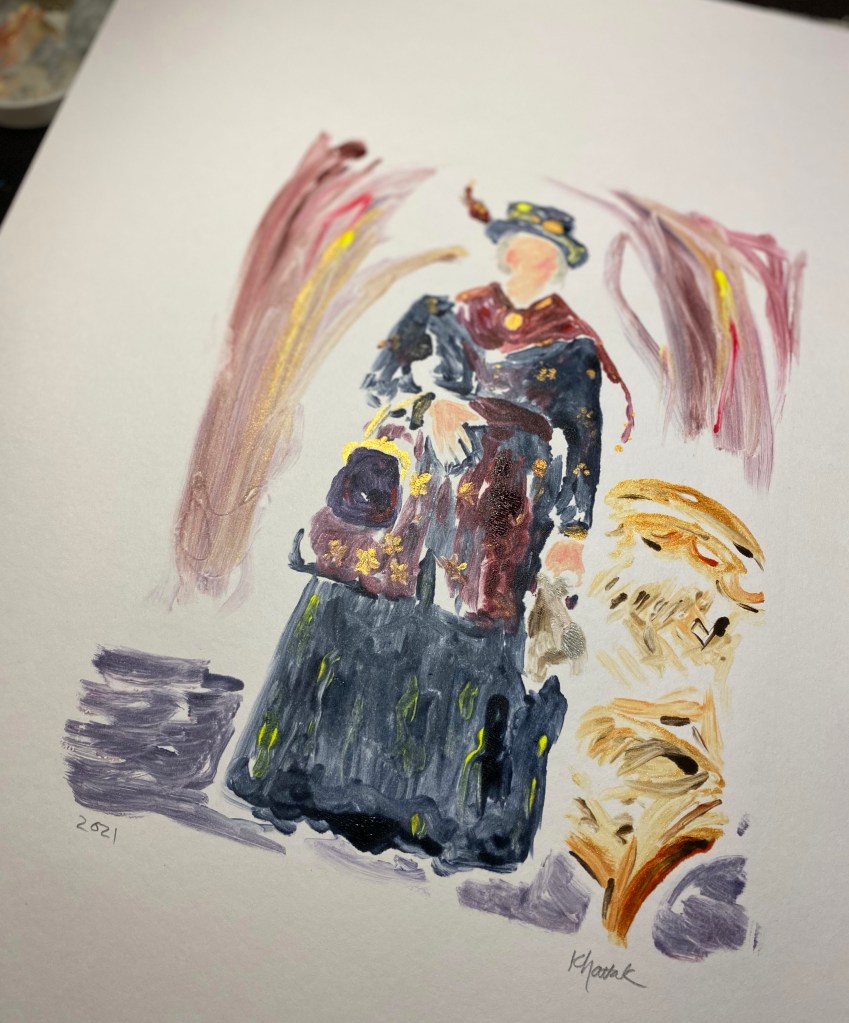
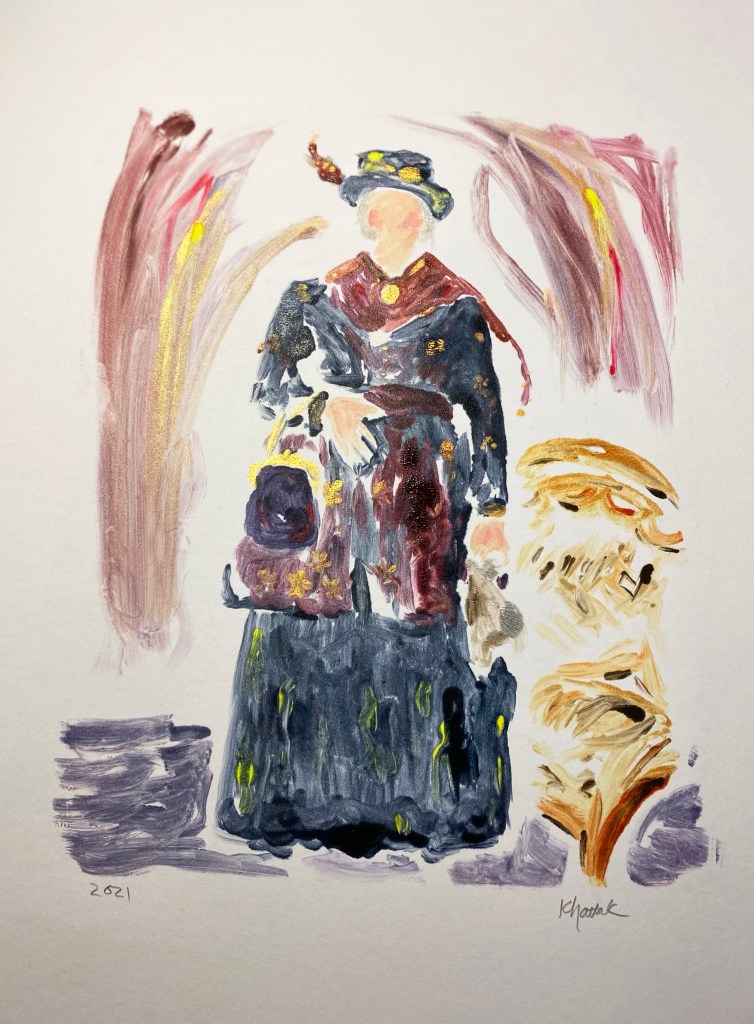
“The Namesake,” Acrylic Monotype by Stephanie Khattak. 12 X 18 on paper.
This monotype print is taken from a vintage East Texas photo of my maternal great-grandmother’s grandmother, Ann. There have been Ann’s in the family ever since, including me. My father’s sister is also an Ann, so the name does double-duty for both sides of the family.
Elizabeth “Ann” was born in 1858 and died in 1948, so of course there aren’t many people left in my family who have direct memories of her. But she’s the originator of the “Panther Tales” that have been told to my great-grandmother, grandmother, mother and me, and everyone remembers those. When she was young and living on Renfro Prairie in East Texas, it seemed like there was a panther behind every tree, waiting to slash someone. She’s kept generations scared straight for a hundred years – none of us ever went far into the woods, and as we still occasionally hear panthers scream in the night there, we are right to stay away!
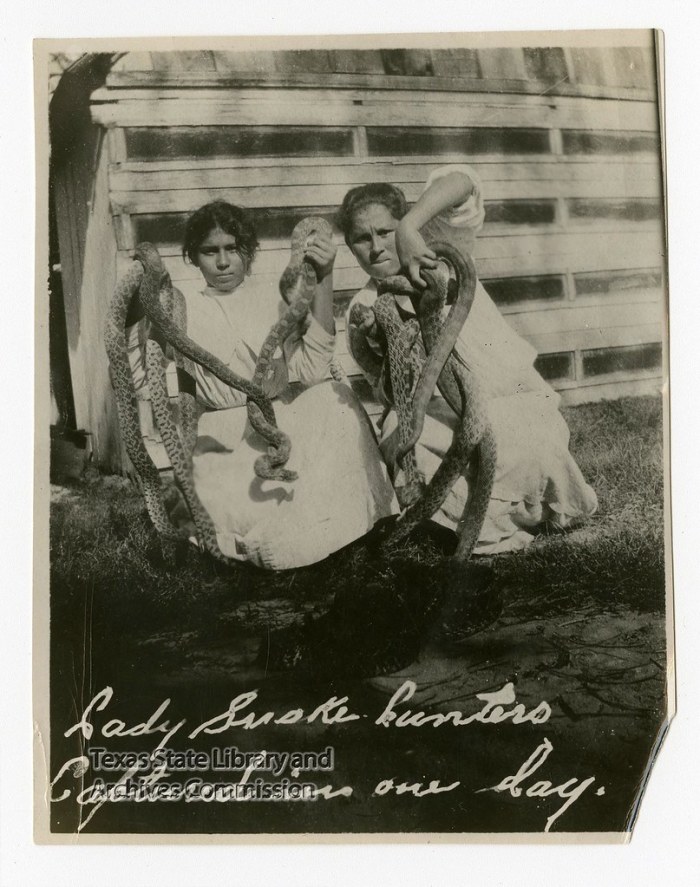
This photo is so visually arresting! And, the more I researched and learned about it, the more compelling its story was. The image was found in the William Deming Hornaday collection on the Texas State Library and Archives Flickr page (a great resource that I use a lot!). This photo stood out to me, and I immediately knew that I wanted to learn more and create my own work inspired by it. But, without much to go on from the Flickr caption, where to start? This is where the process gets fun for me.
As I learned more about William Deming Hornaday, I discovered that he was a photojournalist and eventually the public relations director for UT Austin, and that most of his Texas work was in Central and South Texas. Moving beyond the TSLAC Flickr Page, I went into the Texas Digital Archive and started searching through his work, focusing in on geographic areas and using the “Search Within” function until I found a set that had a lot of snakes in it. I enlarged those files until I found this image, and the one below, which identifies the ladies as Mrs. W.A. King and her sister.
“Mrs. W.A. King and Sister. Expert snake hunters.,” William Deming Hornaday. Texas Digital Archive.
Here’s where it gets REALLY interesting! I took to Google with a simple keyword search, and pulled up this family’s story. These Lady Snake Hunters were part of a huge snake business in Brownsville, Texas, providing the reptiles for circuses and other traveling animal acts.
According to his biographer and other documents, William Abraham Leiberman was a Russian/Polish Jewish-American businessman in New York who saw unusual business opportunities along the Rio Grande and moved to the then rural border town of Brownsville, Texas to open “Snakeville”, a “roadside facility to breed, sell, and show off snakes for tourists and interested clientele around the world.” Leiberman eventually changed his legal name to William Abraham Snake King.
Texas-born Manuela Cortez King was the snake king’s wife, and evidently quite the talented snake handler, herself. I can’t find exact confirmation on the sister who is pictured here, but Mrs. King’s obituary names two sisters: Matiana Walker and Luisa Samaron. Perhaps it is one of them.
Please explore these links forcitationsand further reading:
This video shows W.A. and Manuela Cortez King in a “snake catching contest” in 1914, a contest which they won in 3 minutes and 45 seconds.
*As an animal lover, I acknowledge that this story contains some dated attitudes around animal welfare and exhibition that are not acceptable today. I found “Snakeville” to not be not just a fascinating tale of entrepreneurship that brought to life a unique time, place, and personalities in Texas history, but an exciting opportunity to find a name and deeper identities for this photo.
As soon as my extended family, husband and I were vaccinated and past the CDC recommended waiting period, we said goodbye to the cats and headed to East Texas for the weekend. The Pine Curtain Project didn’t start in quarantine, but definitely gained speed, depth and focus over the past year when I had more time (for better or worse.) So, it was exciting to finally get to go home, not only to hear stories directly from surviving elders, but also to collect more research items and photographs, and to walk around outside around community landmarks before it gets too hot to do so.
Researching online is great and very productive, but there is so much value in being able to learn things first hand. Our large and busy community has dwindled over the years as older people pass away and ancestral land changes over to new community members or is sold to the new businesses that have been encroaching over the past few years. (A new twist on an age-old song: “They paved the horse pasture, put up a port-o-pot lot.”)
I’m lucky to still have two surviving grandparents: one on each side of my family. My grandfather is 86, and my grandmother is 91. They live within a mile or so of each other and my parents, so a lot of their stories overlap. They’re at various levels of mobility, but they are both very interested in family and community history in their own way. So, I was able to spend an hour or so with my grandmother going over her stash of collected family stories, notes and photos, then an afternoon riding around with my grandfather and walking around family cemeteries.
Both outings filled in some blanks for me, and helped me visualize the places I learn about. In many cases, I was able to add names, context, and detail to the stories I have heard over the years.
Over the weekend, a few people asked why I was interested in this history: why now, and what were my plans for it? Those are valid questions. I have always loved my family and community, but I couldn’t wait to leave it when I was 18, and like most young adults, I didn’t always fully appreciate it. I knew from my fashion magazines that big cities had the good shopping and at the time, Lufkin was no place for someone who desired exotic items like boot cut pants. (I can still hear my confused mother asking, “…like Poppa’s Wranglers?” No mom. Like Poppa’s Wrangler’s but way more expensive. Gah.)
Anyway, like any other place, it contains strengths and challenges, and it took a little while for those to balance out for me. But, better late than never, right? And, a real personal benefit of the project is that it has been a great opportunity to form stronger relationships with my family. We may not agree on everything, but we can all agree that some late-great ancestor sounded “crazier’n an outhouse rat,” haha.
I don’t have kids and at nearly 45, that ship has sailed. I am an only child, as well. In many ways, I see this project as a way for me to not only better understand some of the family, community and cultural dynamics that make me who I am, but also to leave a record so that it doesn’t disappear with me.
As I have mentioned before, the Pine Curtain Project is loosely themed around the idea of Ghost Towns and Ghost Stories: what happens in a place and what remains, and to the degree that anyone can know – why.
I have been gathering information over the past few months, and have made decent progress on documentation around the larger ideas on my roadmap for this year.
Images, names and dates are starting to turn into timelines and rough biographies. Over time, these will evolve into narratives. Maybe the project will remain a series of smaller stories, or merge into one big one; I don’t know the answer to that yet, or what form any of it might take beyond my visual art and this blog.
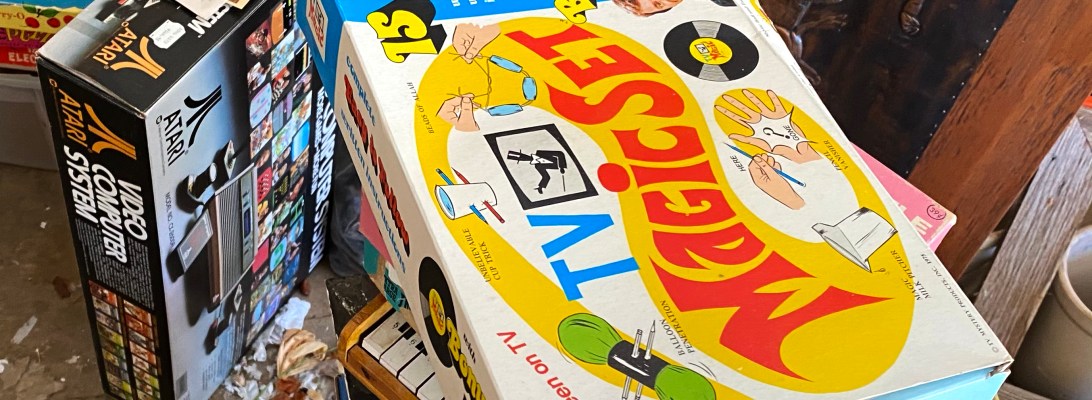
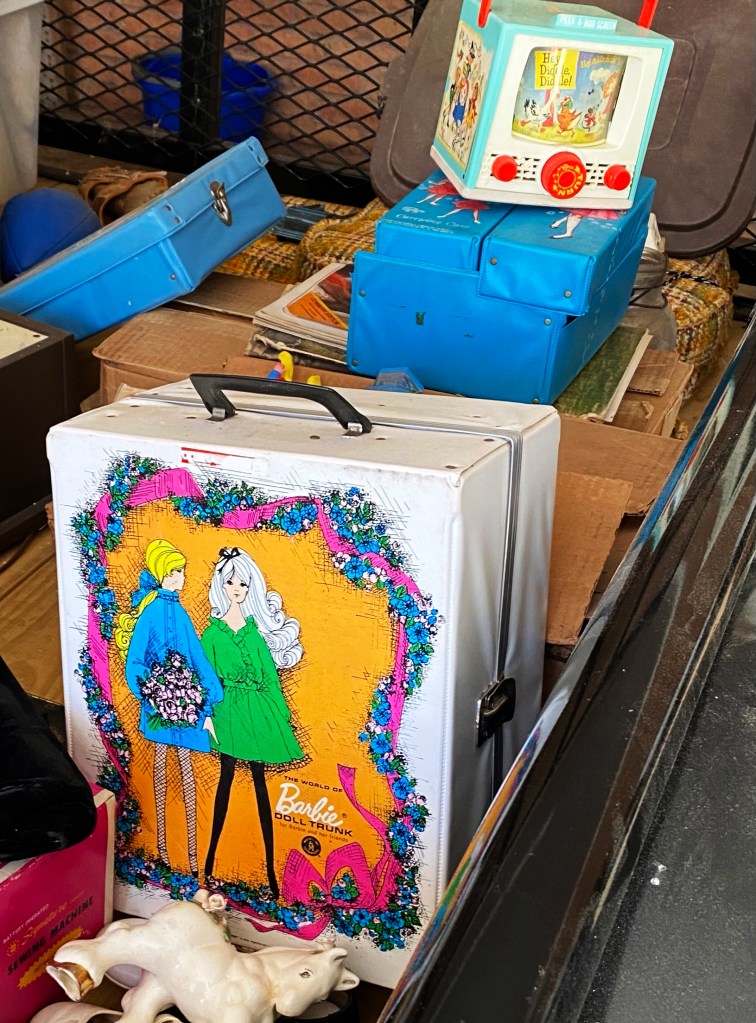
Anyway, I have a new stack of things to parse through this week, and plan to post more art and Curated Histories starting next week. In the meantime, enjoy these images that show just a few of the nearly pristine vintage treasures my cousin found cleaning out her late parents’ house this weekend. I didn’t come home with much of it, but the Barbie trunks are going to hold art supplies now. I REALLY want that Atari but their grandchild gets first refusal. As is appropriate for such a prized heirloom.
The Million & Loving box is an heirloom in itself. Million & Loving was a little neighborhood store, and back in the day had the best candy and served BBQ sandwiches from the back. It went through a few iterations, was sold to a corporation and was just razed to make room for an Exxon/fast food hybrid in Homer, conveniently located at the edge of my grandfather’s front yard.
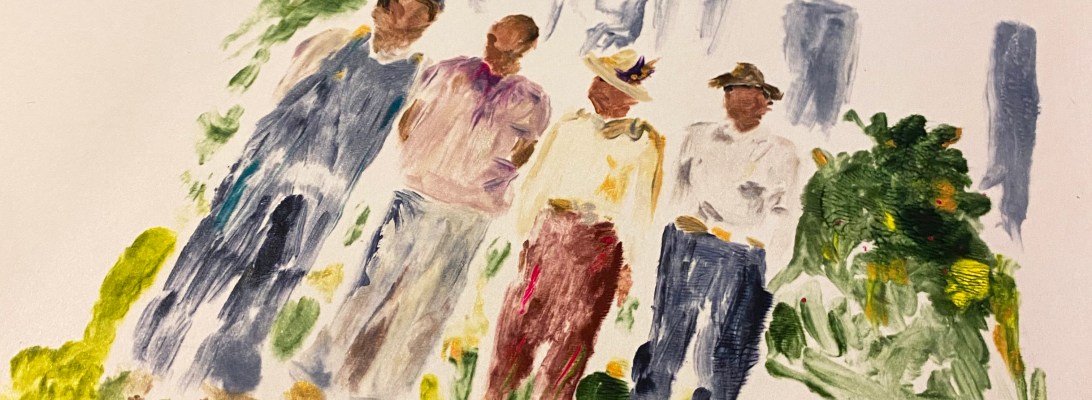
Detail shot, work in progress. Southern Pines Lumberman Team, 1930s. Acrylic monoprint, Stephanie Khattak.
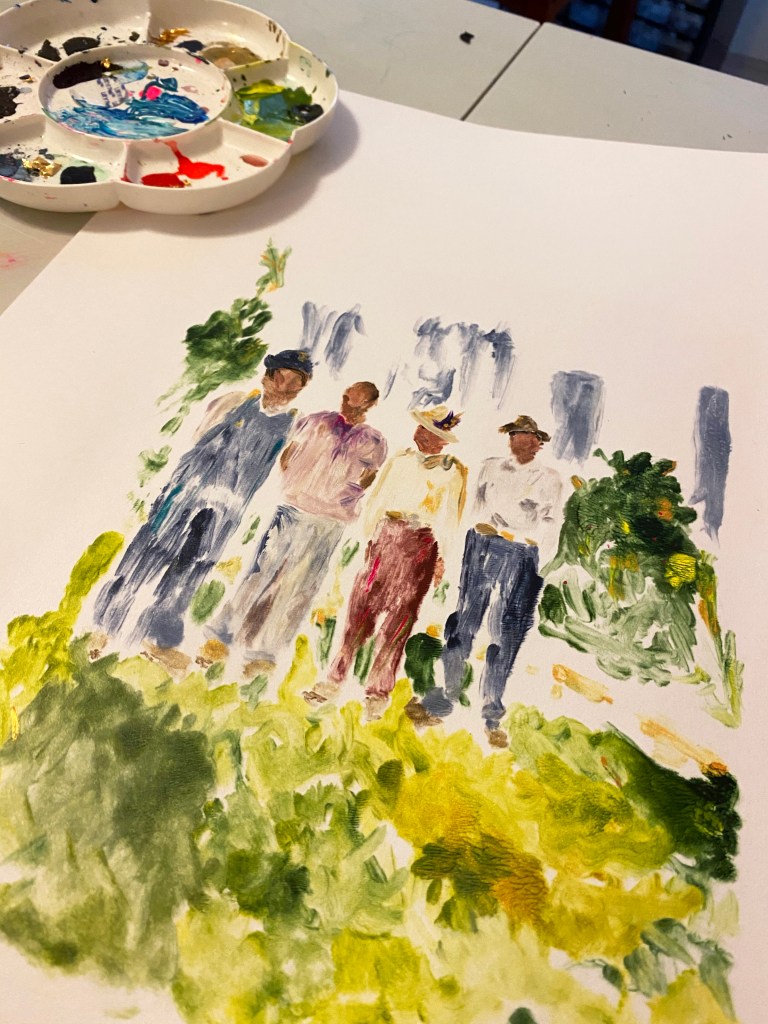
Desktop view, work in progress. Southern Pines Lumberman Team, 1930s. Acrylic monoprint, Stephanie Khattak.
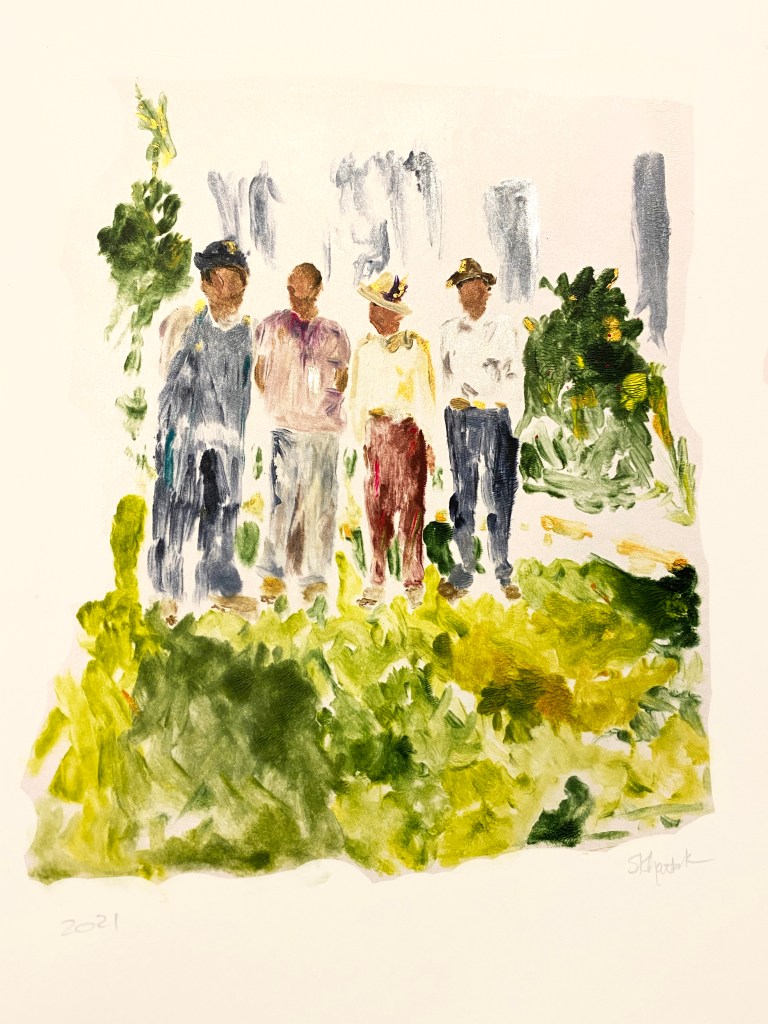
This work in progress is of a logging team, part of the Southern Pines Lumber Co. in the 1930s. The image was pulled from the Diboll History Center, Durham family photo collection. My great-great uncle (my father’s great-uncle) worked on this team and is in this photo, something I didn’t learn until I started to research the image.
This was not a branch of the family tree that I was close to, so learning more about them, and their place in history, has been interesting and a nice surprise.
An image this large and detailed required not only my 16X20 plate (aka Big Betsy), but also a bit of my 8X10 plate to extend the edges. This is the largest and most difficult piece I have attempted in terms of balancing aesthetics, details and expediency so that I can pull the print before the paint dries. It is pretty abstract (keeping with my artistic style) but I wanted to make sure that the horses mostly looked like horses and that the large trees came through.
One reason the source image is so striking is the size of the cut trees against the horses and workmen. When I post the final, I will link to it so you can see for yourself. It’s pretty cool, and there are many other photos in the collection that I want to work from.
“Art enables us to find ourselves and lose ourselves at the same time.” ― Thomas Merton , No Man Is an Island
It’s Monday in “Studio No-Name,” and I’m still thinking on what to call my creative space. It won’t be Studio No-Name!
The process of naming my studio makes me think of the saying, “you must name it to claim it.” I have struggled with “claiming” my identity as an artist over the years, for all the reasons that many people do. I’m not conventionally educated. It’s not my primary income. I’m just not “there yet.” It doesn’t feel like “work”. But art is art and artists are artists. I think it’s important to take steps to legitimize the work that we do, whether our pieces are hung in galleries, displayed proudly at Mom’s house or decorating our own spaces. I’m trying to be better at claiming my practice, and so should you! (Even if we’ve never met, if you’re an artist, I suspect that you can relate to this.)
With that in mind, earlier today, I renewed my Texas Visual Arts Association membership and made a spreadsheet for places to submit work to in the next few months. This isn’t something I have done before, and I’m excited to try! It’s not an easy season of life to be an artist, especially an emerging artist, but opportunities are still there.
I have started a series of work that will be ready for sale in October. I closed my store at the beginning of the year, but I miss having it as a goal to work toward. The sales are nice, of course, but so is the self-directed goal of making enough work to post.
Because my Pine Curtain project is so specific, those pieces won’t be for sale, at least not right away. So, that frees my mind to switch to different subject matter and processes for a while. The above abstract floral is one of a few smaller works on paper that will be available, and I am also working, for the first time, on some larger pieces!











 stephaniekhattak.com