Research Notes: Balinese Room

One of the family history threads I’ve been researching leads to Galveston, Texas in the 1930s-40s and the Maceo family, and by extension, Galveston’s Balinese Room. This spot was super-popular in its heyday, attracting visits and performances from celebrities like Frank Sinatra, Duke Ellington, Peggy Lee and others. Apparently it was quite the place to be – and a dance hall and illegal casino stretching over the Gulf of Mexico does sound pretty cool!

“On January 17th, 1942, the Maceos opened their Galveston jewel, the Balinese Room. The interior had been remodeled in a South Seas motif and the pier had again been expanded, this time to 600 feet. Its private back room was equipped with the most modern gaming equipment, and long before Vegas attracted the big names, the Maceos lured high rollers to “Play on Galveston Island.”” – via Galveston Island/Facebook

Unfortunately, time and Galveston’s famous tropical storms and hurricanes have erased The Balinese Room from its prominent spot across from Hotel Galvez, at 21st and Seawall Blvd. After being purchased and rebuilt several times over the decades, Hurricane Ike demolished it, leaving only the memories and memorabilia of this distinctive place.

Later on, I will dive deeper into my family’s connection with Maceo family associates and its repercussions. For now, enjoy these images and scroll down to read more about this fascinating place and period in Galveston and Texas history.
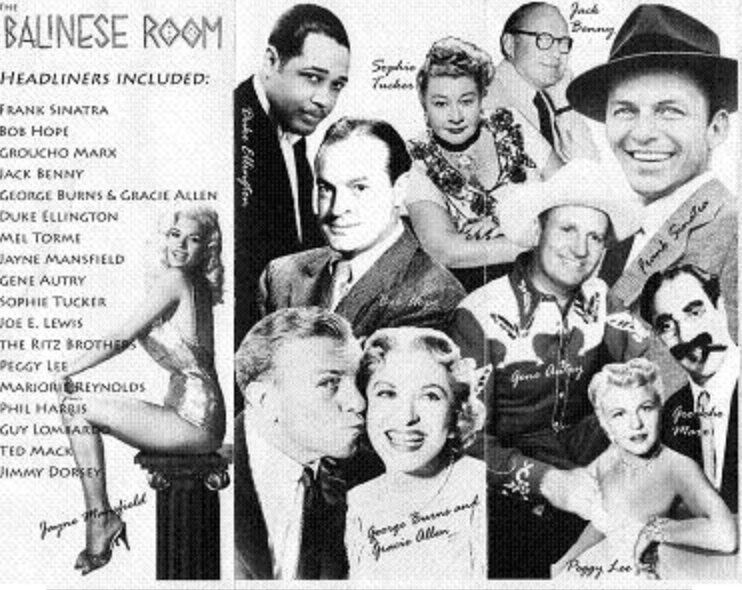
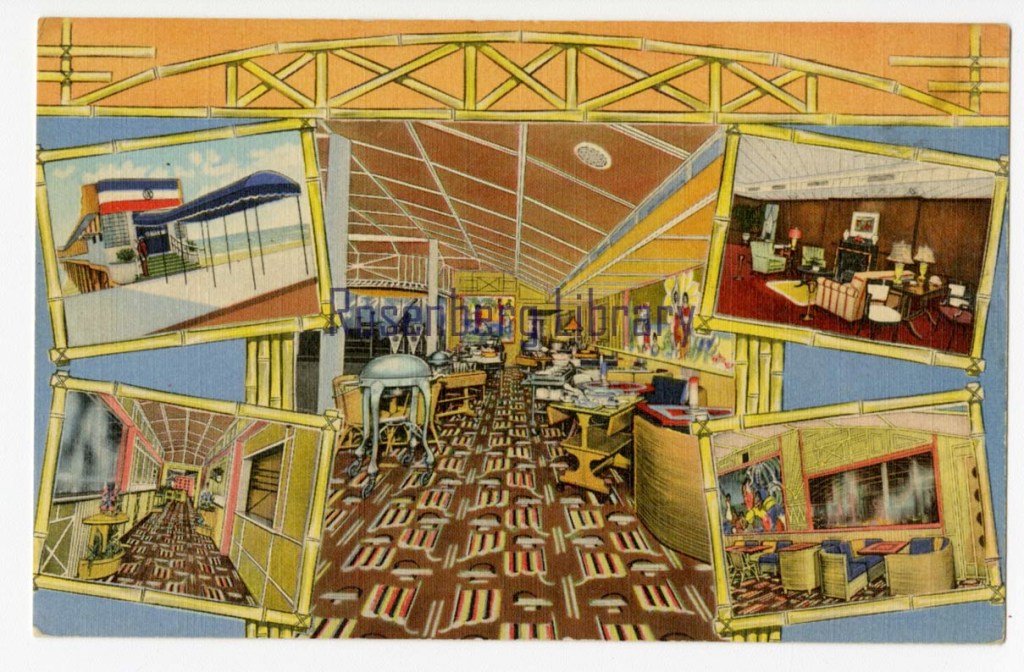
June 10, 1957:The Balinese Room at 2107 Seawall Blvd, Galveston. via Houston Chronicle Files
Galveston’s Seawall Boulevard and Balinese Room, via Galveston Island/Facebook

Please explore these links for further reading:

Boatman, T. Nicole. Island Empire: the Influence of the Maceo Family in Galveston, thesis, August 2014; Denton, Texas. University of North Texas Libraries, UNT Digital Library.

“One Last Shot,” Texas Monthly, June 1993

“Land of the Free: Galveston’s Resilient Spirit Sparks Another Renaissance,” Texas Highways, June 2021

Research Notes: The Angelina Four

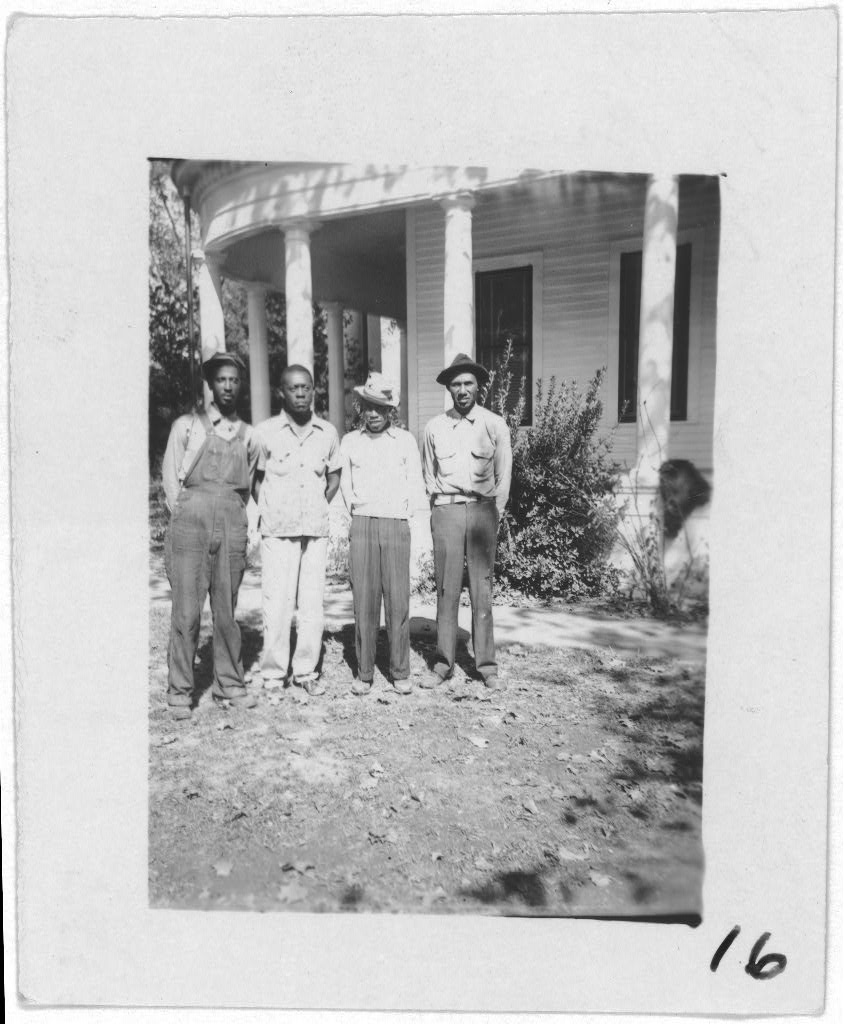
The Angelina Four at Kelty’s Lumber Co., Lufkin, Texas, 1940 Ruby Lomax,
Library of Congress. Alphonso “A.H.” Charlton; Tom “T.J.” Bailey; Jerry Watkins, and Jethro “Jabbo” Williams.

I’ve mentioned these guys before when writing about the work of John Avery and Ruby Lomax, but thought that they needed their own spotlight.

The Angelina Four was a quartet of men who were employed by the Angelina County Lumber Company in Keltys, a community outside of Lufkin. The East Texas musicians recorded 15 pieces, a “singing commercial” – Angelina Longleaf Pine, – and 14 songs that included popular, gospel and spiritual music with rich harmonies.

Notes from Lufkin Recordings. American Folklife Center, Library of Congress.

Please explore these links for citations and further reading:

Amy Bertsch, “Lufkin Recordings,” East Texas History, accessed May 17, 2021.

Megan Biesele, “Keltys, TX,” Handbook of Texas Online, accessed May 17, 2021.

John Foster, “Blues, Baptisms, and Prison Farms: The Lomax Snapshots of 1934-1950,” Design Observer.

Lomax, J. A., Lomax, R. T., Bailey, T. J., Charlton, A. H., Watkins, J. & Williams, J. (1940) Angelina Longleaf Pine. Lufkin, Texas.

*Some of these sources document outdated and now-unacceptable language, policies and ideas around race. Like the authors of these academic works, I do not condone or wish to ignore potential negative impact by reporting or linking to them. In writing about history, I often must weigh the benefit of sharing the “entire picture” against the potential harm in doing so. In this case, I felt that it was important to tell the whole story of the Angelina Four, understanding that the entirety of their lived experiences likely contributed to their creative work and place in history.

Research Notes: Brownsville Snake Hunters, 1900s

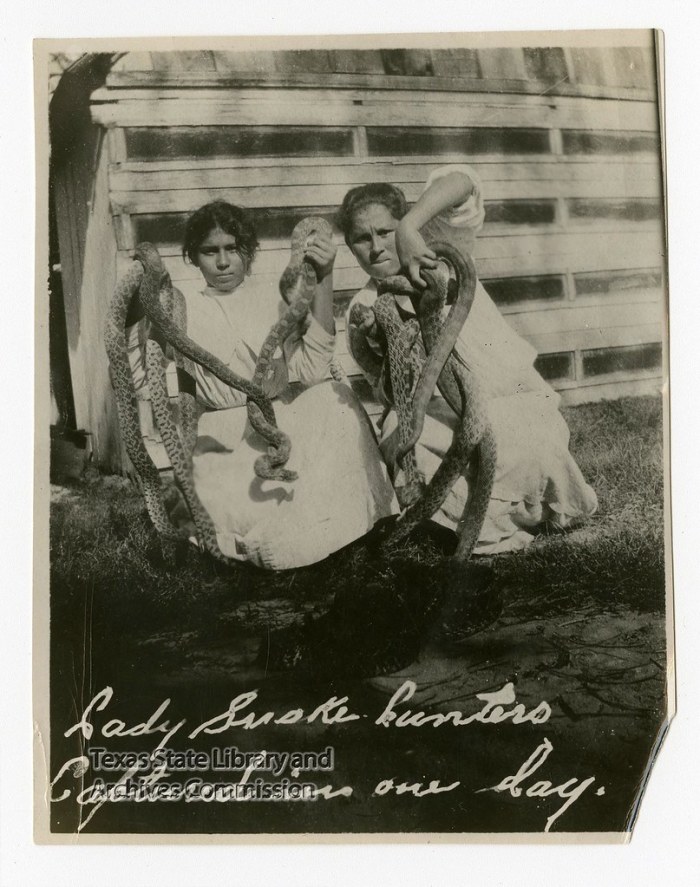
“Lady Snake Hunters, Captured in One Day,” William Deming Hornaday Collection, Texas State Library and Archives.

This photo is so visually arresting! And, the more I researched and learned about it, the more compelling its story was. The image was found in the William Deming Hornaday collection on the Texas State Library and Archives Flickr page (a great resource that I use a lot!). This photo stood out to me, and I immediately knew that I wanted to learn more and create my own work inspired by it. But, without much to go on from the Flickr caption, where to start? This is where the process gets fun for me.

As I learned more about William Deming Hornaday, I discovered that he was a photojournalist and eventually the public relations director for UT Austin, and that most of his Texas work was in Central and South Texas. Moving beyond the TSLAC Flickr Page, I went into the Texas Digital Archive and started searching through his work, focusing in on geographic areas and using the “Search Within” function until I found a set that had a lot of snakes in it. I enlarged those files until I found this image, and the one below, which identifies the ladies as Mrs. W.A. King and her sister.

“Mrs. W.A. King and Sister. Expert snake hunters.,” William Deming Hornaday. Texas Digital Archive.

Here’s where it gets REALLY interesting! I took to Google with a simple keyword search, and pulled up this family’s story. These Lady Snake Hunters were part of a huge snake business in Brownsville, Texas, providing the reptiles for circuses and other traveling animal acts.

According to his biographer and other documents, William Abraham Leiberman was a Russian/Polish Jewish-American businessman in New York who saw unusual business opportunities along the Rio Grande and moved to the then rural border town of Brownsville, Texas to open “Snakeville”, a “roadside facility to breed, sell, and show off snakes for tourists and interested clientele around the world.” Leiberman eventually changed his legal name to William Abraham Snake King.

Texas-born Manuela Cortez King was the snake king’s wife, and evidently quite the talented snake handler, herself. I can’t find exact confirmation on the sister who is pictured here, but Mrs. King’s obituary names two sisters: Matiana Walker and Luisa Samaron. Perhaps it is one of them.

Please explore these links for citations and further reading:

This video shows W.A. and Manuela Cortez King in a “snake catching contest” in 1914, a contest which they won in 3 minutes and 45 seconds.

“Rattlingly Yours…Snake King,” by W.A. King, Jr.

“The Snake King of Brownsville,” Valley Morning Star, Harlingen, Texas. (Gated content)

*As an animal lover, I acknowledge that this story contains some dated attitudes around animal welfare and exhibition that are not acceptable today. I found “Snakeville” to not be not just a fascinating tale of entrepreneurship that brought to life a unique time, place, and personalities in Texas history, but an exciting opportunity to find a name and deeper identities for this photo.

Research Notes: Ruby & John Avery Lomax

Ruby Terrill Lomax and John Avery Lomax produced folklife documentary work that comes up a lot when I am researching East Texas History. Along with her husband John Avery Lomax, Texas folklorist Ruby Terrill Lomax traveled the state and other Southern regions for the 1939 Southern States Recording Trip. The Lomax’s multi-genre journey documented Southern folk musicians and their communities through sound recordings, photographs and other ephemera, and spends valuable time in communities of Color and documenting the creative contributions of incarcerated people. The collection’s primary home is in The American Folklife Center, Library of Congress.

Here are a few items of interest from the collection:

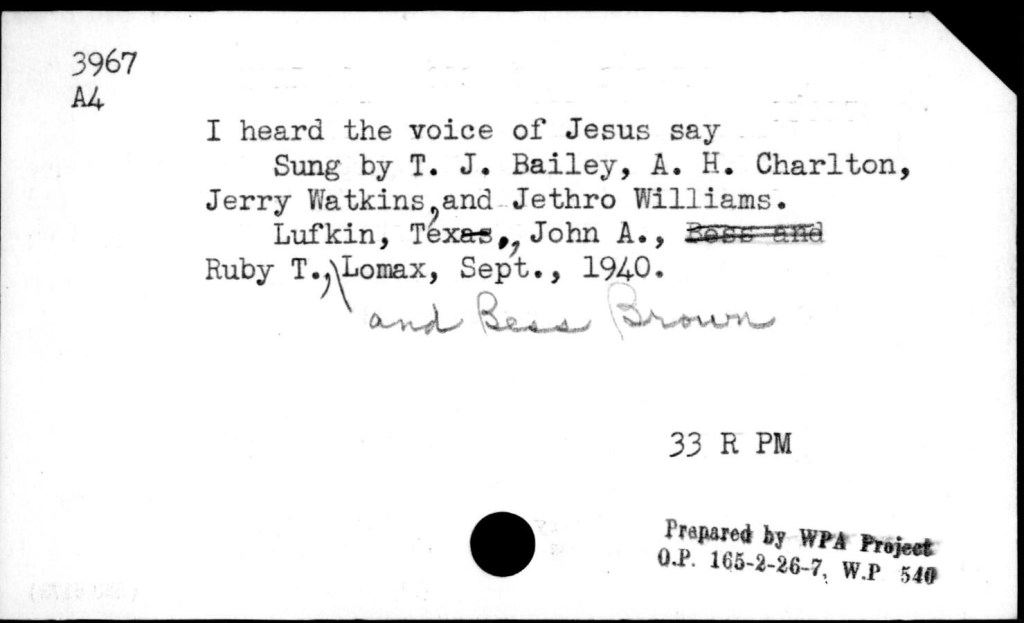
Disc Sleeve with Notes, American Folklife Center
The Angelina Four at Kelty’s Lumber Co., Lufkin, Texas, 1940 Ruby Lomax,
Library of Congress
Enka Square Dance Team dancing at the Mountain Music Festival, Asheville, North Carolina,
Ruby Lomax, Wikimedia Commons

The project’s recordings can be found here: Lomax Iconic Song List, Library of Congress

The Library of Congress also has the 300+ page Field Notes manuscript from this trip, which you can download for easier reading.

Research Notes: Russell Lee

In researching East Texas history, one of my favorite and most valuable discoveries has been the work of photographer Russell Lee. He took iconic photos of Depression-era Lufkin, along with meaningful captures of elsewhere in the East Texas region and across Texas. I have used one of his photos, Railroad Gang in my artwork, and have more stacked up to use in the future. Many of his works are in the public domain, which is a gift for artists, writers and other creators who are inspired by it.

More information on the life and work of Russell Lee can be found in The Wittliff Collections at Texas State University in San Marcos, the Briscoe Center for American History at the University of Texas – Austin, and the Library of Congress. Some of my favorite Russell Lee Texas photos are below. They were found in the Library of Congress, and are in the Public Domain.


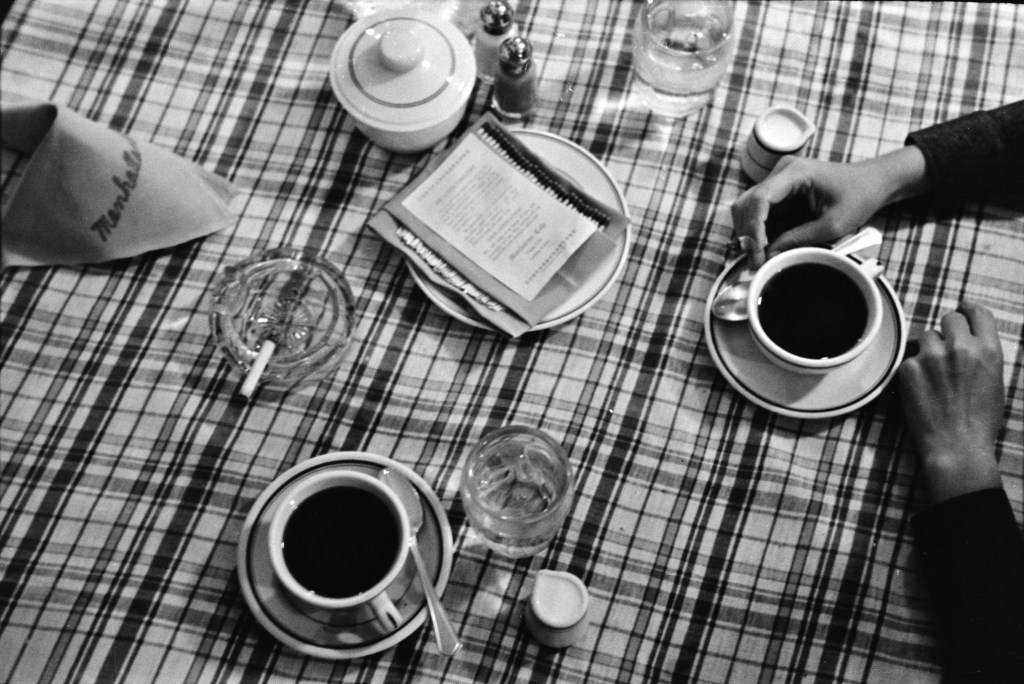
After Dinner Coffee, Lufkin.

Blacksmith Heating Iron in Forge, Southern Paper Mill construction shed, Lufkin, Texas.

East Texas farm owner rolling up old barbed wire near Harleton, Texas.
Bank corner on main street. San Augustine, Texas

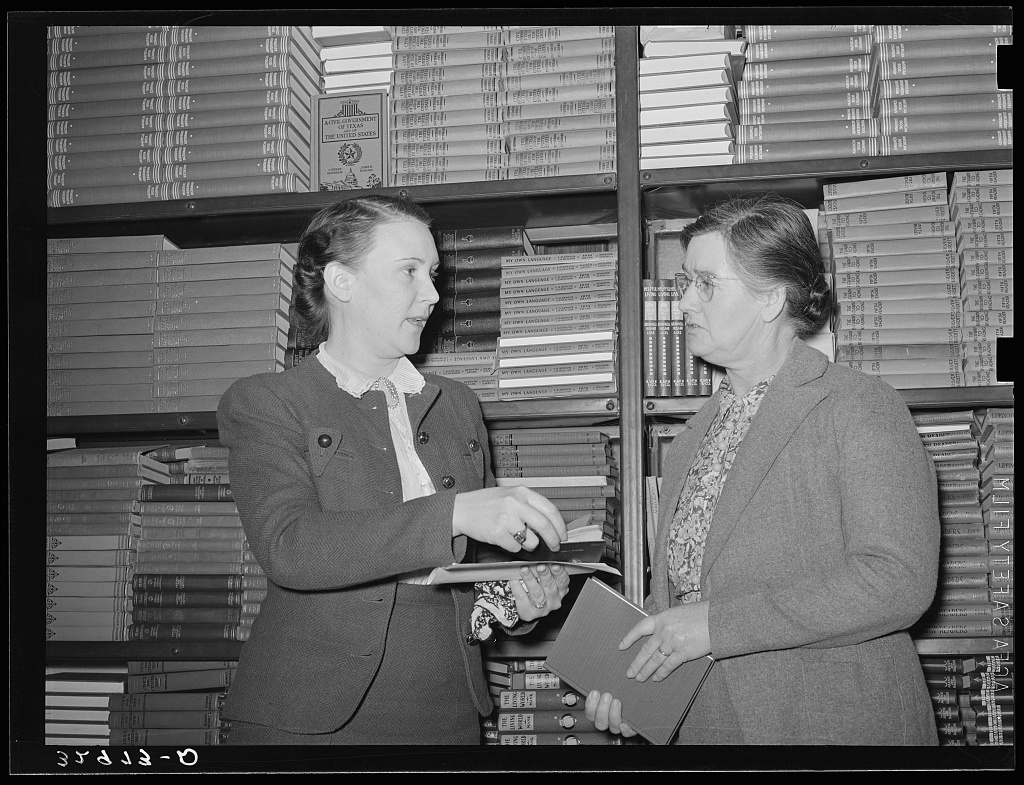
County superintendent of schools and her assistant. San Augustine, Texas